

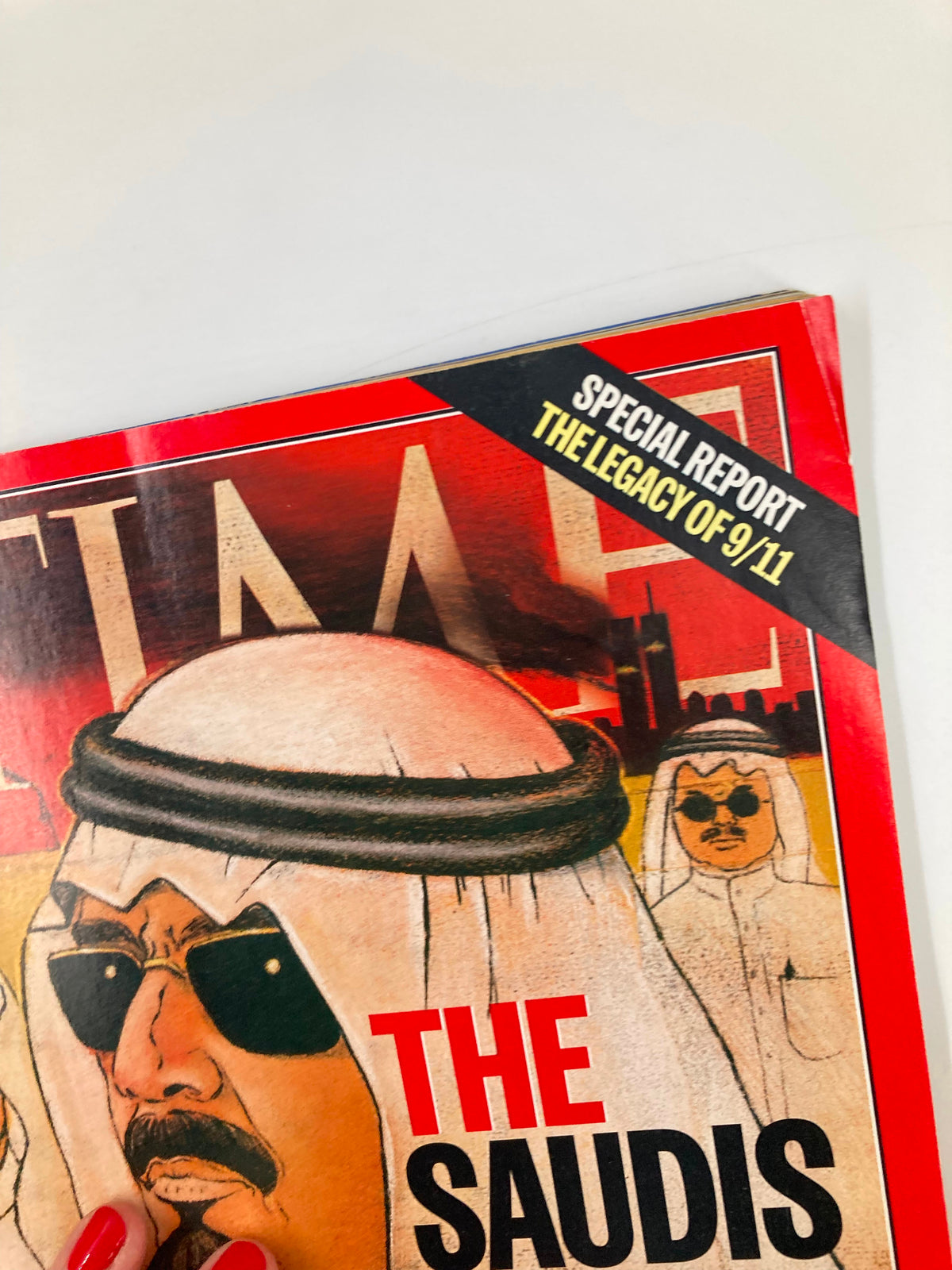


Description
Collector's Note – Why This Issue Matters
The September 15, 2003 issue of Time Magazine — titled "The Saudis and The Legacy of 9/11" — arrives exactly two years and four days after the September 11 attacks, at a moment when the relationship between the United States and Saudi Arabia had become one of the most contested and consequential questions in American foreign policy. Fifteen of the nineteen hijackers had been Saudi nationals. The Bush administration had nonetheless maintained its alliance with the Saudi government while pivoting militarily toward Afghanistan and then Iraq. By September 2003, the Iraq War was six months old, the initial military campaign had ended but the insurgency was beginning, and the question of what had actually motivated the attacks — and who bore institutional responsibility for them — was moving from the realm of immediate crisis response into something more like sustained political reckoning. A Time cover story on the Saudis and 9/11's legacy at this precise moment was engaging with that reckoning directly, in the most widely read American newsweekly, for a general audience that was still processing what the preceding two years had meant. For collectors building archives of Time Magazine's post-9/11 coverage, this issue represents a specific and important chapter in how the mainstream American press narrated the attacks and their aftermath.
The two-year anniversary timing is editorially significant in its own right. First-anniversary coverage in September 2002 had been dominated by commemoration and emotional processing. The second anniversary, in September 2003, arrived in a fundamentally different atmosphere — one shaped by the Iraqi weapons of mass destruction controversy, the ongoing failure to capture Osama bin Laden, and growing public questioning of the intelligence and political decisions that had defined the post-9/11 response. A story specifically focused on Saudi Arabia in this context was pointing toward questions that the administration had largely deflected: the financing networks, the ideological infrastructure, and the diplomatic accommodations that had complicated the official narrative of the war on terror. For anyone assembling a documentary record of 2003 through its print journalism, this issue captures a moment of genuine political and historical reassessment that the passage of time has only made more significant.
About the Publication
Time Magazine, co-founded by Henry Luce and Briton Hadden in 1923, remained throughout the early twenty-first century one of the most widely read weekly newsmagazines in the United States, though its circulation had declined from its mid-twentieth-century peak as cable news and the early internet began fragmenting the media landscape. Its editorial format — departmentalized world news synthesized for an educated general readership — had remained largely consistent across eight decades, and its covers retained their cultural weight as statements of national significance even as the media environment around them changed. The September 2003 period represents the magazine in the middle of its post-9/11 editorial phase, when foreign policy coverage had moved from the shock of the immediate attacks toward the more complex analytical journalism of the occupation and its consequences.
Key Highlights Inside
- "The Saudis and The Legacy of 9/11" cover story: The central feature examines the Saudi-American relationship in the context of the September 11 attacks and their two-year aftermath — published at a moment when that relationship was under more sustained critical scrutiny than at any previous point in its history.
- Two-year anniversary journalism: The September 15, 2003 date places this issue at the second anniversary of the attacks — a moment when coverage was shifting from commemoration toward political and historical analysis, and when the early narratives of the post-9/11 era were beginning to be subjected to serious journalistic challenge.
- Iraq War context: Published six months into the Iraq War, the issue's examination of Saudi Arabia and 9/11's legacy would have been read against the backdrop of ongoing questions about the intelligence, motivations, and alliances that had shaped the American military response to the attacks. Specific additional interior content beyond the cover story is unconfirmed in the listing.
Condition & Rarity
The address label on the front cover identifies this as a subscriber copy — standard provenance for Time issues of this era, when the magazine's subscriber base remained large despite declining overall circulation. The noted creases on the front corners are a common condition attribute for subscriber copies that were mailed rather than hand-delivered, as the mailing process introduces corner stress that accumulates over time and storage. The minor wear throughout is consistent with honest age on a twenty-year-old subscriber copy. The protective plastic covering indicates deliberate preservation. When evaluating any surviving copy of this issue, the label placement relative to the cover imagery and the degree of corner crease damage are the primary grading variables — both affect the cover's visual presentation in ways that matter for display purposes. Interior page condition for a 2003 magazine is generally stable, as the paper stock of early twenty-first-century newsmagazines ages considerably more slowly than mid-century equivalents.
Looking for More Issues Like This?
Post-9/11 Time issues that engage specifically with the Saudi-American relationship and the ongoing legacy of the attacks represent a distinct and historically significant category within the magazine's early 2000s archive — one that collectors focused on contemporary history and foreign policy journalism actively seek. If this issue has already found a home, the full archive of Time Magazine issues is the place to browse for other landmark covers and historically significant editions from the post-9/11 period and beyond. The 2003 magazine collection is also worth exploring for anyone building a broader documentary picture of that consequential year in American political and foreign policy history.