
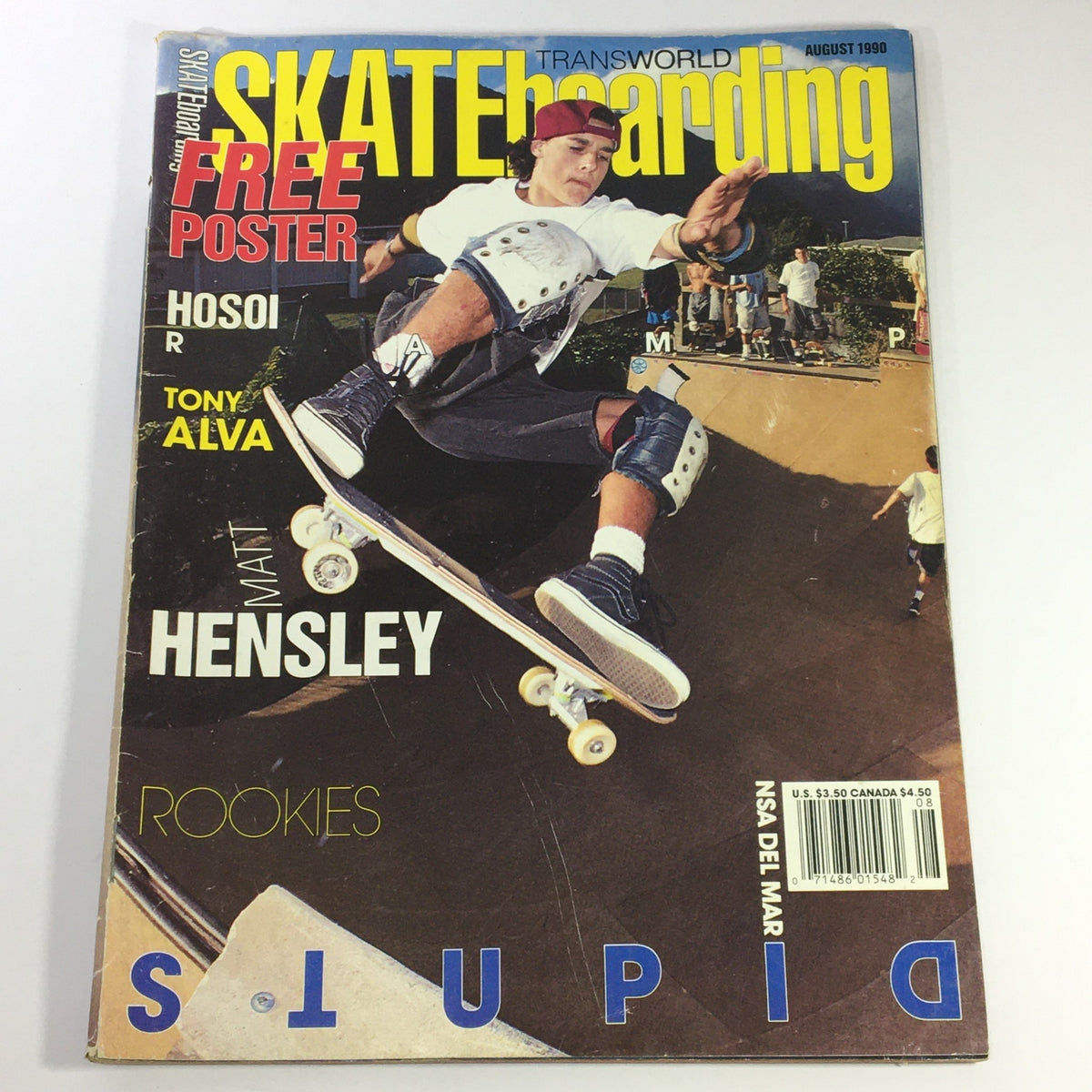

Description
Collector's Note – Why This Issue Matters
The August 1990 issue of Transworld Skateboarding Magazine featuring Matt Hensley and Tony Alva is a primary document of skateboarding at one of its most historically specific and most consequential transitional moments — and the specific pairing of these two figures on a single cover is itself a culturally revealing editorial statement about where the sport had been and where it was going. Tony Alva had been one of the defining figures of skateboarding's first commercial peak in the 1970s — a member of the Zephyr Competition Team, one of the pioneering pool skaters whose aerial innovations in empty swimming pools had defined the vert skating vocabulary that dominated the sport through the late 1970s and 1980s, and a figure whose combination of athletic innovation and countercultural identity had shaped the sport's self-image for a generation. Matt Hensley, by contrast, was in 1990 one of the most prominent figures in the street skating revolution that was in the process of permanently displacing vert as the sport's dominant discipline — a member of H-Street Skateboards whose technically precise, ground-based style represented exactly the opposite aesthetic from Alva's pool and ramp skating. A cover pairing them in August 1990 was therefore a document of the sport's generational handoff at its most acute and most publicly visible phase, presenting the founding generation and the transformative new generation simultaneously and implicitly acknowledging that the transition between them was the defining story of skateboarding culture in 1990. Collectors building a focused archive of Transworld Skateboarding's most historically instructive issues will find the Transworld Skateboard magazine collection at OriginalMagazines.com the most comprehensive resource for issues across the publication's most culturally significant decades.
Matt Hensley's specific place in skateboarding history gives this August 1990 cover a significance that extends well beyond the individual athlete. Hensley had been one of the most celebrated technical street skaters of the late 1980s and early 1990s, his video parts in H-Street's Shackle Me Not (1988) and Hokus Pokus (1989) establishing him as one of the primary architects of the technical street skating aesthetic that would define the sport for the following decade. By August 1990, he was at the absolute peak of his skating prominence — one of the most discussed and most photographed skaters in the world — and his subsequent announcement in 1991 that he was retiring from professional skateboarding to pursue a career as a musician (he would go on to join the band Flogging Molly) made any documentation of his skating career from this period a primary record of a figure who was shortly to depart the sport that had celebrated him. Tony Alva's presence on the same cover, meanwhile, represented the publication's engagement with skateboarding's historical consciousness — the acknowledgment that the sport's present could not be understood without the foundation that figures like Alva had laid in the 1970s. The 1990 magazines collection at OriginalMagazines.com gathers publications from a year that was consequential across American popular culture and sports history, with skateboarding's street revolution one of the most significant cultural developments of the period.
The August 1990 date also places this issue at the specific moment when skateboarding's relationship to mainstream commercial culture was being actively renegotiated. The late 1980s had seen the sport's commercial infrastructure expand dramatically — the video part system had established a new media economy, professional skaters were becoming genuine celebrities within their community, and the shoe companies and apparel brands that would eventually make skateboarding one of the most commercially significant youth culture phenomena of the 1990s and 2000s were beginning to engage with the sport more seriously. The specific combination of Alva's historical credibility and Hensley's contemporary technical authority on a single August 1990 Transworld cover was a precise editorial engagement with that commercial and cultural transition — the magazine positioning itself as the venue that understood both the sport's history and its future.
About the Publication
Transworld Skateboarding Magazine was founded in 1983 and established itself as one of the two most authoritative American skateboarding publications alongside Thrasher, distinguished from its competitor by a somewhat less aggressive aesthetic and a more consistent engagement with the sport's full range of disciplines and geographic communities. By August 1990, the magazine was in its seventh year of publication and had fully established the editorial identity and photographic standards that made it the primary visual archive of professional skateboarding during the street revolution's most formative years. Its coverage of Matt Hensley across the late 1980s and early 1990s was among the most sustained and most celebrated in the publication's history.
Key Highlights Inside
- Matt Hensley cover feature — peak career documentation before retirement — coverage of one of the most technically accomplished and most celebrated street skaters of the era, documented at the absolute peak of his professional prominence in August 1990, approximately one year before his announcement that he would leave professional skateboarding — making this issue a primary document of a historically significant skating career at its most active and most publicly celebrated phase.
- Tony Alva feature — founding generation's historical presence — coverage of one of the defining figures of 1970s pool and vert skating, whose co-appearance with Hensley on the August 1990 cover represents the magazine's engagement with skateboarding's generational handoff and its acknowledgment that the sport's present required understanding of its foundational past.
- Street revolution vs. vert tradition — historical transition documented — the specific editorial choice of pairing Hensley and Alva constitutes a primary document of the most significant structural transition in skateboarding's history — the displacement of vert by street as the dominant discipline — at the precise moment when that transition was most actively underway.
- Newsstand edition, no label — confirmed clean cover presentation — the confirmed newsstand origin and absence of address label places this issue in the more desirable subset of surviving copies, preserving the Hensley/Alva cover in its undisturbed state and distinguishing it from any subscriber copies that might carry address label obstruction.
- Poster removed — condition disclosure — the listing honestly discloses that the original poster insert has been removed from this issue, a standard condition attribute for action sports magazines of this era whose poster inserts were routinely detached by original readers for display; the issue remains complete in all other respects.
Condition & Rarity
Decent condition with minor edge wear, possible rips or marks, no address label, and no poster represents an honest and assessable condition profile for a thirty-six-year-old action sports magazine produced for active readership by a young skating audience rather than for collector preservation. The absent poster is the most specific structural condition disclosure — the majority of surviving Transworld issues from this era have had their poster inserts removed, making the absence a standard rather than exceptional condition attribute, though intact-poster copies are consistently more valuable when available. The no-label newsstand presentation preserves the cover in its undisturbed state. Minor edge wear and possible marks are expected at this age. The plastic protective covering confirms deliberate preservation effort for the remaining issue. For an August 1990 cover pairing Matt Hensley at his career peak with Tony Alva at the generational handoff's most acute phase — a historically specific and editorially consequential combination — condition grades in the decent to good range retain genuine collector relevance for skateboarding history researchers and Transworld archivists who understand the significance of what this cover was documenting.
Looking for More Issues Like This?
Late-1980s and early-1990s Transworld Skateboarding issues documenting the street revolution's most formative years — and the August 1990 Hensley/Alva cover, capturing the sport's generational handoff at its most historically specific and most editorially self-aware moment, is among the most instructive single covers from this consequential period — are consistently sought by collectors of skateboarding history and American youth culture publishing from the era. If you're building a collection of the magazine's most historically significant covers from the street revolution period, the Transworld Skateboard magazine collection at OriginalMagazines.com is the most comprehensive place to browse. The 1990 magazines collection offers essential context from a year that was consequential across American youth culture, skateboarding history, and popular culture more broadly.