

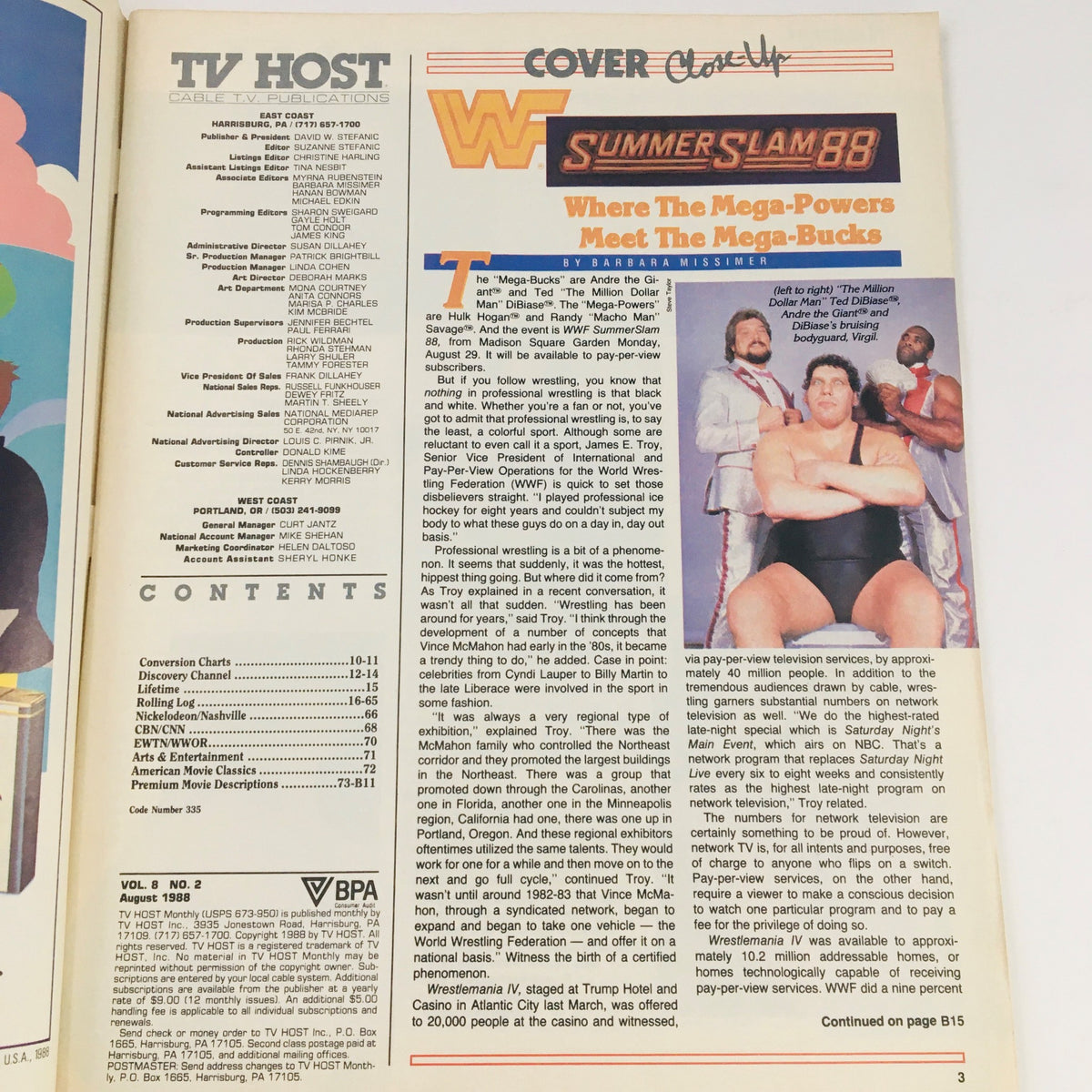


Description
Collector's Note – Why This Issue Matters
The August 1988 issue of TV Host Magazine, Volume 8, Number 2, featuring Hulk Hogan and Andre the Giant on the cover, documents one of the most commercially and culturally significant rivalries in professional wrestling history at a specific and historically charged moment. The Hogan-Andre relationship had produced WrestleMania III in March 1987 — the event at which Hogan bodyslammed Andre before an announced crowd of 93,173 at the Pontiac Silverdome, the largest indoor crowd in professional wrestling history at that point — and the two had been locked in an ongoing storyline that continued through 1988. By August 1988, the rivalry had moved into its television phase: a rematch had taken place at WrestleMania IV in March 1988, and Andre had become affiliated with Ted DiBiase's "Million Dollar Man" character, with the storyline's complexities playing out across WWF television programming that was reaching enormous audiences through syndication, cable, and pay-per-view. A TV Host Magazine cover featuring both men together in August 1988 is a document of the moment when professional wrestling had achieved genuine mainstream television status and when Hogan and Andre were its two most recognized faces for a national audience. For collectors building an archive of Hulk Hogan magazine covers and professional wrestling history, this TV Host issue is a document of the Hogan-Andre rivalry at its television peak.
The TV Host Magazine platform gives this cover a specific significance that pure wrestling publications could not provide. TV Host was a general television programming guide and entertainment magazine whose coverage of professional wrestling in August 1988 reflects the sport's crossover into mainstream television culture — the kind of publication that covered soap operas, prime-time dramas, and game shows alongside WWF programming was engaging wrestling as a legitimate television entertainment category rather than a niche sport. That mainstream television framing is precisely what makes the August 1988 date historically significant: the WWF's partnership with NBC for Saturday Night's Main Event, its presence on cable through USA Network, and its pay-per-view model had collectively transformed professional wrestling from a regional live-event business into a national television franchise, and this TV Host cover is a document of that transformation's achievement. Publications from 1988 capture American popular television culture at a specific moment when professional wrestling was one of its most-watched genres.
About the Publication
TV Host Magazine was a television programming and entertainment guide published in the late 1980s, oriented toward the general television audience rather than specialist sports or wrestling fans. Its format combined programming guides, celebrity profiles, and entertainment features covering the full range of American television — from prime-time dramas and daytime programming to sports entertainment. By August 1988, the WWF's television presence had grown large enough that a general TV magazine's decision to feature Hulk Hogan and Andre the Giant on its cover was an editorial acknowledgment of professional wrestling's mainstream television audience rather than a niche programming decision.
Key Highlights Inside
- Cover featuring Hulk Hogan and Andre the Giant — published August 1988, during the period when their ongoing WWF storyline was playing out across television programming following their WrestleMania III and WrestleMania IV encounters, documenting the two most recognizable faces of professional wrestling's mainstream television breakthrough.
- TV Host Magazine's general television framing — a significant editorial context distinguishing this cover from wrestling-specific publications, reflecting the WWF's achievement of mainstream television status by August 1988.
- Professional wrestling scene coverage from the 1980s — confirmed in the listing as interior content engaging the personalities and programming of the decade's WWF television era.
- Label-free cover — confirming clean newsstand presentation without mailing label adhesion or removal marks, the preferred configuration for display collectors of entertainment television magazines from this era.
- Note: Specific interior articles, interviews, and features beyond what is confirmed in the listing are unverified for this issue. The above reflects what is documented and consistent with TV Host's well-established editorial format during this period.
Condition & Rarity
Good condition with minor age-consistent wear is an appropriate assessment for a television entertainment magazine now over thirty-five years old. The absence of a mailing label confirms newsstand origin — the preferred configuration for display collectors, avoiding the adhesion or removal damage that affects subscriber copies. The plastic protective covering indicates deliberate preservation storage, consistent with treating this as a collectible rather than a reading copy. TV Host Magazine had a more limited distribution than major national publications, and surviving copies of specific issues in above-average condition are less commonly encountered in the collector market than comparable issues of more widely distributed publications. For a publication of this vintage, the primary condition factors are cover image clarity — the Hogan and Andre portrait is the primary visual and collectible attribute — and the completeness of interior wrestling content.
Looking for More Issues Like This?
An August 1988 TV Host Magazine with Hulk Hogan and Andre the Giant on the cover is a specific find for collectors of both professional wrestling history and 1980s American television culture — the mainstream TV magazine framing gives this cover a cultural significance that pure wrestling publications from the same period cannot replicate. If this issue has already been claimed, the archive of Hulk Hogan magazine covers and professional wrestling history is the most focused place to continue searching. The broader 1988 magazine collection offers additional context for this specific year in American television and popular culture history.