


Description
Collector's Note – Why This Issue Matters
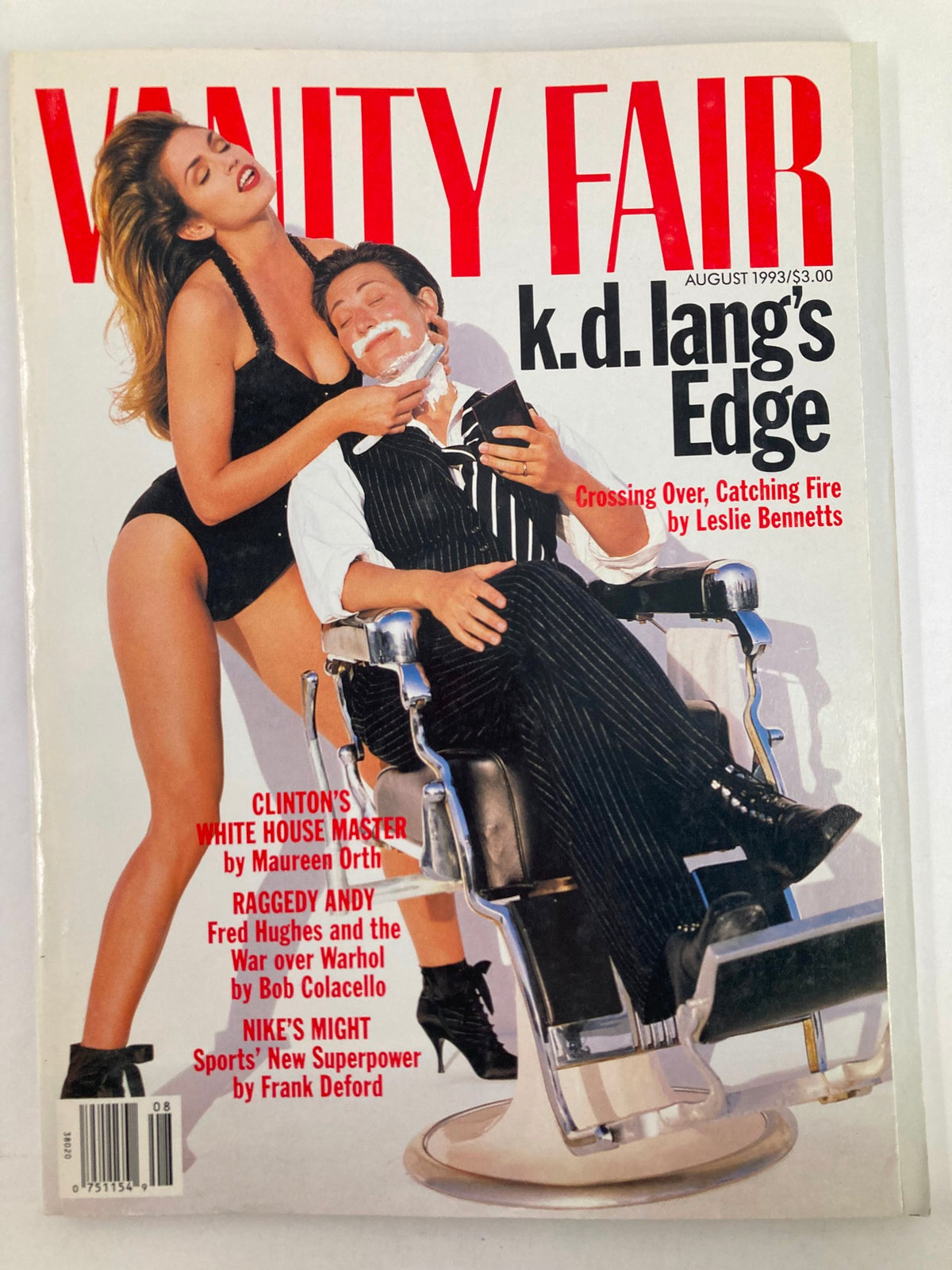
The August 1993 issue of Vanity Fair is one of the most iconic and culturally consequential magazine covers of the twentieth century — a image so precisely calibrated to its moment that it functions simultaneously as a work of art, a provocation, a political statement, and a landmark in the history of celebrity photography. The cover, shot by Herb Ritts, shows k.d. lang — dressed in a pinstripe suit and barber's smock, face lathered with shaving cream, eyes closed in apparent bliss — reclining in a barber's chair while Cindy Crawford, in a black swimsuit and heels, leans over her with a straight razor. The image is composed with complete visual confidence, its gender playfulness rendered in the highest-glamour register of fashion photography, and it landed on newsstands at a moment when American culture was simultaneously more open to and more anxious about questions of gender and sexuality than it had ever been. It did not merely document that cultural moment. It shaped it.
The timing was precise in ways that went beyond the calendar. Lang had publicly come out as a lesbian in a June 1992 The Advocate interview — a relatively rare act of openness for a mainstream recording artist at the time — and her album Ingénue, released in early 1992, had become a critical and commercial triumph that expanded her audience dramatically beyond her country roots. By August 1993 she was one of the most discussed figures in popular music, occupying an unusual position as a crossover star whose sexuality was now an acknowledged part of her public identity. Leslie Bennetts's interior profile, titled "Crossing Over, Catching Fire," engages that position directly and with the kind of substantive long-form reporting that distinguished Vanity Fair's celebrity journalism from the more deferential coverage that characterized most entertainment publications of the era. For collectors building around vintage Vanity Fair issues that mark genuine cultural turning points, this cover is among the five or ten most significant the magazine has ever produced — a short list that most serious collectors could assemble from memory.
The additional cover features visible on this issue — Maureen Orth on Clinton's White House, Bob Colacello on Fred Hughes and the war over Andy Warhol's estate, and Frank Deford on Nike's rise as a sports superpower — underscore the editorial ambition that editor Graydon Carter brought to Vanity Fair in this period. Each of those stories is substantive in its own right. The Clinton White House piece reflects the intense scrutiny of a new administration still finding its footing in its first year. The Warhol estate battle was one of the most contentious and revealing conflicts in the history of the art world, touching on questions of legacy, commerce, and who controls the meaning of an artist's work after death. And Deford's Nike piece documents a company at the precise moment its cultural dominance was becoming undeniable — years before the full implications of that dominance, for athletes, for labor, for the globalization of sports culture, would be fully understood. Together with the lang cover story, they make this one of the most editorially dense single issues Vanity Fair produced in the 1990s. Among surviving magazines from 1993, this issue stands apart not merely as a famous cover but as a complete editorial achievement.
About the Publication
Vanity Fair, relaunched by Condé Nast in 1983 after a decades-long dormancy and edited from 1992 by Graydon Carter, was by August 1993 firmly established as the defining American magazine of cultural power, celebrity, and long-form journalism — a publication whose covers generated genuine public conversation and whose interior reporting set the agenda for the broader media culture in ways that few other titles could claim. Carter's editorial vision combined the magazine's founding Condé Nast glamour with a new appetite for serious investigative and political journalism, and the result was a publication that could put a landmark gender-bending Herb Ritts cover on its front while also running substantive reporting on the Clinton White House and the art world in the same issue. Its readership was affluent, culturally engaged, and broadly distributed across the entertainment, media, finance, and political worlds that the magazine covered — and its covers in particular were treated as cultural events by a readership that understood their significance immediately.
Key Highlights Inside
- k.d. lang's Edge: Crossing Over, Catching Fire — Leslie Bennetts's in-depth profile of k.d. lang, written in the aftermath of her public coming out and the crossover success of Ingénue, exploring her position as a mainstream star whose sexuality had become an acknowledged and celebrated part of her public identity.
- Herb Ritts cover photograph — the iconic image of k.d. lang and Cindy Crawford in a barber's chair, one of the most reproduced and discussed magazine covers in the history of American publishing, shot by one of the era's defining celebrity photographers at the height of his powers.
- Clinton's White House Master — Maureen Orth's reported piece on the Clinton administration's early White House operations, published during the new presidency's formative and turbulent first year.
- Raggedy Andy — Bob Colacello on Fred Hughes and the bitter conflict over Andy Warhol's estate and legacy, one of the defining art-world stories of the early 1990s told by a writer with deep personal knowledge of the Warhol universe.
- Nike's Might — Frank Deford on Nike's emergence as the dominant force in global sports culture, a prescient piece of business and cultural journalism written at the precise moment Nike's power was becoming impossible to ignore.
Condition & Rarity
No address label with good condition and minor wear is a solid configuration for a collectible Vanity Fair from 1993 — and for this particular issue, cover condition is everything, because the Herb Ritts photograph is the primary reason collectors seek it and the primary attribute that separates a displayable copy from a merely readable one. Vanity Fair used heavy coated stock for its covers in this period that reproduces photography with exceptional fidelity but is susceptible to surface scuffing, color dulling, and edge softening with handling over three decades. A plastic protective sleeve provides meaningful ongoing preservation. The August 1993 issue was printed in large quantities to meet the significant public interest the cover generated, but the decades since have reduced the population of copies in genuinely display-worthy condition — issues that were read, passed around, clipped, or stored carelessly represent the majority of what survives. When evaluating any surviving copy of this issue, the absolute priority is the surface and color integrity of the Ritts cover photograph, followed by the flatness and completeness of the spine, the absence of moisture warping in the interior pages, and the overall cleanliness of the cover under direct light — micro-scratching and surface dulling on coated covers from this era are immediately visible and significantly affect display value.
Looking for More Issues Like This?
The August 1993 Vanity Fair is one of those covers that collectors return to consistently precisely because its cultural significance has only grown with time — it belongs in the same conversation as the handful of magazine covers from any era that genuinely moved the culture rather than merely reflecting it. If this issue has already moved on, the Vanity Fair collection at OriginalMagazines.com spans the full Graydon Carter era and regularly surfaces landmark covers from the magazine's most celebrated decade. For collectors assembling a broader picture of early 1990s American cultural and political life, the 1993 magazine collection covers the year across multiple titles — a rich archive from one of the most culturally charged years of the decade.