




Description
Collector's Note – Why This Issue Matters
The April 1, 1947 issue of Vogue documents one of the most consequential moments in the entire history of Western fashion. Just weeks before this issue's publication, on February 12, 1947, Christian Dior had presented his debut collection at 30 Avenue Montaigne in Paris — the collection that Harper's Bazaar editor Carmel Snow would famously call the "New Look." The silhouette Dior unveiled that February — nipped waist, padded hips, full skirts falling well below the knee — was a seismic rupture with the utilitarian, fabric-rationed aesthetic that wartime necessity had imposed on fashion for six years. By April 1947, the Paris collections covered in this issue were being viewed through the lens of that rupture. The spring season was the first full collection cycle to absorb and respond to what Dior had initiated, and Vogue's coverage of 135 fashions from the Paris collections across fifteen pages represents one of the most detailed primary records available of how the industry was moving in the immediate wake of the New Look's arrival. For collectors researching vintage Vogue issues that document the pivot from wartime austerity to postwar elegance, the spring 1947 issues are among the most historically specific documents the decade produced.
The table of contents reveals an editorial depth that goes well beyond fashion reportage. Arturo Toscanini — the most celebrated conductor in the world at the time, whose NBC Symphony Orchestra broadcasts had made classical music accessible to millions of American radio listeners — is the subject of a piece by Louis Biancolli covering a rehearsal conducted in four languages, a detail that captures both the man's international authority and the cosmopolitan cultural environment Vogue was curating for its readers. Stephen Spender, the British poet and critic, contributes notes from England on the fuel crisis — Britain in the winter of 1947 had suffered its worst energy crisis in decades, and Spender's dispatch grounds this otherwise glamorous issue in the harsh postwar European reality that haute couture was simultaneously escaping and responding to. Most remarkably, the issue reproduces a new gouache by Joan Miró and a head of a girl by Pablo Picasso — original artworks presented as editorial content in a fashion magazine, reflecting the particular ambition of postwar Vogue to position itself as a document of cultural life in the broadest sense. The Adrian feature — covering the Hollywood costume designer Gilbert Adrian's 1947 ready-to-wear line — adds an American counterpoint to the Paris and London coverage. Anyone building a research collection around magazines from 1947 will find this issue one of the more intellectually and visually substantial objects the year produced.
About the Publication
Vogue, founded in 1892 and built by Condé Nast after his 1909 acquisition into the world's preeminent fashion authority, was in the immediate postwar years navigating the complex task of covering a fashion industry that was simultaneously recovering from wartime disruption and reinventing itself with extraordinary creative energy. The twice-monthly format of this period — this issue specifically dated April 1, 1947 — allowed the magazine to deliver full coverage of both the Paris and London spring collections in a single issue while maintaining the editorial breadth that positioned it for its affluent, cosmopolitan readership as a complete record of cultural life. The postwar Vogue of the late 1940s combined fashion coverage with arts reproduction, literary criticism, and international reporting in a way that reflected both the magazine's ambition and the particular hunger of its readership for beauty and culture after years of wartime privation.
Key Highlights Inside
- Coverage of 135 fashions from the Paris spring collections across pages 136–151 — one of the most comprehensive single-issue records of the Paris collections published in the immediate aftermath of Dior's February 1947 New Look debut, documenting the industry's first full response to that silhouette revolution.
- The Adrian look for 1947 (pages 156–159) — featuring Gilbert Adrian, the legendary Hollywood costume designer whose transition to ready-to-wear represented one of the most significant American fashion stories of the late 1940s.
- London Collections coverage (pages 162–165) — providing a dual-capital view of the spring 1947 season and documenting British fashion's postwar recovery alongside the more celebrated French revival.
- Arturo Toscanini rehearsing in four languages, by Louis Biancolli — a profile of the world's most celebrated conductor that reflects Vogue's consistent postwar ambition to document cultural life well beyond the fashion industry.
- Stephen Spender on England's fuel crisis (page 161) — a dispatch from one of Britain's foremost poets grounding this issue's elegance in the harsh economic and material realities of postwar European life.
- Reproduction of a new gouache by Joan Miró and a head of a girl by Pablo Picasso — original artworks presented as editorial content, reflecting the particular visual ambition of late-1940s Vogue to function as a document of fine art as well as fashion.
Condition & Rarity
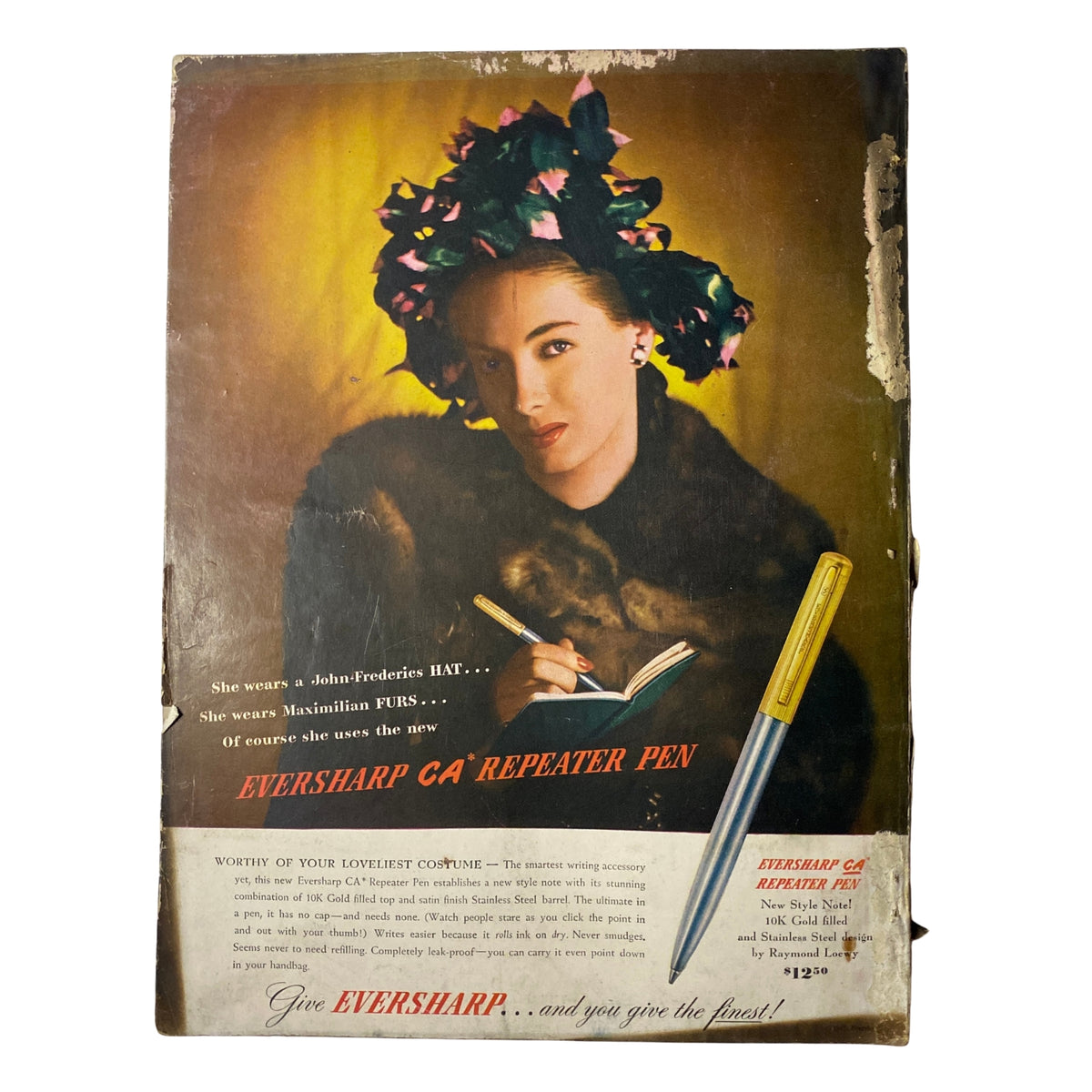
This issue comes from a privately held Vogue archive spanning the 1920s through 1970s, stored for decades before recent conservation work that included light dry surface cleaning — vacuum, brush, and smoke sponge only, with no wet methods applied — and rehousing in archival sleeves. Collectors should expect honest vintage traits characteristic of long-term storage: binding wear or small spine splits, staple-rust halos around the centerfold staples, edge toning, and period shelf dust that can present as dark residue along the spine. The front cover shows creases and marks, and additional marks or small rips within the pages are possible, consistent with the acceptable-condition grade noted. The interior is described as good — dry, legible, and intact — which is the most important structural criterion for a research and reference copy of this significance. A light vintage paper aroma typical of mid-century coated stock may be present. For a publication now approaching eighty years of age that spent decades in archival storage before professional conservation handling, this condition profile is honest and representative of what long-term survival without active deterioration looks like in practice.
Looking for More Issues Like This?
Postwar Vogue issues from the spring 1947 season — documenting the Paris and London collections in the immediate wake of Dior's New Look and combining that fashion coverage with Miró, Picasso, Toscanini, and Stephen Spender — are among the more intellectually layered single issues in the magazine's late-1940s run, and copies from a decades-long private archive with documented conservation handling are a more traceable provenance than most surviving copies of this era carry. If this issue is no longer available, the broader vintage Vogue archive at OriginalMagazines.com spans multiple decades of the magazine's publishing history and is the most reliable place to continue the search for postwar issues. The complete 1947 magazine collection is also worth exploring for collectors documenting that pivotal year of postwar cultural and fashion renewal across multiple publications.