






Description
Collector's Note – Why This Issue Matters
April 15, 1939 is one of the most historically charged publication dates in Vogue's entire pre-war archive, and this issue — photographed by Horst P. Horst, featuring Helen Bennett on the cover — is a primary document of American fashion culture in the final spring of peace before the Second World War. Horst had been shooting for Vogue since 1931, and his April 1939 cover work represents the culmination of nearly a decade of creative collaboration with the publication at the specific historical threshold when his most celebrated work was being produced. Just five months after this issue's publication, Germany would invade Poland on September 1, 1939, and the world of elegant country fashions, Parisian cottons, Monte Carlo, and Cambodian court photography that this April 1939 Vogue documented would be permanently transformed. The specific prewar atmosphere that the listing's description captures — "poised elegance and prewar optimism" — is exactly correct, and it is precisely this atmospheric quality that makes an April 1939 Vogue a primary document of a world on the threshold of its own end: a magazine produced by editors, photographers, and writers who could not know what September 1939 would bring, capturing a specific cultural moment that would never return. For collectors building an archive of Vogue magazine issues from the prewar period, this April 15, 1939 edition is among the most historically significant primary source entries in the publication's final-peacetime-spring catalog.
The Dolores del Rio feature on page 62 is a secondary celebrity historical document of specific interest — del Rio was one of the most significant Latin American stars in Hollywood history, her career spanning the silent era through the sound period, and a Vogue feature in April 1939 reflects her specific late-thirties celebrity status at a point when her Hollywood career was in transition and her subsequent Mexican cinema work was still ahead of her. The Christian Bérard "designs beds" feature on pages 76-77 is a primary document of one of the most significant figures in French decorative arts and fashion illustration of the period — Bérard was a central figure in the Parisian artistic world of the 1930s, his work for the ballet, theater, and fashion press constituting one of the more distinctive artistic contributions to the late-thirties French cultural scene, and a Vogue feature on his bed designs in April 1939 is a primary bibliographic record of his decorative arts work in its original publication context. The "Girl-queens of Cambodia" feature on pages 64-65 reflects Vogue's characteristic engagement with international and ethnographic subjects alongside its fashion content — an April 1939 Vogue feature on Cambodian royal culture is a primary document of the prewar Western fashion press's specific engagement with colonial Southeast Asian cultural traditions. Collectors researching Vogue and fashion magazines from 1939 will find this April 15 edition a primary source document of unusual historical density across fashion, celebrity, decorative arts, and international cultural history.
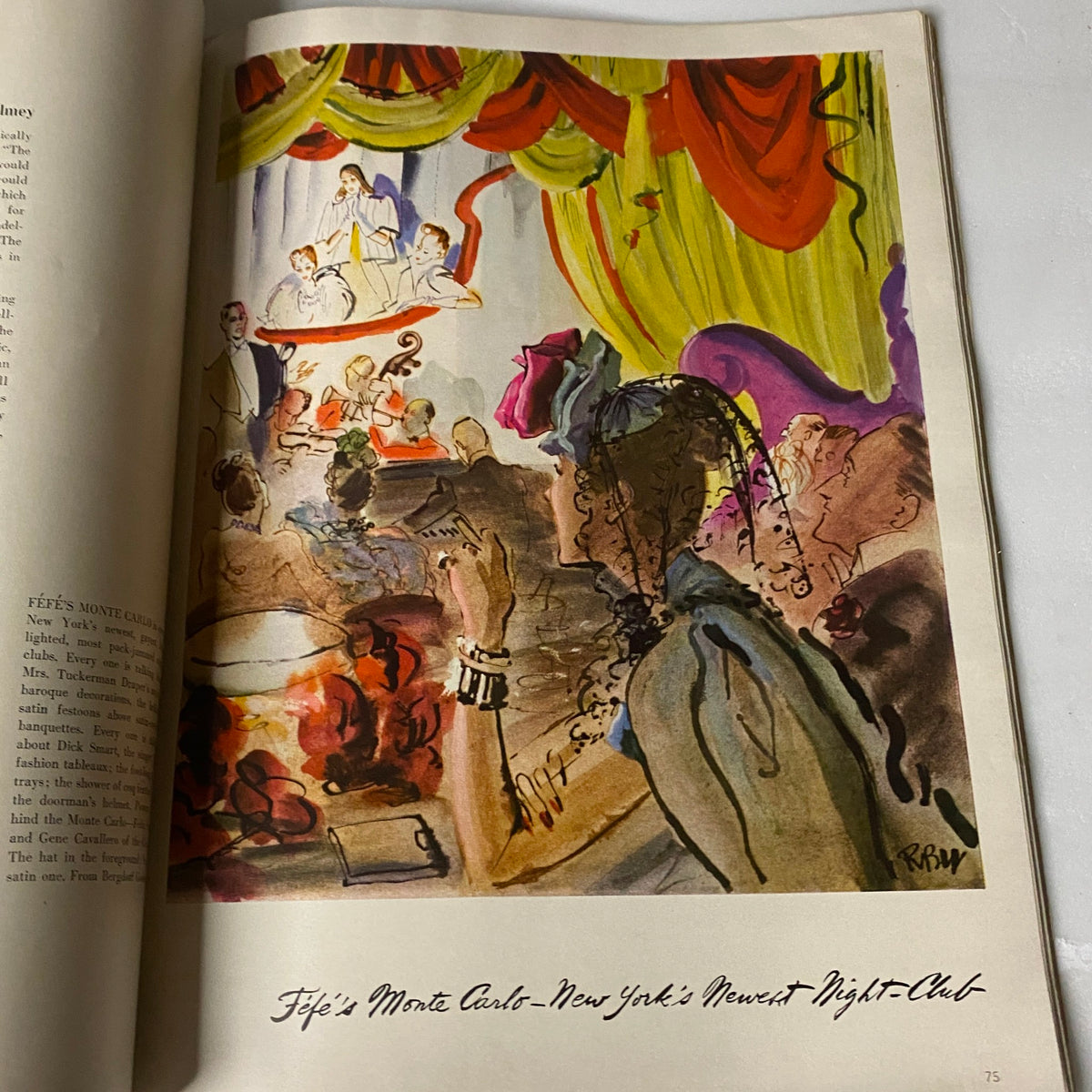
The "Féfé's Monte Carlo" feature on page 75 and the extensive travel department — Vogue's Travelog covering pages 26-33 — are primary documents of the specific prewar European leisure culture that would be completely disrupted by the war that began five months later. Monte Carlo, Paris cottons, European country house visits, and the specific social world of Vogue's international readership constitute a primary record of a specific late-peacetime cultural geography that the war would permanently alter. The "A decorator looks at California" feature on pages 90-93 reflects the specific American-European design cultural conversation of the late thirties, and "Three new foxes" on pages 88-89 adds a primary document of the late-thirties American fur fashion moment. This issue comes from a privately held Vogue archive spanning the 1920s through the 1970s, stored for decades before conservation treatment and archival resleeving — a provenance that connects it directly to the original publication cycle of the final peacetime spring.
About the Publication
Vogue was founded in 1892 and has been published by Condé Nast since 1909, operating continuously as the most authoritative fashion magazine in the American market across more than a century of publication. The April 15, 1939 Vogue was produced by an editorial team that included Horst P. Horst at the height of his creative powers and contributors engaging the full range of American and European fashion, celebrity, decorative arts, and travel culture in the final spring before the Second World War transformed every aspect of the world they were documenting. The bimonthly format that produced the April 15 date reflected Vogue's peak-season publishing schedule, and the specific combination of Horst's photography, del Rio's Hollywood celebrity, Bérard's decorative arts, and the extensive European travel content reflects the publication's characteristic editorial ambition in one of its most historically concentrated single issues. This issue comes from a privately held Vogue archive spanning the 1920s through the 1970s.
Key Highlights Inside
- Horst P. Horst cover photograph of Helen Bennett — a primary visual document of one of the twentieth century's most significant fashion photographers at the peak of his late-thirties creative authority, produced in the final spring before the Second World War permanently transformed the specific European-American cultural world that his Vogue work had been documenting since 1931.
- Dolores del Rio feature on page 62 — a primary document of one of Hollywood's most significant Latin American stars at her specific late-thirties career moment, constituting a primary source record of her Vogue presence in the period before her subsequent transition to Mexican cinema.
- Christian Bérard "designs beds" feature on pages 76-77 — a primary bibliographic document of one of the most significant figures in French decorative arts and fashion illustration in his original Vogue publication context, constituting a primary record of Bérard's decorative arts work in the specific late-thirties Parisian artistic world that the war would shortly destroy.
- Vogue's Travelog on pages 26-33, "Féfé's Monte Carlo" on page 75, "Paris cottons" on pages 82-83, and "Paris ideas for new beds" on pages 80-81 — a primary source survey of the specific prewar European leisure and design culture that this April 1939 Vogue documents at its final peacetime moment, constituting a primary record of a cultural geography that was five months from permanent transformation.
- "Girl-queens of Cambodia" on pages 64-65 and "Lady Williams-Taylor at home" on pages 66-69 — the international and aristocratic social documentation range that gave prewar Vogue its characteristic breadth across colonial Southeast Asian culture and British high society simultaneously, reflecting the specific global reach of the publication's editorial vision in its late-thirties expression.
- Slacks and skirts fashion editorial across pages 50-61, "A decorator looks at California" on pages 90-93, and Discoveries in beauty on pages 100-107 — the full American and European fashion and beauty range of an April 15, 1939 Vogue documented with the page-level specificity that makes this table of contents an unusually complete primary source of prewar fashion culture at its final elegant expression.
Condition & Rarity
This issue comes from a privately held Vogue archive spanning the 1920s through the 1970s, stored away for decades before being brought back into circulation with light dry surface cleaning and archival resleeving. The binding wear, staple-rust halos, edge toning, and period shelf dust noted in the collection description are honest and expected characteristics of an eighty-seven-year-old bimonthly fashion magazine from long-term archival storage. Acceptable condition with good interior, showing creases, marks, and possible minor rips, describes a copy that has survived nearly nine decades while retaining the legible interior content most directly relevant to its research and collector value. For collectors whose primary interest is the Horst cover photography, the del Rio celebrity feature, the Bérard decorative arts documentation, and the prewar European travel and fashion content — all of which remain accessible in good interior condition — this archive copy represents a genuinely significant final-peacetime-spring Vogue primary source. The plastic protective sleeve provides ongoing archival protection for a publication approaching its ninth decade. Collectors evaluating surviving examples should prioritize the Horst cover image integrity and the completeness of the Bérard and del Rio features as primary condition criteria for a publication of this historical significance and age.
Looking for More Issues Like This?
An archive copy of Vogue April 15, 1939 with Horst P. Horst cover photography, a Dolores del Rio feature, Christian Bérard decorative arts documentation, and the extensive European travel content of the final peacetime spring is among the most historically concentrated prewar Vogue primary sources in the publication's archive — the combination of Horst's photographic authority, Bérard's French cultural significance, del Rio's Hollywood celebrity, and the specific April 1939 threshold moment five months before the war gives this issue a research profile that extends across fashion photography history, French cultural history, Hollywood celebrity history, and prewar cultural geography simultaneously. If this issue is no longer available, the full Vogue collection at OriginalMagazines.com is the most comprehensive place to browse surviving issues from across the magazine's history and locate other Horst prewar covers, late-thirties fashion history issues, or significant issues from the publication's final peacetime decade. The 1939 magazine collection brings together issues from across that year's major publications for collectors working to document the full breadth of American print culture during the last full year of peace before the Second World War.