







Description
Collector's Note – Why This Issue Matters
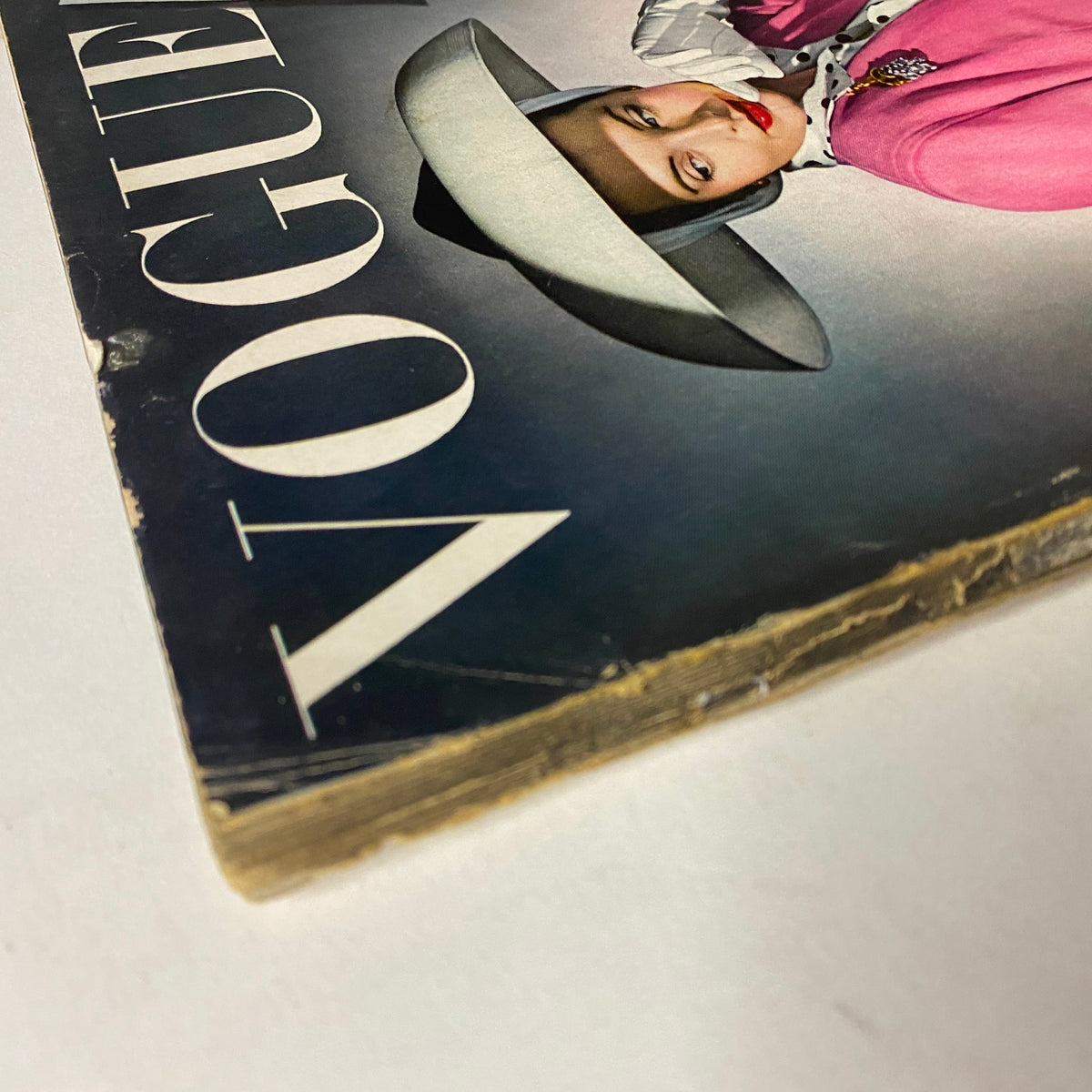
April 15, 1942 is a historically specific and editorially significant publication date in Vogue's wartime archive, and the "Our Ration-al Lives" cover concept — photographed by John Rawlings — is a primary document of the American fashion press navigating the specific wartime material restrictions that were transforming consumer culture just four months after Pearl Harbor. The wordplay of "ration-al" is itself a primary artifact: the editorial intelligence of framing rationing as a new form of rationality — practicality reinterpreted as its own aesthetic virtue — reflects exactly how Vogue was actively constructing the wartime woman's relationship to scarcity rather than merely reporting on restrictions. The specific materials documented in the fashion content — undyed shantung, pale suits, pencil lines, gingham, and the serene "little black dress" — constitute a primary source record of the specific fabric and design vocabulary that wartime restrictions were producing, documented in April 1942 at the beginning of the American rationing system's implementation. The War Production Board's L-85 regulations limiting fabric use in civilian clothing would be formally issued in 1943, making April 1942 a primary document of the transitional moment when the specific visual language of wartime fashion was being established before the regulations had fully formalized. For collectors building an archive of Vogue magazine issues from the wartime period, this April 15, 1942 edition is a primary document of the publication constructing the wartime fashion aesthetic at one of its most historically precise early-mobilization moments.
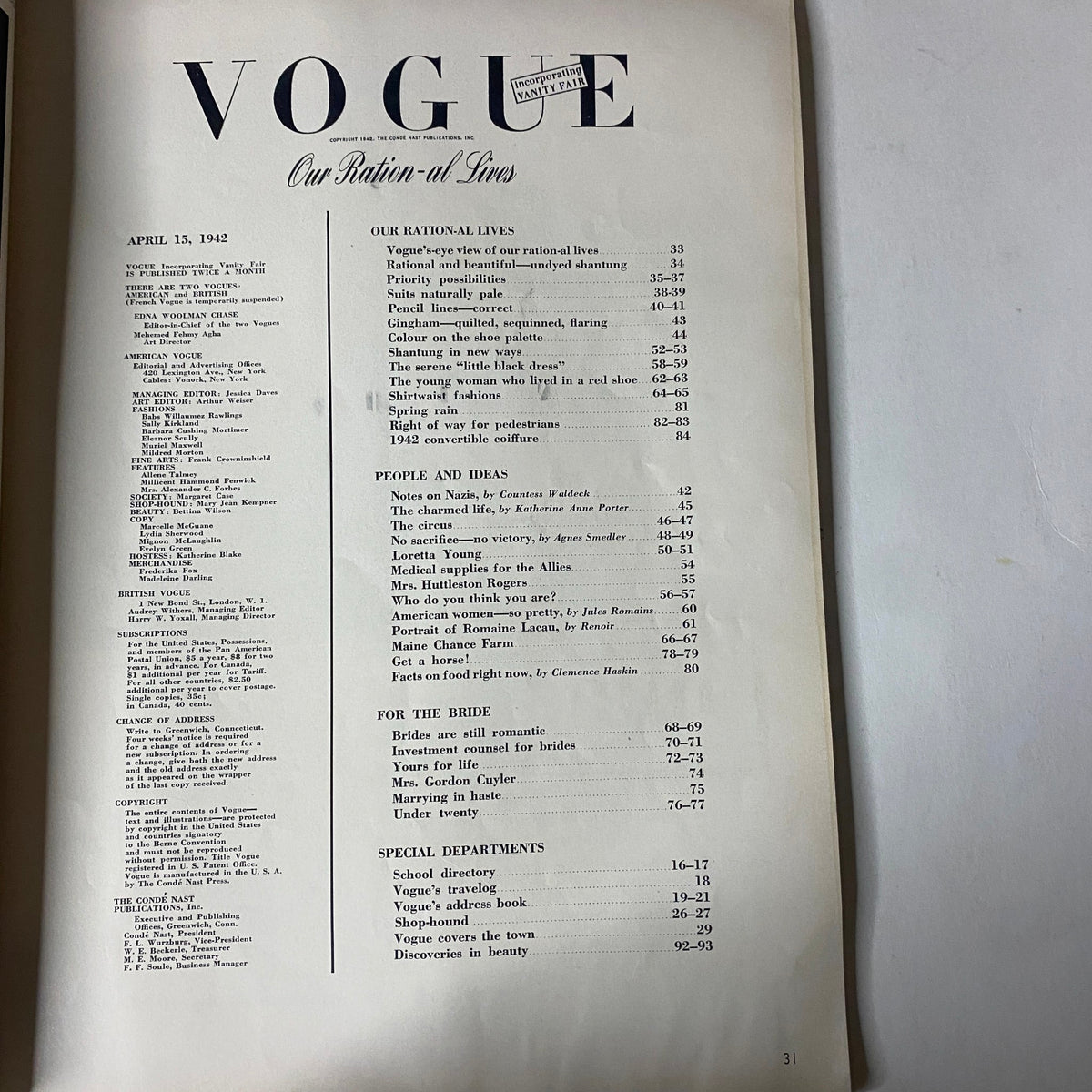
The literary and journalistic content documented in the "People and Ideas" section is a primary source of exceptional quality. Katherine Anne Porter's "The charmed life" essay on page 45 is a primary bibliographic document of one of the most significant American short story writers of the twentieth century contributing to Vogue in April 1942 — Porter's Ship of Fools would not be published until 1962, but her short fiction had already established her as a major literary figure, and her Vogue essay constitutes a precisely dated entry in her bibliography. Agnes Smedley's "No sacrifice — no victory" on pages 48-49 is an even more historically specific primary document: Smedley was one of the most controversial American journalists of the century, known for her sympathetic coverage of the Chinese Communist Party and her radical political commitments, and her presence in the pages of Vogue in April 1942 is a primary source of both her wartime public voice and the specific wartime alliance conditions that allowed so radical a figure to appear in the American fashion press's most prestigious publication. The "Notes on Nazis" by Countess Waldeck on page 42 adds a third significant journalistic primary source — Waldeck was a significant European political journalist and anti-Nazi writer whose contributions to American publications during this period constitute primary documents of European perspective on the German occupation. Jules Romains's "American women — so pretty" on page 60 adds a French intellectual's commentary on American femininity. Collectors researching Vogue and cultural magazines from 1942 will find this April 15 edition a primary source document of extraordinary literary and journalistic depth for a fashion magazine issue.
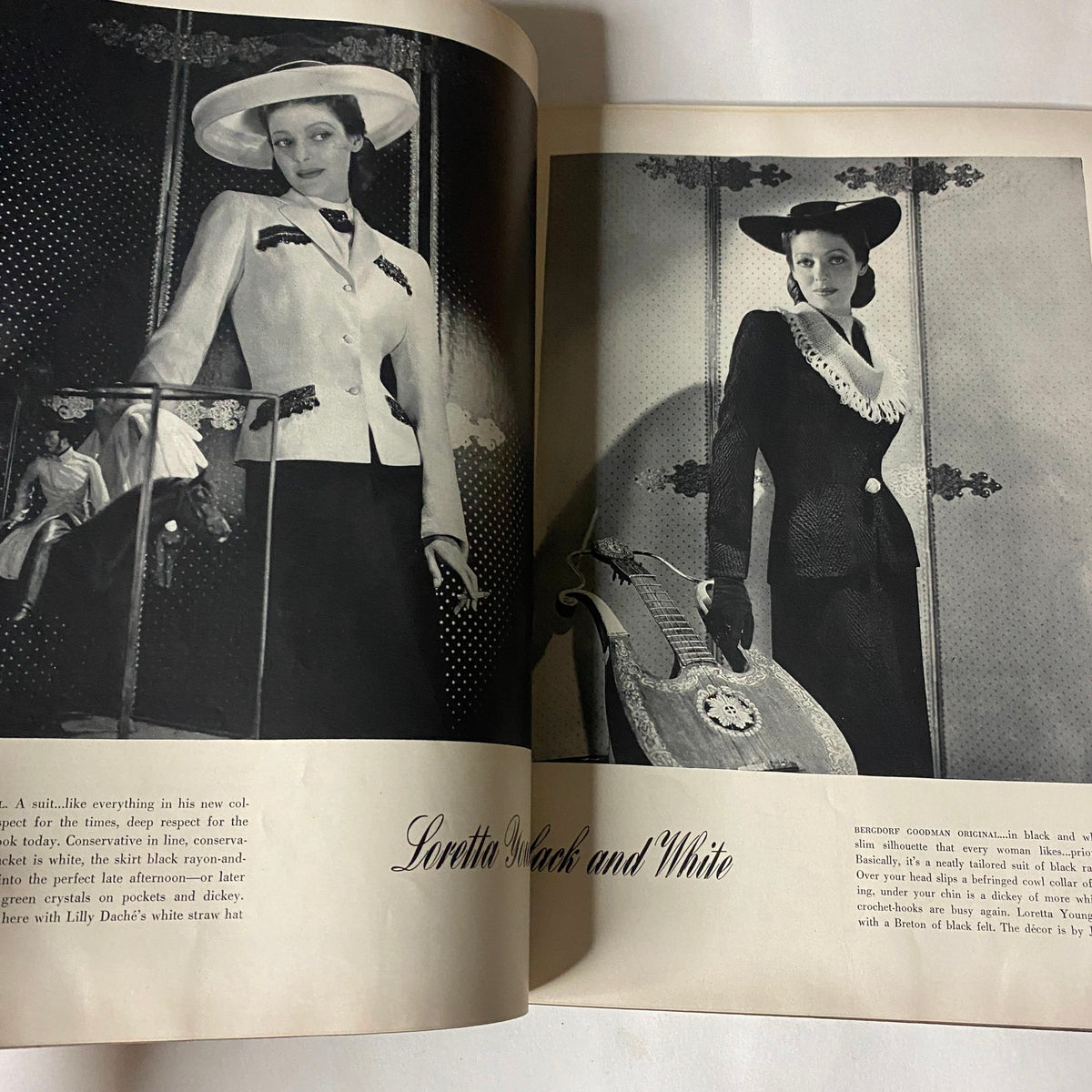
The Loretta Young feature on pages 50-51 and the Maine Chance Farm feature on pages 66-67 add celebrity and lifestyle dimensions that reflect the specific early-wartime Vogue's characteristic engagement with its readership's full social and cultural life alongside its rationing-focused fashion content. John Rawlings's cover photography represents his sustained wartime collaboration with the publication — his April 1942 cover engaging the rationing theme with the specific visual intelligence that made his wartime Vogue work some of the most historically significant fashion photography produced under conditions of genuine material constraint. The bridal section on pages 68-77 — "Brides are still romantic," "Investment counsel for brides," and "Marrying in haste" — constitutes a primary document of wartime marriage culture at a historically specific moment when accelerated military deployment was generating the specific emotional and practical circumstances that the "marrying in haste" framing directly engaged. This issue comes from a privately held Vogue archive spanning the 1920s through the 1970s, stored for decades before conservation treatment and archival resleeving.
About the Publication
Vogue was founded in 1892 and has been published by Condé Nast since 1909, operating continuously as the most authoritative fashion magazine in the American market across more than a century of publication. The April 15, 1942 Vogue was produced in the specific early-wartime moment when the publication was actively developing the editorial language for addressing wartime constraints — the "Ration-al Lives" concept represents this development at one of its most linguistically and conceptually precise expressions. The combination of John Rawlings's cover photography, Katherine Anne Porter's literary contribution, Agnes Smedley's radical political journalism, and Countess Waldeck's anti-Nazi commentary in a single issue reflects the publication's extraordinary contributor relationships and its characteristic ambition to address its readership as participants in the full range of American and world affairs. This issue comes from a privately held Vogue archive spanning the 1920s through the 1970s.
Key Highlights Inside
- John Rawlings "Our Ration-al Lives" cover — a primary visual document of one of Vogue's most accomplished wartime photographers engaging the specific April 1942 rationing and material restriction moment with the editorial intelligence of the "ration-al" wordplay, constituting a primary artifact of wartime fashion photography at its most conceptually precise early-mobilization expression.
- Katherine Anne Porter "The charmed life" on page 45 — a primary bibliographic document of one of the most significant American short story writers contributing to Vogue in April 1942, constituting a precisely dated entry in her bibliography and a primary source of her specific literary voice at a wartime career moment.
- Agnes Smedley "No sacrifice — no victory" on pages 48-49 — a primary document of one of the most controversial American political journalists of the century contributing wartime mobilization journalism to Vogue, reflecting the specific wartime alliance conditions that brought so radical a voice into the fashion press's most prestigious venue and constituting a primary source record of Smedley's wartime public writing.
- Countess Waldeck "Notes on Nazis" on page 42 and Jules Romains "American women — so pretty" on page 60 — primary documents of European anti-Nazi journalism and French intellectual commentary on American femininity in April 1942, collectively providing the transatlantic journalistic range that gave this issue's non-fashion content its extraordinary primary source depth.
- "Brides are still romantic" and "Marrying in haste" on pages 68-77 — a primary document of wartime marriage culture at the specific early-mobilization moment when accelerated military deployment was generating the "marrying in haste" circumstances directly named in the feature, constituting a primary source of how Vogue was engaging the wartime emotional and practical dimensions of its readership's marriage decisions.
- Rationing fashion content — "Rational and beautiful — undyed shantung," "Priority possibilities," "Suits naturally pale," and the serene "little black dress" — a primary source record of the specific wartime fashion vocabulary being constructed before the War Production Board's formal L-85 regulations, documented in John Rawlings's photography at the precise early-rationing transitional moment.
Condition & Rarity
This issue comes from a privately held Vogue archive spanning the 1920s through the 1970s, stored away for decades before being brought back into circulation with light dry surface cleaning and archival resleeving. Good condition with interiors described as dry and legible, alongside the binding wear, staple-rust halos, edge toning, and period shelf dust that are honest and expected characteristics of an eighty-four-year-old bimonthly fashion magazine from long-term archival storage, describes a copy that has survived nearly nine decades while retaining the legible interior content most directly relevant to its research and collector value. The Rawlings cover photograph, the Porter, Smedley, and Waldeck essays, and the rationing fashion documentation are all within the confirmed good interior condition range. The plastic protective sleeve provides ongoing archival protection for a publication approaching its ninth decade. Collectors evaluating surviving examples should prioritize the Rawlings cover image integrity and the completeness of the literary and journalistic content as primary condition criteria for a publication of this extraordinary historical density and age.
Looking for More Issues Like This?
An archive copy of Vogue April 15, 1942 with John Rawlings's "Ration-al Lives" cover, Katherine Anne Porter's essay, Agnes Smedley's wartime mobilization journalism, Countess Waldeck's Nazi commentary, and the full wartime fashion primary source documentation is among the most literarily and historically significant entries in the publication's wartime archive — the convergence of Rawlings's photographic authority, Porter's literary significance, Smedley's radical political journalism, and the pre-regulation wartime fashion documentation gives this issue a primary source profile extending across fashion history, American literary history, political journalism, and wartime social history simultaneously. If this issue is no longer available, the full Vogue collection at OriginalMagazines.com is the most comprehensive place to browse surviving issues from across the magazine's history and locate other Rawlings wartime covers, early-wartime rationing issues, or significant literary contributor entries from Vogue's most historically challenging years. The 1942 magazine collection brings together issues from across that year's major publications for collectors interested in the full range of American fashion and cultural print journalism during the first full year of American wartime mobilization.