


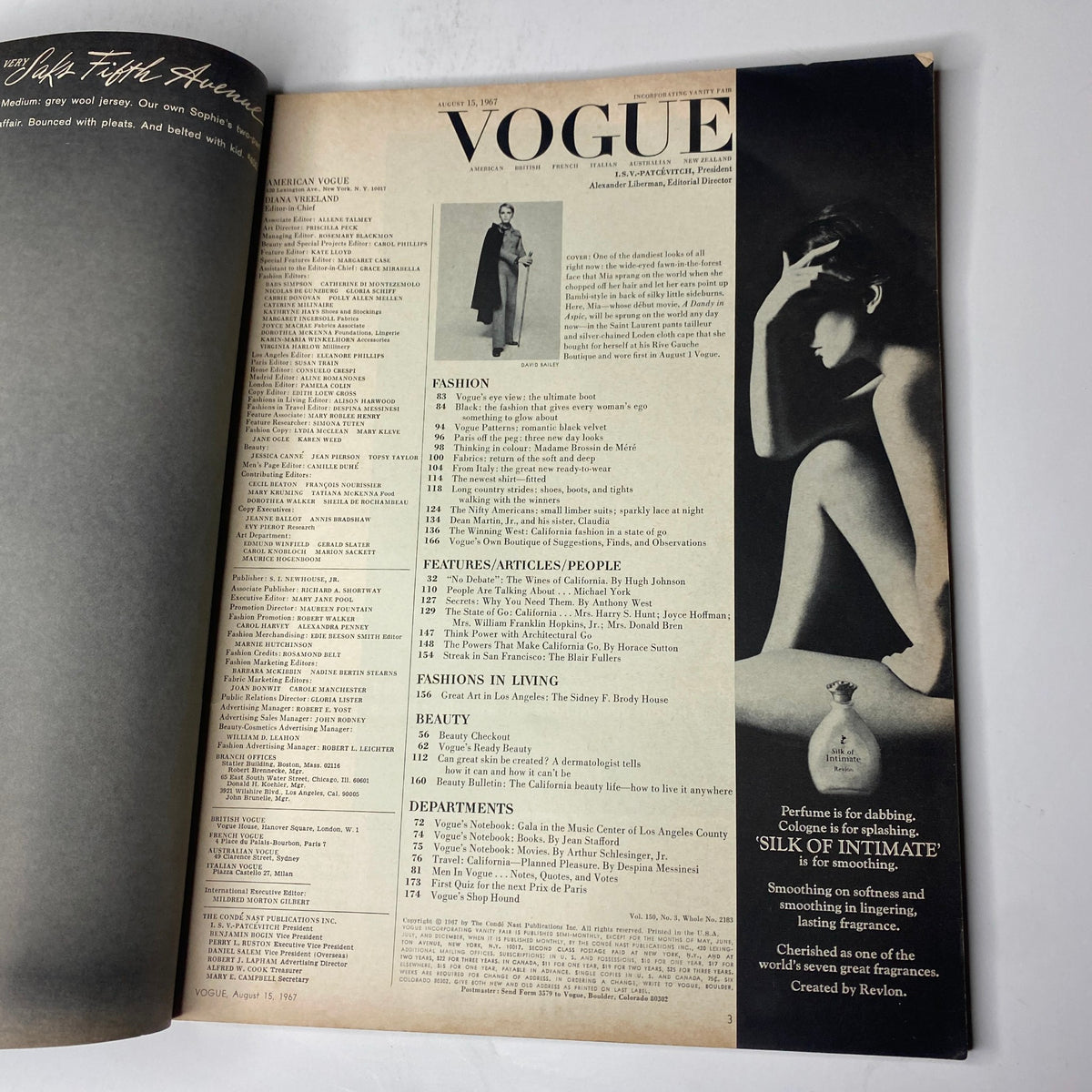


Description
Collector's Note – Why This Issue Matters
August 15, 1967 is a date that carries remarkable biographical and cultural weight for anyone researching Mia Farrow's career and public identity. Rosemary's Baby was in production during the spring and summer of 1967 — Farrow was filming Roman Polanski's landmark horror film at the same time this Vogue cover was being shot, and her famous close-cropped pixie cut, which she had received during that production and which had itself become a cultural talking point, defined her image throughout this period. The cover's styling — matte-black velvet by Norman Norell, with shimmer only at the throat, face, and hands, hair twisted into a low chignon by Ara Gallant, makeup by Pablo of Elizabeth Arden — represents Vogue's considered response to a public figure whose image was itself in active transformation. Farrow in August 1967 was not simply an actress with a magazine cover; she was a figure at the center of multiple intersecting cultural conversations simultaneously — about youth, about femininity, about the changing relationship between Hollywood and fashion, and about the specific aesthetic possibilities of a woman who had rejected conventional long-haired glamour for something more austere and more confrontational. For collectors building a documented archive of Mia Farrow magazine covers, this Vogue is the definitive primary document of her image at its most culturally resonant moment — photographed by Irving Penn, styled by the best team in fashion publishing, and framed by one of the medium's most authoritative editorial voices.
The photographer deserves particular attention. Irving Penn was by August 1967 widely regarded as the greatest fashion photographer alive, and his contribution to this issue was not a routine assignment but a deliberate editorial choice to bring the most serious visual intelligence in the field to bear on a subject who warranted it. Penn's approach to fashion photography — his preference for the studio over the street, his attention to the precise relationship between subject, light, and negative space, his ability to find the essential rather than the decorative in any image — was perfectly suited to the specific challenge of photographing Farrow in this period. The velvet dress, the chignon, the deliberately restrained palette: these are elements that reward Penn's analytical eye, and the resulting cover image is one of the more artistically significant photographs to appear on a Vogue cover in the late sixties. That combination — Farrow as subject, Penn as photographer, Norman Norell as designer, Vogue as platform, August 1967 as moment — produces an artifact whose documentary value operates simultaneously on multiple levels: fashion history, photographic history, celebrity history, and the broader cultural history of how American culture was processing femininity and style in one of the most transformative years of the decade. Collectors researching Vogue magazine issues from the Penn era will find this cover among his most precisely composed and culturally loaded contributions to the publication.
The editorial contents documented in the listing extend the issue's historical value well beyond the cover. The California orientation of much of the content — the San Francisco piece by Blair Fuller, the Los Angeles art feature on the Sidney F. Brody House, the California beauty dermatology feature, the "Beauty Bulletin: The California beauty life" — reflects Vogue's active engagement in 1967 with a California cultural moment that was then at its most intense and globally watched. The Summer of Love was happening in San Francisco at exactly the moment this issue was being published; Vogue's California-inflected August edition was, whether intentionally or not, a fashion publication attempting to document the aesthetic and cultural geography of a state that had become the center of the world's attention that summer. The "People Are Talking About Henry Miller" item places this issue in dialogue with one of the most persistent figures in twentieth-century American literary controversy; the wine debate by Hugh Johnson, the Harry James profile, and the interview with Mr. and Mrs. Jones Hoffman collectively constitute an editorial range that reflects Vogue's consistent ambition under its mid-sixties editorial leadership to address the full spectrum of its readers' cultural interests. Collectors researching Vogue and fashion magazines from 1967 will find this issue a particularly complete and well-documented primary source of the magazine's California-oriented August editorial identity.
About the Publication
Vogue was founded in 1892 and has been published by Condé Nast since 1909, developing across its long history into the most authoritative and widely referenced fashion publication in the American market. By August 1967 the magazine was operating under the editorial leadership that would shape its late-sixties identity, and its visual and editorial standards were at a peak that reflected both the extraordinary talent it had assembled — Irving Penn, Richard Avedon, and other giants of twentieth-century photography were regular contributors — and the cultural moment it was navigating, in which fashion had achieved an unprecedented level of social and political significance as a vehicle for the generational and ideological conflicts of the decade. The bimonthly format that produced the August 15 date reflected Vogue's mid-sixties publishing schedule, which issued twice-monthly editions during the fashion season rather than a single monthly issue. Its readership was affluent, educated, and culturally engaged — women who looked to Vogue not merely for guidance on what to wear but for a broader orientation toward the aesthetic possibilities of contemporary American life, delivered with the visual authority that only Vogue's editorial and photographic resources could provide.
Key Highlights Inside
- Mia Farrow cover photograph by Irving Penn — one of the most artistically significant fashion photographs published on a Vogue cover in the late sixties, combining the era's most celebrated photographer with one of its most culturally resonant subjects at a biographical moment — Rosemary's Baby in production, her pixie cut transforming her public image — that gives the image a historical depth beyond its considerable visual achievement. Norman Norell's black velvet dress, Ara Gallant's hair, and Pablo of Elizabeth Arden's makeup are documented with the precision that makes this a fully verified primary source for fashion historians.
- California cultural orientation spanning multiple features — San Francisco piece by Blair Fuller on page 151, Los Angeles art feature on the Sidney F. Brody House on page 156, California beauty dermatology insights on page 66, and the "California beauty life" bulletin on page 144 — collectively constituting one of Vogue's most focused California editorial moments, published during the Summer of Love when the state's cultural significance was at its most globally intense.
- Fashion editorial anchored by a black velvet theme running from the cover through the "Vogue's Point of Summer: Black velvet" feature on page 96 to the "Fashion in Living: Black velvet influence" on page 132 — a rare example of a single fabric and color serving as an organizing editorial concept across multiple fashion sections, reflecting the deliberate thematic coherence that distinguished Vogue's mid-sixties editorial approach at its most considered.
- "People Are Talking About Henry Miller" on page 50 — a cultural note engaging one of the most persistently controversial figures in twentieth-century American literature at a moment when his long-suppressed American publications were becoming more widely available and his cultural significance was being actively reassessed, placed in Vogue as an acknowledgment of his relevance to the magazine's culturally engaged readership.
- Books by Judith Crist on page 26, movies by Frederic Tuten on page 72, Harry James profile on page 127, wine debate by Hugh Johnson on page 32, and interview with Mr. and Mrs. Jones Hoffman on page 128 — the full cultural journalism range of a mid-sixties Vogue operating at its characteristic breadth, engaging literature, film, music, food culture, and the visual arts in a single issue alongside twelve distinct fashion editorial sections.
- Revlon "Silk of Intimate" fragrance advertisement documented as an issue highlight — a primary source record of mid-sixties luxury fragrance marketing directed at Vogue's specific readership, representing the kind of period advertising that researchers studying the intersection of fashion publishing and luxury commercial culture from this era find particularly valuable as documentary material.
Condition & Rarity
Vogue issues from August 1967 present specific condition considerations shaped by the publication's bimonthly format, its coated paper stock, and the nearly sixty years that have elapsed since publication. Good condition for a 1967 Vogue is an honest and meaningful assessment — it indicates a copy that retains structural integrity and displays the cover image with sufficient clarity to convey both Farrow's presence and Penn's photographic achievement, while acknowledging the expected evidence of nearly six decades of existence that separates a Good grade from the Very Good or higher grades that surviving copies of this issue occasionally achieve. The absence of a mailing label is a significant condition attribute for a mid-sixties Vogue, where the bimonthly subscription model meant that the majority of copies in circulation were subscriber copies bearing labels; a label-free newsstand copy preserves the Penn cover photograph in its full and uninterrupted form, which is both visually and documentarily significant for an image of this artistic and historical importance. The plastic protective sleeve provides ongoing archival protection for a publication whose coated paper stock is susceptible to the surface oxidation and scuffing that unprotected storage accelerates over decades. Collectors evaluating surviving examples of this issue should prioritize the integrity of the Penn cover image as the primary condition criterion, followed by the completeness of the California-themed editorial content and the spine condition of a bimonthly issue whose perfect-bound format makes spine integrity a meaningful secondary consideration.
Looking for More Issues Like This?
A label-free newsstand copy of the August 15, 1967 Vogue with an Irving Penn photograph of Mia Farrow on the cover is one of the more historically specific and artistically significant entries in the late-sixties Vogue back-catalog — the combination of photographer, subject, biographical moment, and California cultural context gives this issue a collector profile that ensures sustained interest from fashion historians, Penn researchers, and Farrow collectors alike. If this issue is no longer available, the Mia Farrow magazine collection at OriginalMagazines.com is the most focused place to locate other cover appearances and features from her career across multiple publications. The full Vogue collection offers surviving issues from across the magazine's history for collectors building a broader archive of Penn's Vogue work or the publication's late-sixties editorial identity, and the 1967 magazine collection brings together issues from across that extraordinary year's major publications for collectors working to document the full breadth of American fashion and cultural print journalism at the decade's most transformative moment.