



Description
Collector's Note – Why This Issue Matters
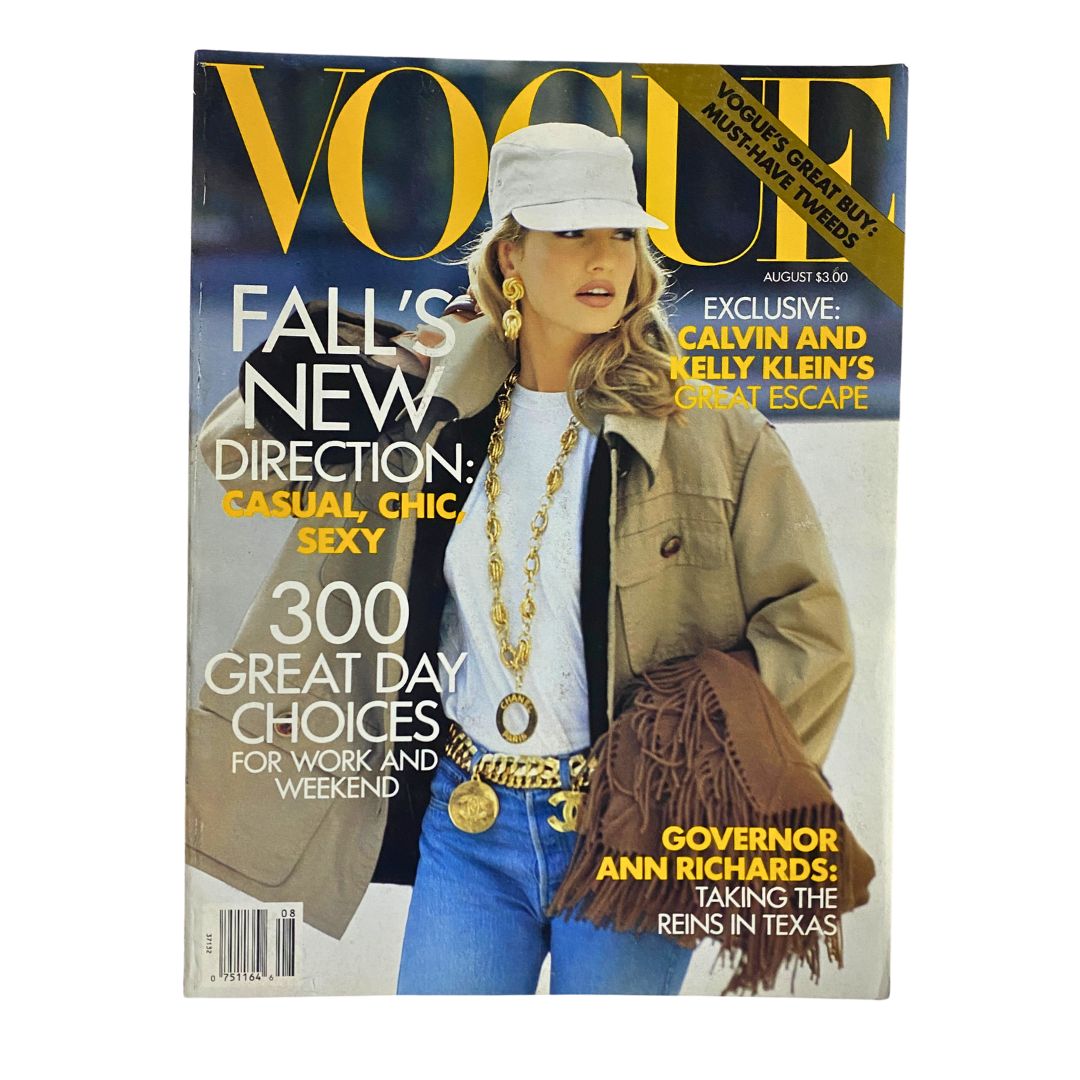
The August 1991 issue of Vogue featuring Karen Mulder photographed by Patrick Demarchelier is a document of two careers at a historically significant intersection point in the early years of the supermodel era — and situating both the model and the photographer within their trajectories in the summer of 1991 reveals why this issue deserves serious collector attention. Karen Mulder had emerged as one of the defining faces of European high fashion in the late 1980s and was, by August 1991, at the peak of her early supermodel celebrity — her work with Chanel had made her particularly associated with Karl Lagerfeld's vision of the house, and her presence on major European and American fashion covers was consistent with her standing as one of the most commercially sought-after models of the period. Patrick Demarchelier had been developing his distinctive editorial voice throughout the late 1980s and had become, by the early 1990s, one of the most celebrated fashion photographers working — his appointment as Princess Diana's personal photographer in 1988 had raised his public profile significantly, and his work for Vogue combined the warmth and natural elegance that had always characterized his approach with an increasing technical confidence and visual authority. A Demarchelier cover of Mulder for an August 1991 Vogue represents the supermodel era's most characteristic visual proposition — the known face photographed by the trusted photographer, producing an image of aspirational glamour calibrated to the specific cultural moment. For collectors building a comprehensive archive of Karen Mulder's appearances in major fashion print media, this August 1991 Vogue is among the most significant American covers of her career.
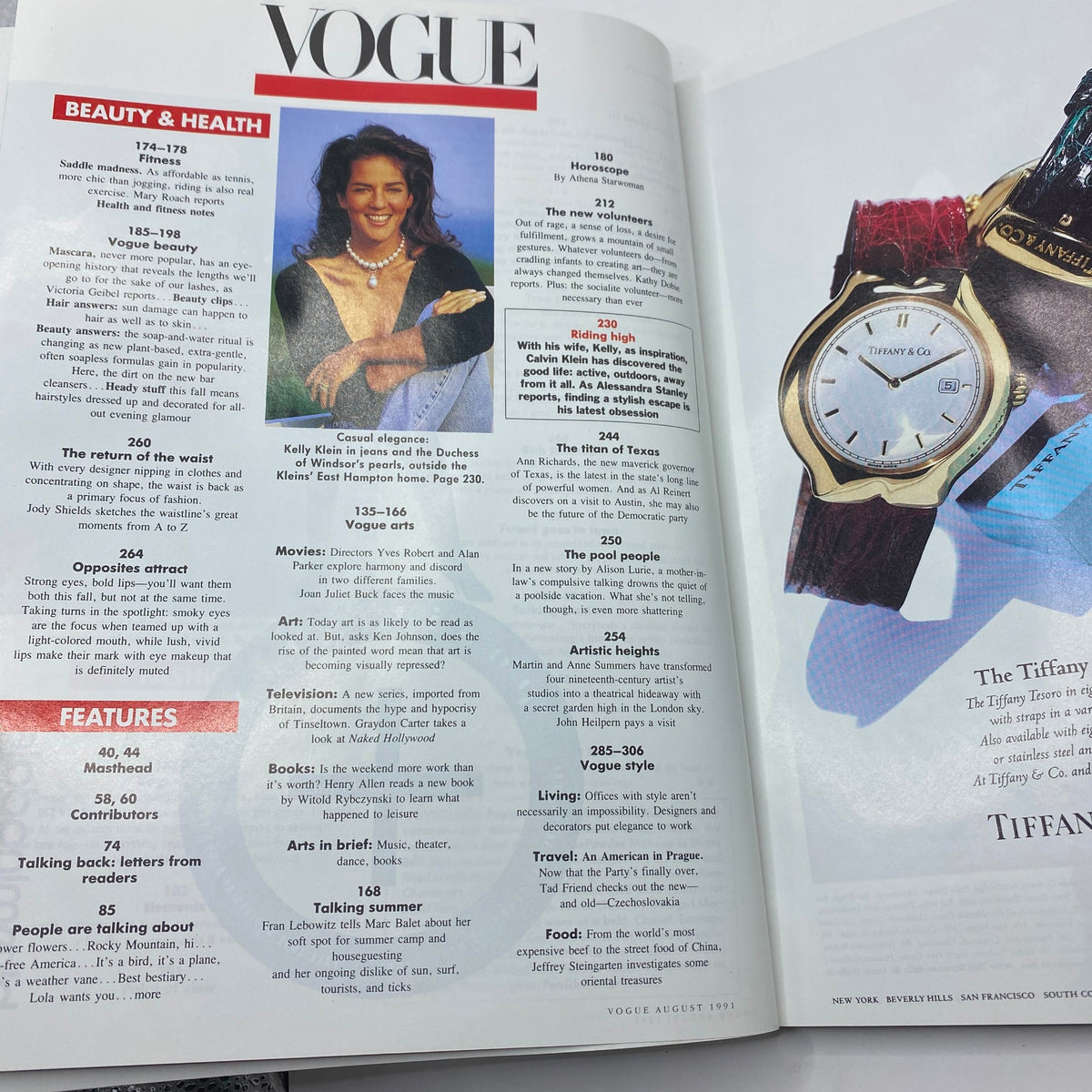
The table of contents for this issue establishes it as a document of exceptional editorial range that goes well beyond its fashion cover. Graydon Carter — who would become editor of Vanity Fair just two months after this issue's publication, in September 1991, beginning one of the most consequential editorial tenures in American magazine history — contributes a television piece on a British documentary series about Hollywood. Fran Lebowitz in conversation with Marc Balet delivers the kind of acerbic cultural commentary that made her one of the most celebrated essayists of her generation. Calvin Klein is profiled through his wife Kelly's influence on his lifestyle in a feature by Alessandra Stanley. Ann Richards — the newly elected Governor of Texas — is the subject of a political profile by Al Reinert, in an editorial choice that reflects the Wintour-era Vogue's consistent integration of political and cultural figures alongside its fashion content. A short story by Alison Lurie — the Pulitzer Prize-winning novelist — appears in the fiction slot. Jeffrey Steingarten reports on Asian food from street vendors to Wagyu beef. This is the Mirabella-era Vogue in final transition to the Wintour era, and the editorial ambition of the content reflects a publication still fully committed to substantive cultural journalism alongside fashion. For collectors tracing the full arc of Vogue's editorial evolution across the Wintour years, this August 1991 issue is a document from the early period of that era, when the magazine's intellectual ambitions remained fully visible alongside its increasing celebrity focus.
August 1991 also places this issue at a historically interesting moment in the broader supermodel culture that Mulder was central to. The early 1990s represented the absolute peak of supermodel visibility in American and European popular culture — the handful of women who occupied the top tier of the modelling world had become genuine celebrities whose faces were as recognized as any film star's, whose names were known to audiences who had never previously followed fashion, and whose cultural presence extended far beyond fashion magazine pages into music videos, advertising campaigns, and mainstream celebrity media. The specific cultural phenomenon of the supermodel — the idea that a model could be a star in her own right rather than simply an anonymous hanger for clothes — was at its most intense precisely during this period, and Karen Mulder was one of the figures who embodied it. The full magazine landscape of 1991 captures the supermodel era at its cultural apex, and this Vogue issue is a primary document of that moment from the most authoritative fashion publishing platform in America.
About the Publication
Vogue is the oldest and most internationally influential American fashion magazine, founded in 1892 and operating under Condé Nast ownership since 1909. The August 1991 issue falls in the early years of Anna Wintour's editorial tenure, which had begun in 1988, at a moment when Wintour's vision for the magazine was fully established but the editorial range and intellectual ambition that had characterized the Grace Mirabella years were still strongly present in the mix. Wintour had brought a sharper focus on celebrity culture and a more aggressive engagement with the fashion industry's commercial dynamics, but the editorial breadth visible in this August 1991 table of contents — Alison Lurie fiction, Fran Lebowitz on summer, Jeffrey Steingarten on Asian food, Ann Richards as political subject — reflects the magazine maintaining a seriousness of cultural purpose alongside its commercial and fashion editorial priorities. The magazine's audience in 1991 was affluent, fashion-engaged, and broadly culturally literate, and issues from this early Wintour period document a publication navigating the transition between two distinct editorial eras while producing consistently distinguished content.
Key Highlights Inside
- Cover photography by Patrick Demarchelier featuring Karen Mulder — one of the early 1990s supermodel era's most celebrated and commercially prominent figures, photographed by the photographer who had become one of fashion's most trusted and most versatile practitioners, producing a cover that captures the specific visual language of early-Wintour-era Vogue at its most confident.
- Graydon Carter on a British documentary series about Hollywood — a cultural television piece by the writer who would become Vanity Fair's editor just two months after this issue's publication, making his contribution here a historically interesting document of a major editorial figure in the months before his most consequential career appointment.
- "Riding High" — a profile of Calvin Klein and his wife Kelly by Alessandra Stanley, examining the designer's outdoor lifestyle and active escape from the fashion world, published at a moment when Klein's cultural influence was at its height and his personal lifestyle was as discussed as his commercial output.
- "The Titan of Texas" — a political profile of Ann Richards, the newly elected Governor of Texas, by Al Reinert, reflecting Vogue's consistent integration of significant political women into its editorial mix and its editorial recognition that Richards — with her sharp wit, progressive politics, and commanding personal presence — was a figure of genuine national significance.
- Fiction by Alison Lurie and an essay by Fran Lebowitz — contributions from two of the most respected American literary figures of their generation, reflecting the early-Wintour-era magazine's maintained commitment to genuine literary content as a counterpart to its fashion and celebrity editorial.
- Food reporting by Jeffrey Steingarten on Asian cuisine, a travel piece on post-Communist Prague, and "The Return of the Waist" as the season's primary fashion story — a late-summer editorial package that documents both the specific aesthetic preoccupations of fall 1991 fashion and the broader cultural moment of a magazine engaging with a rapidly changing world.
Condition & Rarity
Specific condition details beyond the absence of a mailing label and the presence of a plastic protective covering are not provided in the listing, and collectors should refer to the available photographs for an accurate assessment of cover gloss retention, spine integrity, and interior page quality. The absence of a mailing label confirms newsstand origin, preserving the full visual presentation of Demarchelier's Mulder portrait without the adhesive damage or paper obstruction that subscriber labels frequently caused on Vogue covers of this era — a meaningful distinction for collectors who prioritize cover presentation and display value. The plastic protective covering supports ongoing preservation of the cover stock — early-1990s Vogue was printed on high-quality coated paper that holds color and gloss well under careful storage — and for the interior pages and photography spreads. When evaluating any surviving copy of this August 1991 issue, collectors should pay particular attention to the Demarchelier cover portrait condition and gloss retention, the spine integrity along the perfect binding, the flatness and tanning of the interior page block, and the condition of the fashion photography spreads throughout the issue, which alongside the cover represent the primary visual content and the most important factor in collector assessment.
Looking for More Issues Like This?
Early-1990s Vogue issues featuring Patrick Demarchelier photography during the peak supermodel era represent a specific and consistently sought-after segment of the fashion magazine collecting market — the combination of Demarchelier's visual authority, Karen Mulder's supermodel-era cultural standing, and the exceptional editorial breadth documented in this issue's table of contents makes this August 1991 issue a document of genuine historical and artistic interest for collectors across multiple categories. The full Karen Mulder magazine archive at OriginalMagazines.com is the most focused place to explore her other significant cover and editorial appearances across the peak years of her career. The complete Vogue magazine collection spans the full range of the title's publishing history and is essential browsing for anyone building a serious run of early-Wintour-era issues. For collectors working through the broader fashion and cultural magazine landscape of the supermodel era's apex year, the complete 1991 magazine collection covers the full range of titles from a year that sits at the cultural peak of one of the most visually and commercially distinctive periods in the history of fashion media.