



Description
Collector's Note – Why This Issue Matters
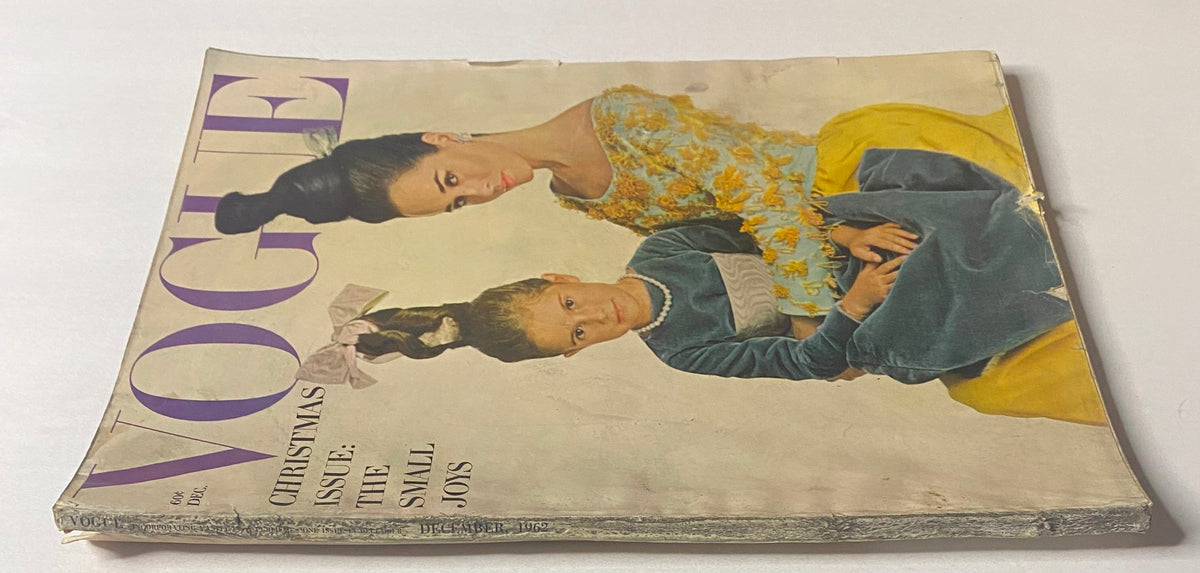
The December 1962 issue of Vogue featuring Sondra Peterson photographed by Irving Penn on the cover is a primary document of mid-century American fashion magazine publishing at its most artistically ambitious — and the combination of Penn's photography with the surrounding editorial content makes this one of the more culturally rich issues in the magazine's early-sixties run. Irving Penn was by December 1962 already recognized as one of the greatest photographers in the history of the medium, his work for Vogue since the late 1940s having established the specific visual language of postwar fashion photography that would influence the field for decades. A December holiday cover by Penn represented the magazine's most prestigious seasonal statement made with its most significant photographic resource, and the Sondra Peterson cover would have carried the full weight of that institutional investment. The December issue was also the most carefully produced and most advertising-supported of the year — the holiday number represented the magazine's full editorial authority concentrated in a single issue, and the table of contents for this December 1962 edition reflects that ambition with unusual breadth. The full scope of Penn's work for Vogue and the publication's complete visual history across this pivotal period is traceable through the Vogue magazine collection.
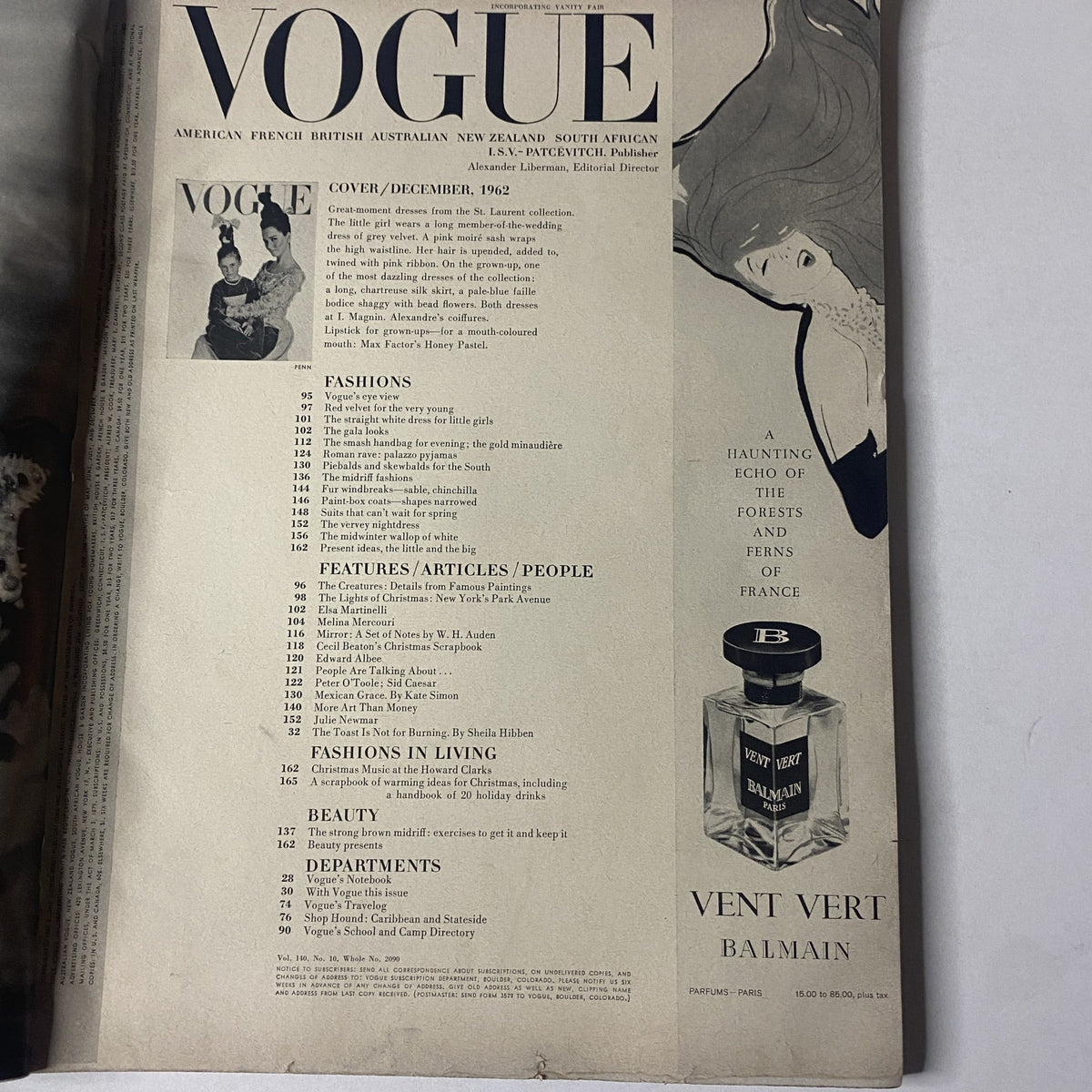
The literary and cultural content of this issue is of a quality that is genuinely exceptional even by early-sixties Vogue standards. W.H. Auden contributing "Mirror: A Set of Notes" places one of the twentieth century's most significant English-language poets in a December 1962 Vogue — a pairing that is characteristic of the magazine's mid-century editorial philosophy of treating fashion as one dimension of a fully engaged cultural life. Cecil Beaton's Christmas Scrapbook adds the perspective of one of the century's most significant photographer-designers. An Edward Albee feature arrives in the year of his extraordinary theatrical breakthrough: Who's Afraid of Virginia Woolf? had opened on Broadway in October 1962, just two months before this issue, and its appearance here is a primary document of how the mainstream fashion press was engaging with one of the most discussed and controversial theatrical events of the decade at its moment of maximum newness and impact. Kate Simon's "Mexican Grace" and Sheila Hibben's "The Toast Is Not for Burning" add further literary depth alongside features on Elsa Martinelli, Melina Mercouri, Peter O'Toole, Sid Caesar, and Julie Newmar — a roster of cultural personalities that documents the specific constellation of celebrity and creative achievement that December 1962 represented. The broader context of this pivotal year in American cultural history — the Cuban Missile Crisis had occurred just two months earlier in October — is documented across the 1962 magazine collection.
The archive provenance of this issue is worth specific attention as a collector detail. Issues from a privately held Vogue archive spanning the 1920s through 1970s carry a specific and well-understood condition profile: extended storage in consistent conditions tends to produce more stable paper than material that has circulated through multiple hands and environments, and the light dry surface cleaning described — vacuum, brush, and smoke sponge only, no wet methods — is the correct conservation approach for paper of this age. The archival sleeve housing is the appropriate ongoing conservation measure. For researchers and collectors working on Penn's career, the visual history of early-sixties Vogue, or the specific constellation of cultural figures documented in this issue's table of contents, the condition and provenance of this archive-sourced example represent a legitimate and research-quality primary source.
About the Publication
American Vogue, founded in 1892 and acquired by Condé Nast in 1909, is the flagship publication of the global fashion media industry and the standard against which all other fashion magazines have historically measured themselves. In December 1962 the magazine was operating under the editorship of Jessica Daves, who had held the position since 1952, with Diana Vreeland serving as a senior editor whose influence on the visual and editorial character of the publication was already substantial — Vreeland would become Editor-in-Chief in 1963. The early-sixties Vogue was producing some of its most visually and intellectually distinguished issues, the combination of photographers like Penn and Avedon with the specific elegance of early-sixties fashion and the magazine's sustained commitment to serious literary and cultural content creating a record of unusual quality. Its December holiday issues were its most carefully produced of the year, and the 1962 edition reflects that care with an editorial range that encompasses haute couture, poetry, theater, celebrity portraiture, and domestic holiday content simultaneously.
Key Highlights Inside
- Irving Penn cover photograph of Sondra Peterson — a December holiday cover by one of the most significant photographers in the history of the medium, his work for Vogue having established the visual language of postwar fashion photography, representing the magazine's most prestigious seasonal statement made with its most significant photographic resource.
- "Mirror: A Set of Notes" (W.H. Auden, p.116) — a contribution from one of the twentieth century's most significant English-language poets, reflecting the early-sixties Vogue's characteristic investment in literary seriousness as a component of its fashion authority.
- Edward Albee feature (p.120) — published two months after Who's Afraid of Virginia Woolf?'s October 1962 Broadway opening, constituting a primary document of the mainstream fashion press's engagement with one of the most discussed theatrical events of the decade at its moment of maximum cultural impact.
- Cecil Beaton's Christmas Scrapbook (p.118) — a contribution from one of the century's most significant photographer-designers, adding a specifically British aesthetic sensibility to the issue's holiday editorial character.
- Features on Elsa Martinelli, Melina Mercouri, Peter O'Toole, Sid Caesar, and Julie Newmar — a cross-section of the specific constellation of international film, theater, and entertainment celebrities who defined December 1962's cultural moment, providing primary documentation of their respective public personas at this specific historical point.
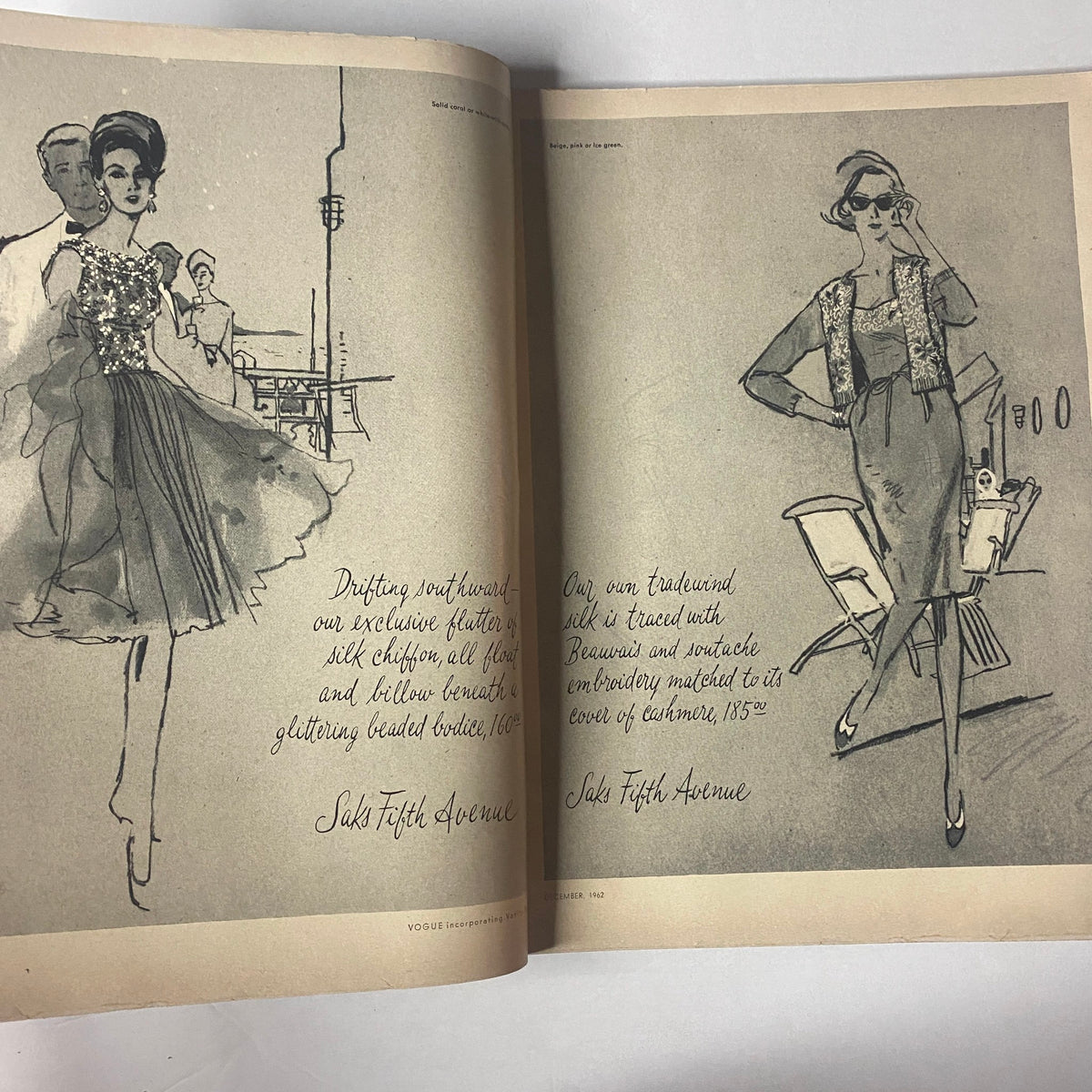
- Holiday fashion and couture content — palazzo pyjamas, sable and chinchilla fur windbreaks, gold minaudières, paint-box coats, and white midwinter fashion together constituting a comprehensive primary document of the specific silhouettes, materials, and styling approaches of early-sixties holiday couture at its most fully developed expression.
Condition & Rarity
Issues from a privately held Vogue archive spanning the 1920s through 1970s carry a specific and well-understood condition profile for collectors of mid-century periodicals. Extended storage in consistent conditions tends to produce more stable paper than material that has circulated through multiple hands, and archive-sourced issues often retain better interior legibility than exterior wear might suggest. The condition characteristics expected for this issue — binding wear or small splits, staple-rust halos, edge toning, and period shelf dust along the spine — are the honest and expected attributes of original, unrestored material from this era. The light dry surface cleaning performed is the correct conservation approach for paper of this age. Good interior condition with dry, legible pages is a meaningful positive for a sixty-plus-year-old holiday issue with this editorial depth, as the legibility of the Penn cover photography, the Auden text, and the fashion content are the primary research and display utilities of the surviving artifact. The archival sleeve is the appropriate ongoing conservation housing.
Looking for More Issues Like This?
A December 1962 Vogue with an Irving Penn cover, W.H. Auden prose, a freshly-opened Edward Albee feature, and the holiday couture content documented here is among the more editorially ambitious and culturally significant entries in the magazine's early-sixties run — an archive-sourced example that rewards serious research attention from fashion historians, Penn scholars, literary historians, and early-sixties cultural researchers simultaneously. If this particular issue is no longer available, the full Vogue magazine collection at OriginalMagazines.com is the most comprehensive source for exploring other issues across the publication's long and visually distinguished run, with particular strength in the mid-century decades where the magazine's photographic and literary legacy is most richly represented. For collectors building a broader archive of this pivotal year in American cultural history, the complete 1962 magazine collection brings together titles from a year whose significance — the Cuban Missile Crisis, theatrical breakthroughs, and the specific cultural confidence of early-sixties America — rewards sustained collector attention.