

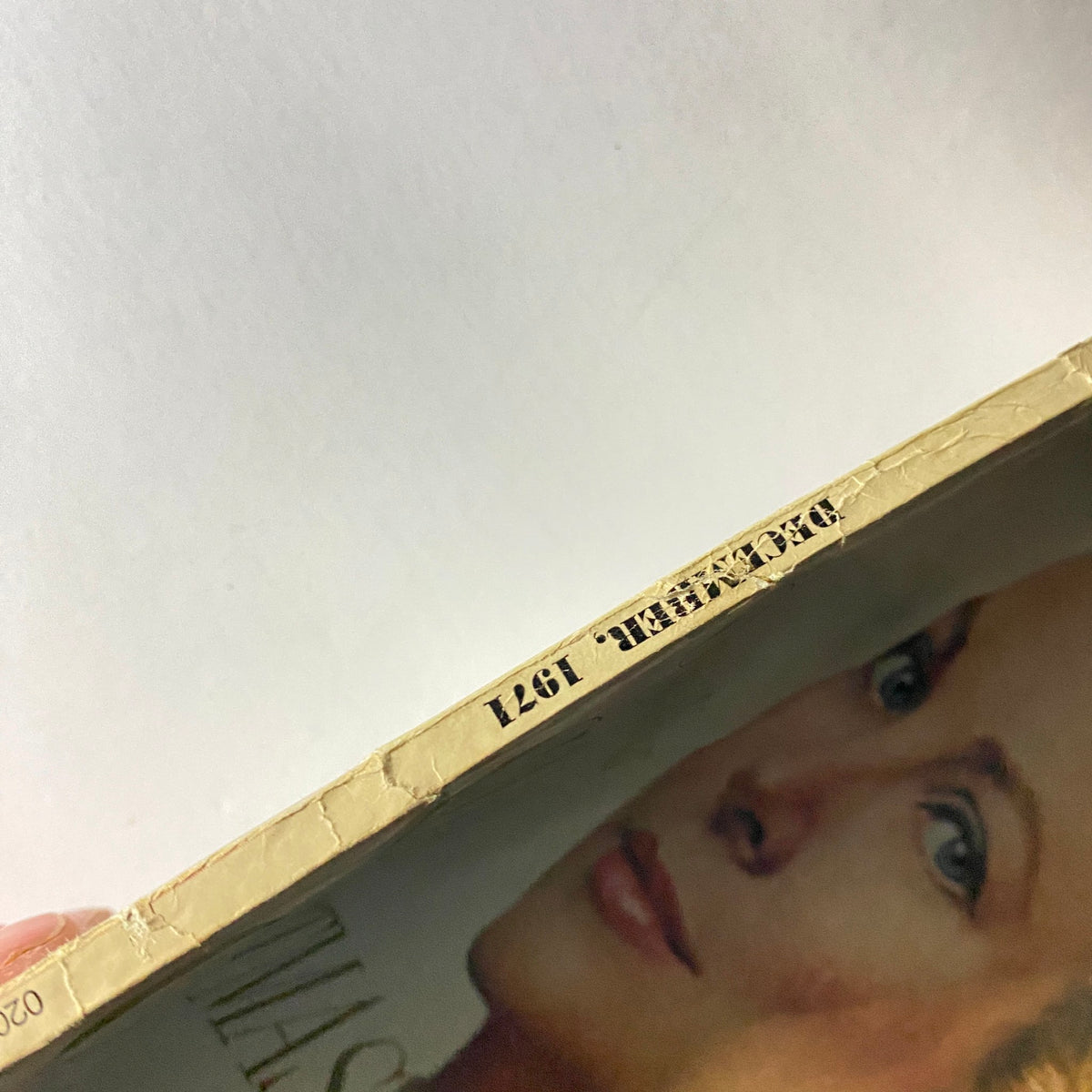



Description
Collector's Note – Why This Issue Matters
The December 1971 issue of Vogue Magazine, with Princess Grace of Monaco on the cover, is one of the most editorially distinguished and historically layered issues in the publication's early-1970s archive. By December 1971, Grace Kelly — who had left Hollywood in 1956 to become Princess of Monaco — was in the fifteenth year of her life as a reigning princess, and her appearances in the fashion press remained significant events precisely because they were controlled and selective. The confirmed interior feature is an interview by Curtis Bill Pepper photographed by Lord Snowdon — an extraordinary attribution that gives the piece immediate weight. Snowdon, then at the height of his editorial influence following his celebrated work for Vogue Paris and other publications, brought a particular quality of aristocratic intimacy to his portrait subjects, and his access to Princess Grace in this context reflects the specific social world that the most ambitious fashion journalism of the period could inhabit. For collectors building an archive of Grace Kelly and Princess Grace magazine appearances, this December 1971 Vogue cover and interview represents one of the more substantial and photographically distinguished appearances of her Monaco years.
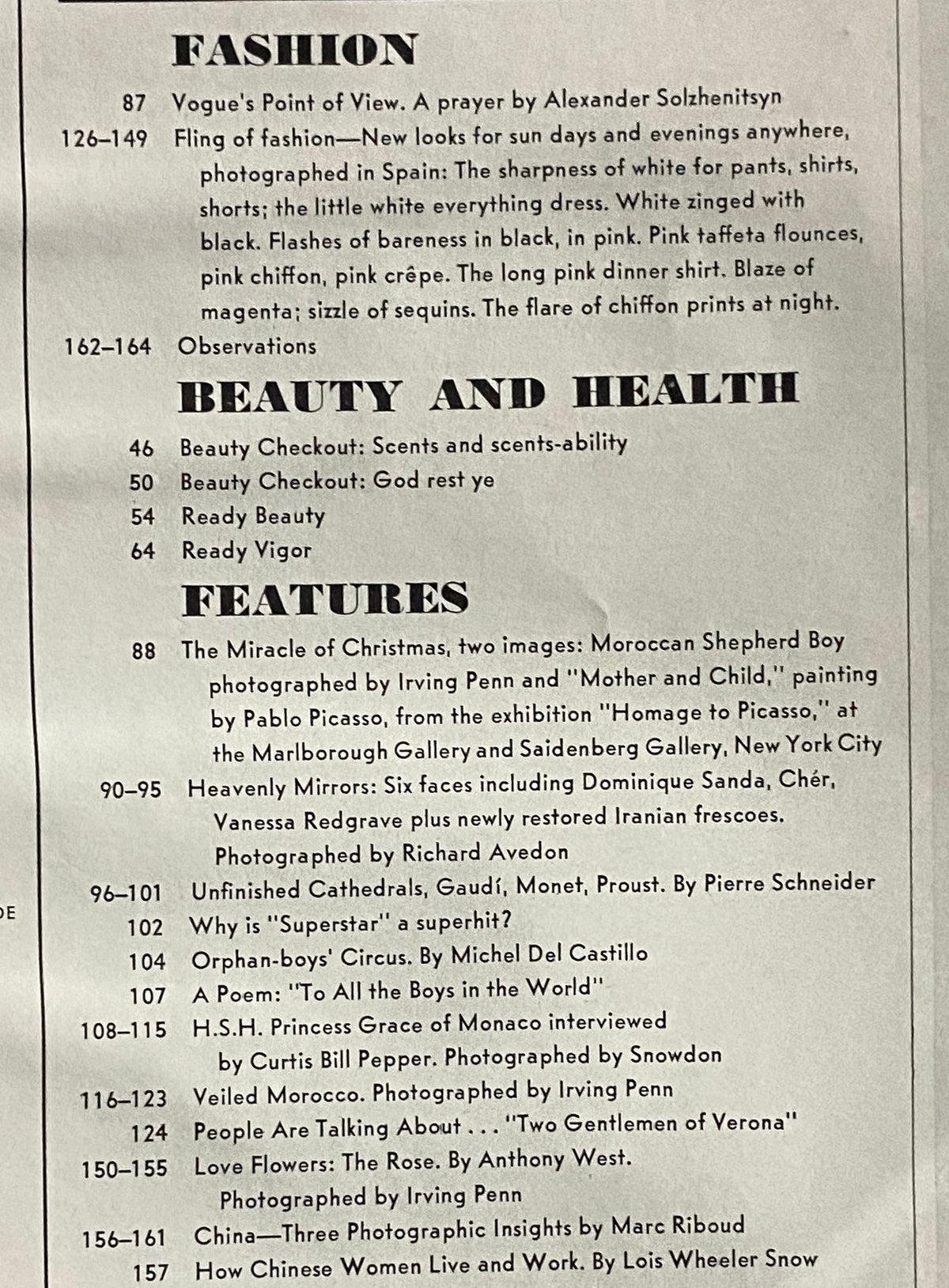
The confirmed table of contents for this issue makes it remarkable far beyond the Princess Grace feature. The December 1971 Vogue assembles a constellation of collaborators that reflects the publication at the apex of its editorial ambition under Diana Vreeland. Irving Penn photographed both the Moroccan Shepherd Boy for the Christmas feature and the "Veiled Morocco" travel feature — two distinct assignments in the same issue from one of the twentieth century's greatest photographers. Richard Avedon's "Heavenly Mirrors" feature brought together Dominique Sanda, Cher, and Vanessa Redgrave alongside Iranian frescoes in what was characteristically Vreeland-era Vogue: art history and celebrity in the same visual frame. The issue opens with a prayer by Alexander Solzhenitsyn — whose Nobel Prize for Literature had just been announced in October 1971 — used as Vogue's editorial statement. Pierre Schneider writing on Gaudí, Monet, and Proust; Marc Riboud's photographic insights from China; a piece on Chinese women's lives by Lois Wheeler Snow — this is not a fashion magazine that happened to have a Princess Grace cover. It is one of the most culturally ambitious single issues Vogue produced during the Vreeland years. Publications from 1971 document American and international culture at a specific moment of early-1970s intellectual and artistic energy, and this Vogue December issue captures that energy at extraordinary concentration.
About the Publication
American Vogue in December 1971 was operating in the final months of Diana Vreeland's editorship, which had run from 1963 to 1971 and is widely regarded as the most creatively and intellectually ambitious period in the magazine's twentieth-century history. Vreeland had expanded the publication's scope beyond fashion into art, travel, politics, and ideas, commissioning major photographers — Penn, Avedon, Snowdon — and engaging writers and cultural figures from outside the fashion world to bring genuine intellectual range to its pages. The December issue was traditionally among the year's most carefully produced, and this 1971 edition reflects the full ambition of Vreeland's editorial vision in what was effectively her farewell season as editor.
Key Highlights Inside
- Cover and interior feature on H.S.H. Princess Grace of Monaco — interviewed by Curtis Bill Pepper and photographed by Lord Snowdon, representing one of the most distinguished treatments of her Monaco-era public image in the American fashion press.
- Irving Penn photography — present in two separate major features: the Christmas "Moroccan Shepherd Boy" image and the "Veiled Morocco" travel spread, representing Penn at the height of his editorial authority in a single issue.
- Richard Avedon's "Heavenly Mirrors" — bringing together Dominique Sanda, Cher, Vanessa Redgrave, and newly restored Iranian frescoes in one of the most characteristically Vreeland-era visual statements in the issue.
- Vogue's Point of View: a prayer by Alexander Solzhenitsyn — the Nobel Prize-winning Soviet dissident used as the magazine's editorial opening statement in December 1971, two months after his Nobel announcement, reflecting Vreeland's conviction that Vogue's readership deserved the most serious available cultural voices.
- "Unfinished Cathedrals: Gaudí, Monet, Proust" by Pierre Schneider and "China — Three Photographic Insights" by Marc Riboud with text by Lois Wheeler Snow — confirming the issue's extraordinary breadth of cultural and political engagement in the same pages as Christmas fashion photography.
- Fashion editorial set in Spain — "Fling of fashion" featuring white, pink, magenta, and sequin looks — providing the seasonal fashion content that anchored the issue's commercial identity alongside its remarkable cultural editorial program.
Condition & Rarity
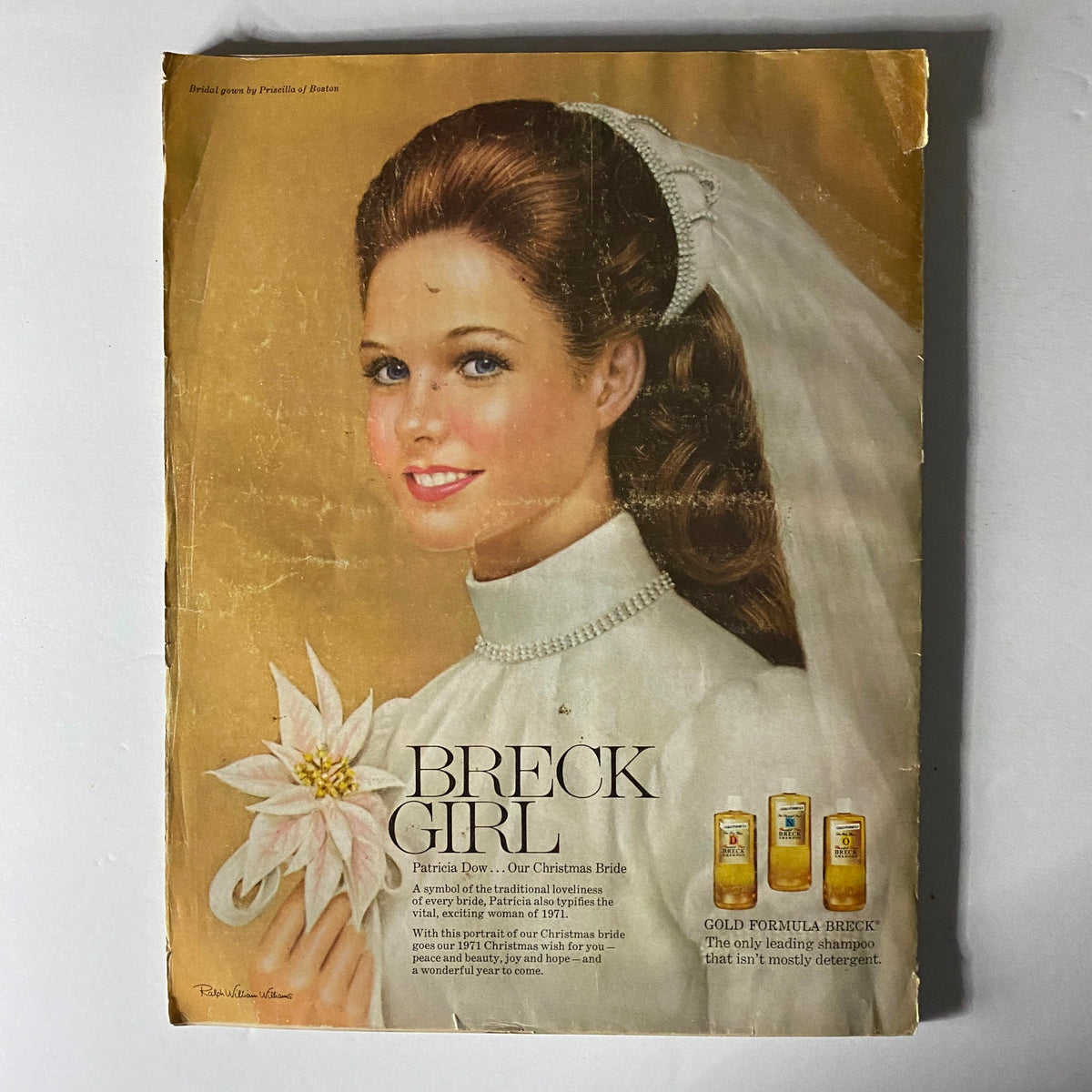
Excellent condition with light age-consistent wear is a strong rating for a monthly fashion magazine now over fifty years old. The absence of a mailing label confirms newsstand origin — subscriber copies of American Vogue from 1971 were delivered with address labels applied directly to the cover, and label-free examples are the preferred configuration for display collectors, avoiding the label adhesion or removal damage that affects many surviving copies of this era. The plastic protective covering indicates deliberate preservation storage. For a coated-stock monthly publication of this vintage, the primary condition factors to assess in any surviving copy are cover surface brightness and color saturation, spine integrity given the issue's substantial page count, and the completeness and quality of the Penn and Avedon photography spreads that constitute the issue's most historically significant visual content.
Looking for More Issues Like This?
A label-free, excellent-condition December 1971 Vogue with Princess Grace on the cover, Snowdon's portrait photography inside, and Irving Penn and Richard Avedon both present in major features is one of the most substantively distinguished configurations in the Vreeland era's final year — serious collectors of both Grace Kelly ephemera and Vogue's editorial history recognize this issue immediately. If it has already been claimed, the archive of Princess Grace and Grace Kelly magazine appearances is the natural first stop. The full Vogue magazine collection spans the publication's entire run, and the 1971 magazine archive offers broader context for this specific and culturally rich year.