







Description
Collector's Note – Why This Issue Matters
The December 2006 issue of American Vogue arrives at a moment when Nicole Kidman was occupying a particular and fascinating position in the cultural landscape. She had won the Academy Award for Best Actress for The Hours in 2003, cementing her status as one of the most respected performers of her generation, and by late 2006 she was in the midst of a personal reinvention — her marriage to Keith Urban earlier that year had shifted the public narrative around her considerably, and her screen work was drawing on a new emotional range and confidence. A December Vogue cover is among the most prestigious placements in American fashion media, reserved for figures of genuine cross-cultural resonance, and Kidman's selection for the holiday issue of 2006 reflects her standing as one of the rare individuals who operated with equal fluency in film, fashion, and the aspirational lifestyle content that Vogue's December issues traditionally celebrate. Collectors building a serious archive of her media presence will find the Nicole Kidman magazine collection a comprehensive resource for tracing how her image was constructed and evolved across two decades of major publication coverage.
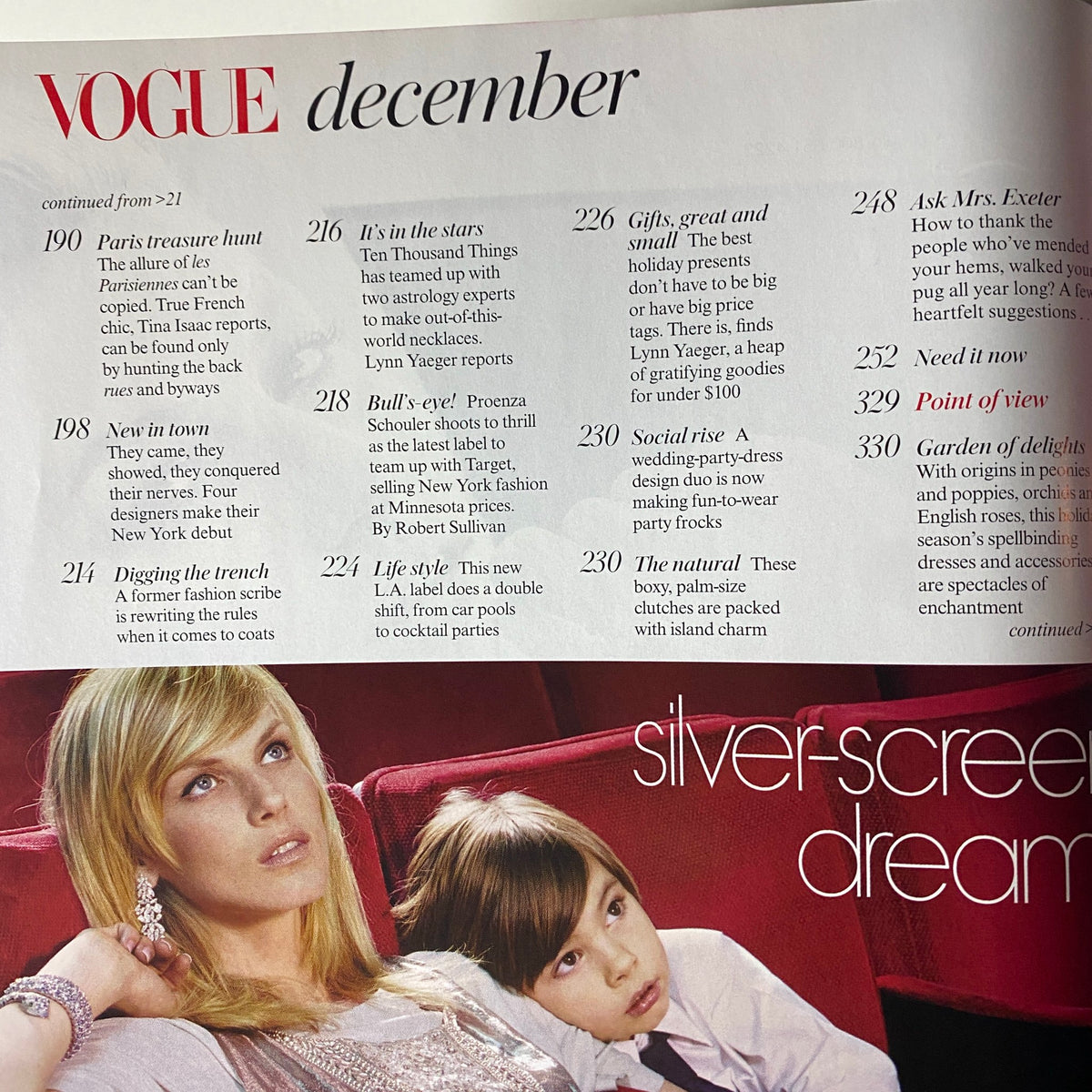
The editorial content documented in this issue's table of contents is remarkably rich, even by Vogue's December standards. The fashion features alone constitute a detailed map of where luxury style stood in late 2006 — a moment when the pre-financial crisis economy was producing levels of high-end consumer spending that would not be seen again for years, and when the fashion industry was simultaneously grappling with the democratizing pressures of eBay resellers, fast fashion's ascent, and a renewed interest in vintage and heritage dressing. The "Positive Feedback" feature examining eBay sellers evolving into boutique owners, the "New Old Thing" piece on vintage fashion's investment appeal, and the "What Price Glory?" economics of luxury pricing read together as a remarkably prescient snapshot of forces that would reshape the fashion industry fundamentally within the following decade. The Vogue magazine collection allows collectors to situate this issue within the publication's longer editorial arc, making the mid-2000s period particularly legible as a distinct and historically interesting chapter in the magazine's history.
The cultural and arts coverage in this issue adds further depth that distinguishes it from a purely fashion-focused collectible. André Leon Talley's "Life with André" feature represents one of fashion's most distinctive and beloved editorial voices at a point when his influence within the industry was at its most pronounced. The film coverage — Ralph Fiennes in The Constant Gardener and Elijah Wood in Everything Is Illuminated — and the Broadway revival of Sweeney Todd situate the issue firmly within the cultural moment of late 2006. Rafael Nadal's profile following his record-breaking season and James Blunt's emergence as a transatlantic music sensation add sports and music dimensions that reinforce the breadth of Vogue's editorial ambition under Anna Wintour. The Sarah Jessica Parker interview on her career and perfume line, and Karen Elson's Grey Gardens-inspired fashion feature, complete a picture of a December issue operating at the full range of the magazine's considerable editorial scope. For collectors interested in the broader cultural context, the 2006 magazine archive provides cross-title perspective on a year that sits at an interesting inflection point in early twenty-first century cultural history.
About the Publication
American Vogue, founded in 1892 and acquired by Condé Nast in 1909, is the flagship publication of the global fashion media industry and the standard against which all other fashion magazines have historically measured themselves. Under the editorship of Anna Wintour, who took the helm in 1988, the magazine developed an editorial identity that was simultaneously more celebrity-driven and more culturally ambitious than its predecessors — its covers became carefully negotiated statements of cultural currency, its fashion coverage engaged seriously with the economics and sociology of luxury consumption alongside the aesthetics of dress, and its arts and culture sections maintained a level of editorial seriousness that reinforced Vogue's claim to be something more than a fashion magazine. By December 2006, Wintour's tenure was approaching its twentieth year and the magazine's authority within both the fashion industry and the broader cultural conversation was at a sustained peak. Its December issues in particular — holiday-themed, lavishly produced, and typically featuring one of the year's most significant cover subjects — are among the most actively collected entries in the magazine's annual run.
Key Highlights Inside
- Nicole Kidman December cover — one of the year's most prominent fashion media placements, documenting Kidman at a moment of personal and professional reinvention and reflecting Vogue's editorial judgment of her standing as a cross-cultural icon of elegance and serious creative achievement.
- Life with André (André Leon Talley) — a feature from one of fashion's most distinctive editorial voices, whose presence in the magazine's December issue carried particular weight given his central role in Vogue's editorial identity throughout this period.
- Fashion economics features including "What Price Glory?", "The New Old Thing," and "Positive Feedback" — a cluster of pieces that together constitute a remarkably prescient analysis of the luxury market, vintage fashion's investment appeal, and the early disruption of traditional retail by online resellers, all documented at a pre-financial crisis moment that gives them considerable retrospective historical interest.
- Roland Mouret's couture breakdown and the "Price of Admission" fashion spread — detailed fashion content ranging from a $17 bargain to an $18,000 statement piece, capturing the full spectrum of late-2006 luxury fashion consumption in a single editorial package.
- Sarah Jessica Parker interview on her career and perfume line, and Karen Elson's Grey Gardens feature — two of the issue's most distinctive celebrity and fashion-editorial contributions, representing the breadth of Vogue's December approach to combining celebrity access with high-concept fashion storytelling.
- Arts and culture coverage spanning film (Ralph Fiennes, Elijah Wood), Broadway (Sweeney Todd revival), sports (Rafael Nadal), music (James Blunt), and food (David Bouley) — the full complement of Vogue's cultural departments operating at December's most expansive and ambitious register.
Condition & Rarity
Surviving copies of the December 2006 Vogue in very good condition represent a clean and collectible example of the magazine's late-2000s run. Minor edge wear on a copy of this vintage is the expected and honest condition profile of an original, unrestored periodical that has been stored rather than archived — experienced collectors evaluate it as evidence of authenticity rather than as a meaningful detraction from the issue's value. The absence of a subscriber address label is a significant positive in collector evaluation: newsstand copies preserve the full Nicole Kidman cover image exactly as it was designed and printed, without the adhesive marks or partially obscured photography that subscription labels permanently leave behind. For a December cover with this level of visual investment — holiday issues traditionally received Vogue's most elaborate and carefully considered cover photography — the label-free condition is a genuine distinction that affects display value directly. The protective plastic sleeve present on well-preserved copies is the standard archival measure for a magazine of this paper stock and production quality, stabilizing further deterioration from handling and environmental exposure without requiring any alteration to the original item.
Looking for More Issues Like This?
A no-label copy of Nicole Kidman's December 2006 Vogue cover in very good condition — paired with the exceptional editorial depth documented in this issue's table of contents — makes this one of the more rewarding finds in the magazine's mid-2000s run. If this particular issue is no longer available, the Nicole Kidman magazine collection is the best starting point for finding other covers and features documenting her presence across major publications throughout her career. The full Vogue magazine archive covers the complete run of the title for collectors working through its history systematically, and the 2006 magazine collection brings together fashion, culture, and lifestyle titles from a year that sits at a genuinely interesting moment in early twenty-first century cultural and economic history.