




Description
Collector's Note – Why This Issue Matters
The February 1998 issue of American Vogue featuring Stella Tennant on the cover documents one of the most distinctive and intellectually interesting models of the nineties at the height of her influence on the decade's fashion conversation. Tennant — the aristocratic British model whose angular features, cropped hair, and deliberate anti-glamour aesthetic made her one of the defining faces of mid-to-late nineties fashion — represented something genuinely different from the bombshell supermodel ideal that had dominated the early part of the decade. Her presence on a February 1998 Vogue cover is a statement of where fashion's taste-making apparatus had moved: toward a cooler, more cerebral, more European aesthetic that prized distinction over accessibility and intellectual positioning over mass appeal. The nineties had produced a succession of specific model types, each reflecting the fashion industry's evolving aesthetic values, and Tennant was the most complete expression of the decade's final, most self-consciously sophisticated phase. A Vogue cover in February 1998 is precisely the kind of primary document that captures that specific aesthetic moment with the authority of the industry's most influential publication behind it. The full context of the magazine's cover choices across the late nineties is traceable through the Vogue magazine collection, which documents how Anna Wintour's editorial vision was expressing itself as the decade moved toward its conclusion.
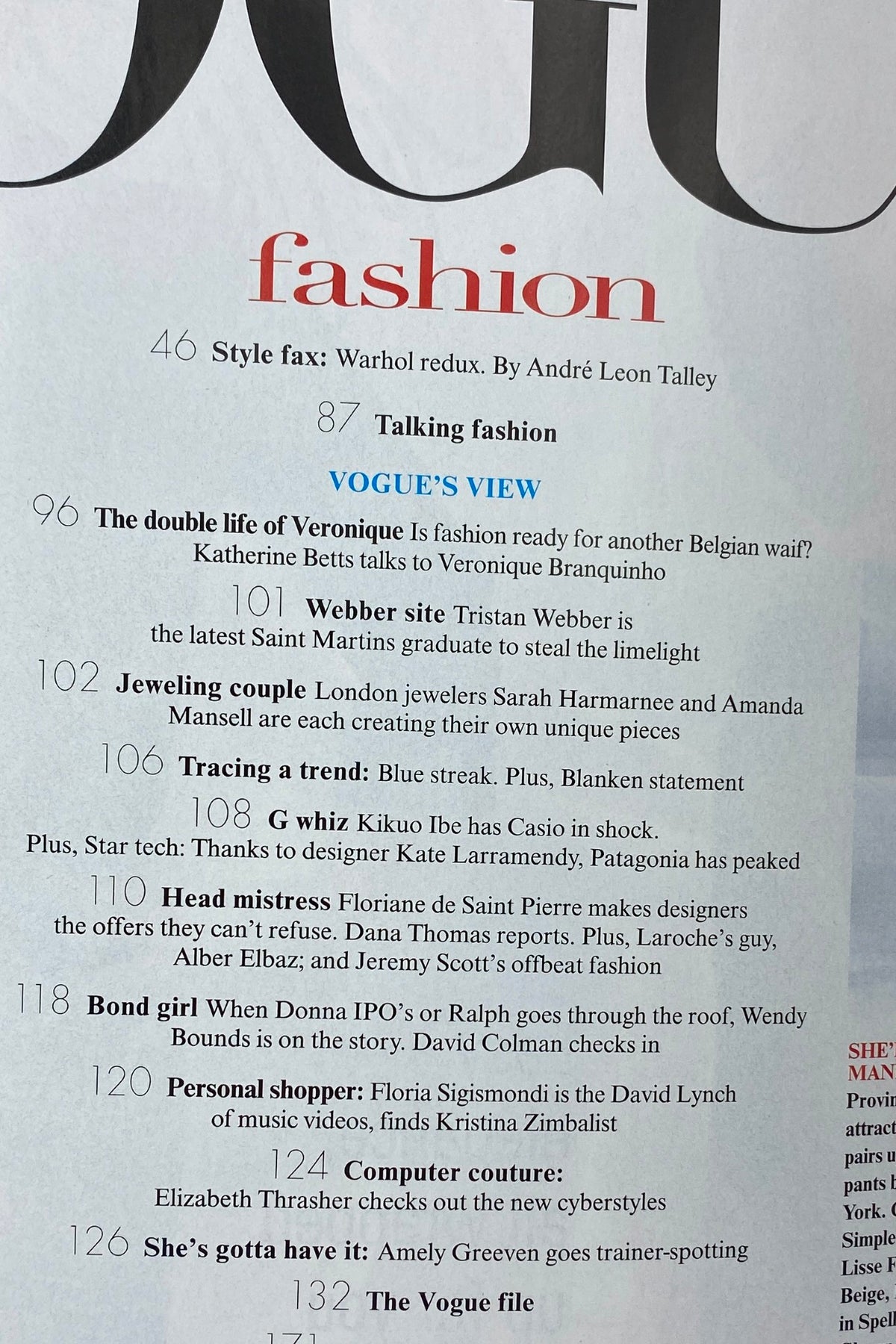
The editorial content of this issue is unusually rich in its documentation of emerging talent and evolving industry structures. Katherine Betts' feature on Véronique Branquinho — asking whether fashion was ready for "another Belgian waif" — is a primary document of the moment when the Antwerp avant-garde's influence on mainstream fashion was at its most actively contested and debated. Branquinho was presenting her debut collection in Paris at precisely this time, and a Vogue feature asking whether the industry was ready for her represents the mainstream fashion establishment in the act of assessing a challenge to its own aesthetic consensus. The accompanying spotlight on Tristan Webber as the latest Central Saint Martins graduate to "steal the limelight" reflects the same moment of generational turnover, as the London school's influence on international fashion was being felt with increasing force. André Leon Talley's "Warhol Redux" piece situates the issue's fashion content within the broader art-fashion dialogue of the late nineties, a decade when the boundaries between those two worlds were being actively renegotiated. For collectors building a cross-title archive of the late-nineties fashion moment, the 1998 magazine collection provides the broader publishing context that makes these specific editorial choices legible within the larger cultural conversation of the year.
Several additional features in this issue reward attention from researchers working on specific subjects. The profile of Floriane de Saint Pierre — the influential Paris-based executive search consultant who was placing designers in major fashion houses — documents a dimension of the industry's infrastructure that fashion journalism rarely addressed directly, making it an unusual primary source on how creative talent was being moved through the fashion system in the late nineties. The Donna and Ralph financial markets piece by Wendy Bounds and David Colman, addressing IPOs and stock performance for fashion brands, reflects the era's intense interest in the financialization of luxury fashion that would accelerate dramatically over the following decade. Alber Elbaz at Laroche and Jeremy Scott as an offbeat presence are both brief mentions that carry considerable retrospective weight: Elbaz would go on to one of the most celebrated tenures in luxury fashion at Lanvin, and Scott's eventual prominence makes his early press appearances objects of genuine collector and researcher interest.
About the Publication
American Vogue, founded in 1892 and acquired by Condé Nast in 1909, is the flagship publication of the global fashion media industry and the standard against which all other fashion magazines have historically measured themselves. Under the editorship of Anna Wintour, who took the helm in 1988, the magazine developed an editorial identity that combined fashion authority with genuine cultural engagement — its covers became carefully negotiated statements of cultural currency, and its Vogue's View section functioned as a forward-looking intelligence digest about where fashion was moving and who was driving it. By February 1998, Wintour's tenure was in its tenth year and the magazine's authority within the fashion industry was fully established and widely acknowledged. Its February issues — positioned at the intersection of the fall 2000 runway season previews and the ongoing spring retail season — carried significant editorial investment in identifying and contextualizing emerging talent alongside the established names that anchored its fashion coverage.
Key Highlights Inside
- Stella Tennant February 1998 cover — documenting one of the decade's most intellectually distinctive models at the height of her influence on nineties fashion's aesthetic values, her anti-glamour aristocratic presence on a Vogue cover reflecting the industry's most sophisticated and self-aware late-decade sensibility.
- "The Double Life of Véronique" (Katherine Betts on Véronique Branquinho) — a primary document of the moment when Antwerp's avant-garde influence on mainstream fashion was being most actively debated, published as Branquinho was presenting her debut Paris collection and the industry was assessing whether it was ready for another Belgian challenge to its aesthetic consensus.
- "Style Fax: Warhol Redux" (André Leon Talley) — situating the issue's fashion content within the art-fashion dialogue that was one of the defining intellectual preoccupations of late-nineties style culture, from one of the era's most influential fashion editorial voices.
- Tristan Webber and Jeremy Scott profiles alongside a mention of Alber Elbaz at Laroche — a cluster of emerging talent documentation that carries considerable retrospective weight, as subsequent careers have made these early press appearances primary sources in the biographical records of figures who went on to significant industry influence.
- Floriane de Saint Pierre profile (Dana Thomas) — an unusual document of the fashion industry's executive search infrastructure, examining the consultant who was placing creative directors in major houses and thereby shaping the industry's creative direction from behind the scenes at a moment of significant generational transition.
- Fashion finance coverage by Wendy Bounds and David Colman on Donna Karan and Ralph Lauren's market performance — reflecting the late-nineties fascination with the financialization of luxury fashion brands that would accelerate dramatically in the following decade and reshape the industry's structure permanently.
Condition & Rarity
Surviving copies of the February 1998 Vogue in very good condition represent a clean and display-quality example of one of the more editorially distinctive issues in the magazine's late-nineties run. Minor edge wear on a copy of this vintage is the expected and honest condition profile of an original, unrestored periodical rather than a reproduction. The absence of a subscriber address label is a meaningful positive in collector evaluation: the Stella Tennant cover image survives fully intact as designed and printed, without the adhesive marks or obscured photography that subscription labels permanently leave behind. For a cover where Tennant's specific visual presence — the cropped hair, the angular features, the deliberate anti-glamour styling — is a primary reason for collecting this issue, the label-free condition preserves that visual integrity in ways that matter both to display-focused collectors and to researchers documenting her career and the aesthetic values she represented. The protective plastic sleeve on well-preserved copies is the standard archival measure for a magazine of this paper stock and production quality, stabilizing further deterioration without requiring any alteration to the original item.
Looking for More Issues Like This?
A no-label copy of the February 1998 Vogue featuring Stella Tennant — with the exceptional editorial depth and emerging-talent documentation detailed in this issue's table of contents — is one of the more rewarding finds in the magazine's late-nineties run, combining a historically significant cover with industry intelligence that rewards serious research attention. If this particular issue is no longer available, the full Vogue magazine collection at OriginalMagazines.com is the most comprehensive single source for exploring other issues across the publication's long run, with strong representation in the nineties decades that fashion historians and cultural researchers are increasingly prioritizing. For collectors building a broader archive of the late-nineties fashion moment, the complete 1998 magazine collection brings together titles from a year that sits at the creative and commercial peak of the decade's most sophisticated aesthetic phase.