


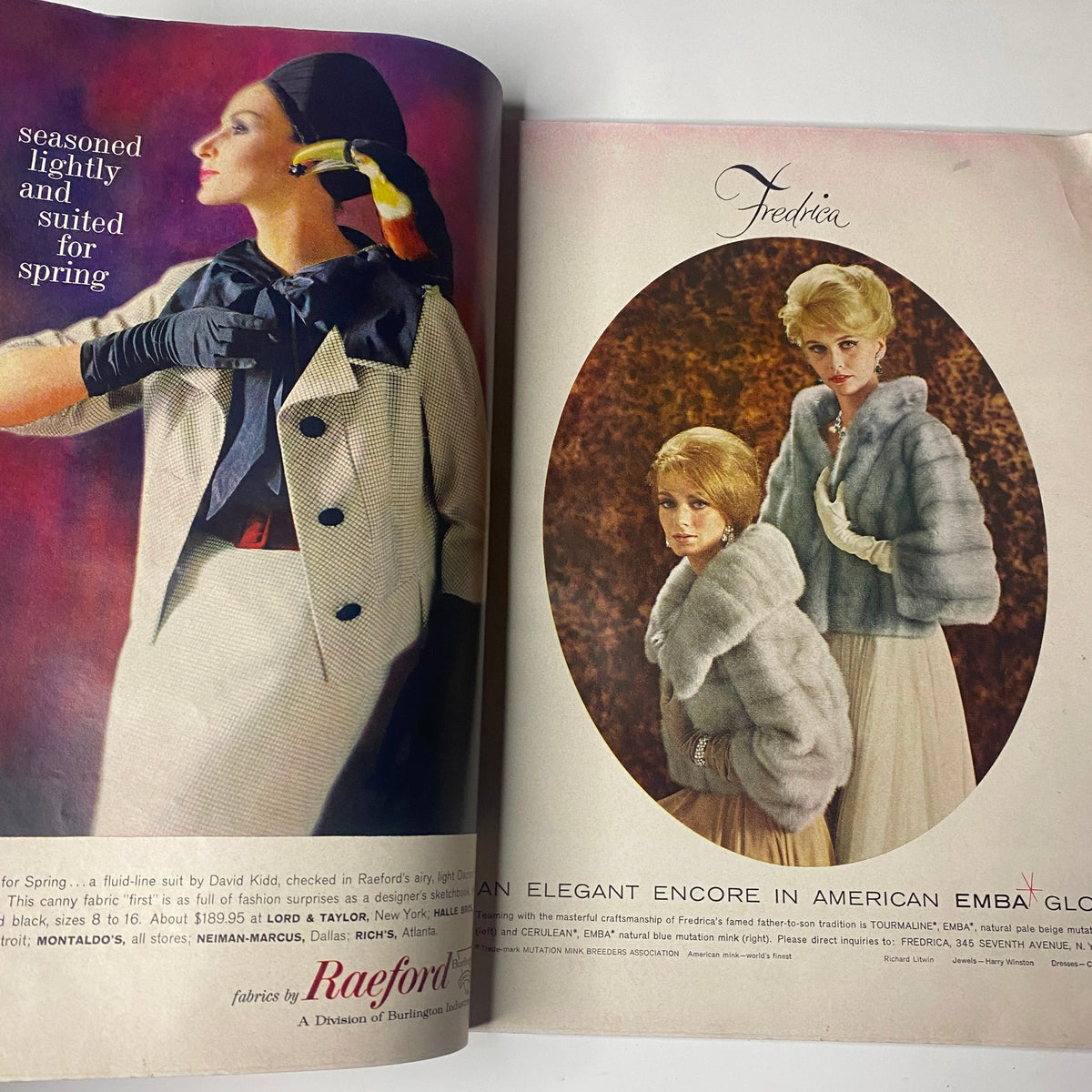


Description
Collector's Note – Why This Issue Matters
January 1, 1961 is one of the most historically precise and symbolically resonant publication dates in Vogue's twentieth-century archive. This is the first issue of the first year of the 1960s in the most literal sense — a New Year's Day publication that was produced with the full awareness of that threshold moment, and whose editorial framing reflects exactly the kind of forward-looking cultural confidence that the opening of the decade inspired. The cover, an Irving Penn photograph of Dorothy McGowan, was produced by one of the twentieth century's most significant photographers at the height of his creative partnership with Vogue — Penn had been shooting for the magazine since 1943 and his covers and editorial work from this period are among the most studied in the history of fashion photography. McGowan, one of the significant model faces of the late-fifties and early-sixties Vogue, appears here in the specific visual register that Penn had made his signature: formal, precisely lit, compositionally austere in ways that gave his subjects a sculptural authority that distinguished his work from every contemporary. For collectors building an archive of Vogue magazine issues from the Kennedy era, this January 1, 1961 edition is the foundational document of the decade — the first issue of the most culturally significant decade in the publication's history, with one of the most important photographers in its archive on the cover.
The documented table of contents preserved in the listing reveals an editorial package of extraordinary historical richness. The "President-elect John Fitzgerald Kennedy" feature on page 80 is the single most historically significant piece of content in the issue — Kennedy would be inaugurated on January 20, 1961, just nineteen days after this issue's publication date, and a Vogue feature on the president-elect in the January 1 issue documents the specific cultural moment of anticipation and optimism that preceded the inauguration with a directness and contemporaneity that only primary source journalism can capture. The framing is significant: Vogue in January 1961 was addressing Kennedy not as a political figure to be analyzed but as a cultural phenomenon to be engaged, reflecting the magazine's consistent understanding of the presidency as a matter of cultural and aesthetic significance as well as political consequence. The Vogue editorial team's judgment that the Kennedy transition warranted space in the January 1 issue — alongside Penn's cover, the fashion spreads, and the cancer and space research reports — is itself a primary document of how the fashion press understood the relationship between political change and cultural aspiration at the opening of the decade. Collectors researching Vogue and cultural magazines from 1961 will find no issue from that year more precisely dated or more editorially consequential than this first one.
The "Ozma Report" mentioned alongside the cancer research on page 136 is a historically specific and fascinating editorial detail. Project Ozma was the first scientific search for extraterrestrial intelligence, conducted by astronomer Frank Drake at the National Radio Astronomy Observatory in Green Bank, West Virginia, beginning in April 1960. A Vogue feature engaging the Ozma project in January 1961 — alongside a cancer research report — is a primary document of the specific early-sixties cultural moment when space, science, and the possibility of contact with other civilizations were being absorbed into the mainstream cultural conversation in ways that the Sputnik shock of 1957 had initiated and the Kennedy space program would soon amplify. That this content appeared in Vogue rather than a science publication is itself historically interesting, reflecting the specific character of the early-sixties moment when the boundaries between fashion journalism, cultural commentary, and scientific engagement were more permeable than they would later become. The plastics report, the freighter travel feature, the language learning article, and Mrs. Murray Vanderbilt's twenty-four-hour Paris flight collectively constitute a comprehensive primary source record of how Vogue was imagining the future of American life on the first day of the decade that would define it.
About the Publication
Vogue was founded in 1892 and has been published by Condé Nast since 1909, operating continuously as the most authoritative fashion magazine in the American market across more than a century of publication. The early-sixties Vogue was operating at one of its most creatively ambitious periods — its photography, fashion coverage, and cultural journalism in this period are now recognized as among the defining examples of mid-century magazine publishing at its most accomplished. The bimonthly format that produced the January 1 date reflected Vogue's peak-season publishing schedule, and the January 1, 1961 issue's combination of Irving Penn cover photography, Kennedy transition coverage, and scientific horizon reporting reflects the full breadth of the editorial ambition that made the early-sixties Vogue one of the most culturally significant publications in American history. This issue comes from a privately held Vogue archive spanning the 1920s through the 1970s, and has undergone light dry surface cleaning before archival sleeving.
Key Highlights Inside
- Dorothy McGowan cover photograph by Irving Penn — a primary document of one of the twentieth century's most significant fashion photographers at the height of his creative partnership with Vogue, representing the specific visual aesthetic — formally lit, compositionally austere, sculptural in its authority — that had made Penn's Vogue covers the defining visual standard of mid-century fashion photography.
- "President-elect John Fitzgerald Kennedy" feature on page 80 — a primary document of Vogue's engagement with the Kennedy transition published nineteen days before the inauguration, representing the fashion press's specific understanding of the presidency as a cultural and aesthetic phenomenon as much as a political one, and constituting a precisely dated primary source of the anticipatory cultural mood of early January 1961.
- Ozma Report and Cancer Research Report on page 136 — a documented engagement with Project Ozma, the first scientific search for extraterrestrial intelligence, alongside contemporary cancer research, appearing in Vogue in January 1961 as a primary document of the specific early-sixties cultural moment when scientific possibility and cultural aspiration were being absorbed into the mainstream fashion press in unusually direct ways.
- Mrs. Murray Vanderbilt's twenty-four-hour Paris flight feature and "1961 New Time Scheme" on page 74, with her portrait by Von Dongen — a primary document of the early jet age's specific transformation of transatlantic social life, painted by the Dutch-French Post-Impressionist Kees van Dongen who was then in his eighties, constituting one of the more historically specific intersections of aviation culture and traditional portraiture in Vogue's early-sixties archive.
- Mme. Hélène Rochas profile as tenth in Vogue's "Series of Fashion Personalities" on page 116, ten pages of Australian beach photography for the U.S. sun-flash feature, and Vogue's colour direction report on page 92 — the fashion editorial architecture of a January 1, 1961 Vogue at its most forward-looking, documented with the attribution and page specificity that makes the full table of contents an unusually complete research resource for fashion historians working on this transitional period.
- "Cruising the Lesser Antilles" by Peggy Talbott Noyes, "A Note on Lemons and Friends" by George Bradshaw, "The Coronet in My Hair" by Patrick Campbell, and fiction by Robert Fontaine — the complete literary and travel journalism range of a New Year's Day Vogue, providing the full cultural and geographical context within which the Kennedy coverage and fashion editorial were positioned for the magazine's readership at the opening of 1961.
Condition & Rarity
This issue comes from a privately held Vogue archive spanning the 1920s through the 1970s, stored away for decades before being brought back into circulation. The binding wear or small splits, staple-rust halos, edge toning, and period shelf dust noted in the collection description are honest and expected characteristics of a sixty-four-year-old bimonthly fashion magazine from archival long-term storage — the physical evidence of six decades of existence that accumulated before the current owner's careful conservation intervention. The light dry surface cleaning performed before archival sleeving — vacuum, brush, and smoke sponge only, no wet methods — represents the conservation standard for vintage paper materials and has stabilized the issue's condition without altering its authentic vintage characteristics. Good condition with interiors described as dry and legible is the most important positive condition attribute for a publication of this age and paper chemistry — it indicates that the Penn cover portrait and the full documented table of contents remain visually accessible and structurally intact despite the external evidence of their age. The plastic protective sleeve provides archival-standard protection going forward. Collectors evaluating surviving examples should prioritize the Penn cover image integrity, the completeness and legibility of the Kennedy feature pages, and the overall structural soundness of the staple binding as primary condition criteria for a New Year's Day issue of this historical significance.
Looking for More Issues Like This?
A documented archive copy of the January 1, 1961 Vogue with an Irving Penn cover, a Kennedy transition feature, the Ozma Report, and a fully preserved table of contents is among the most historically layered entries in the early-sixties Vogue catalog — the New Year's Day date, the Penn photography, the pre-inauguration Kennedy documentation, and the scientific horizon content give this issue a research profile that extends across fashion history, photographic history, political history, and the history of science communication simultaneously. If this issue is no longer available, the full Vogue collection at OriginalMagazines.com is the most comprehensive place to browse surviving issues from across the magazine's history and locate other Irving Penn covers, Kennedy-era editions, or significant issues from Vogue's early-sixties creative peak. The 1961 magazine collection brings together surviving issues from across that year's major publications for collectors working to document the full breadth of American print culture during the first year of the decade that defined modern America.