



Description
Collector's Note – Why This Issue Matters
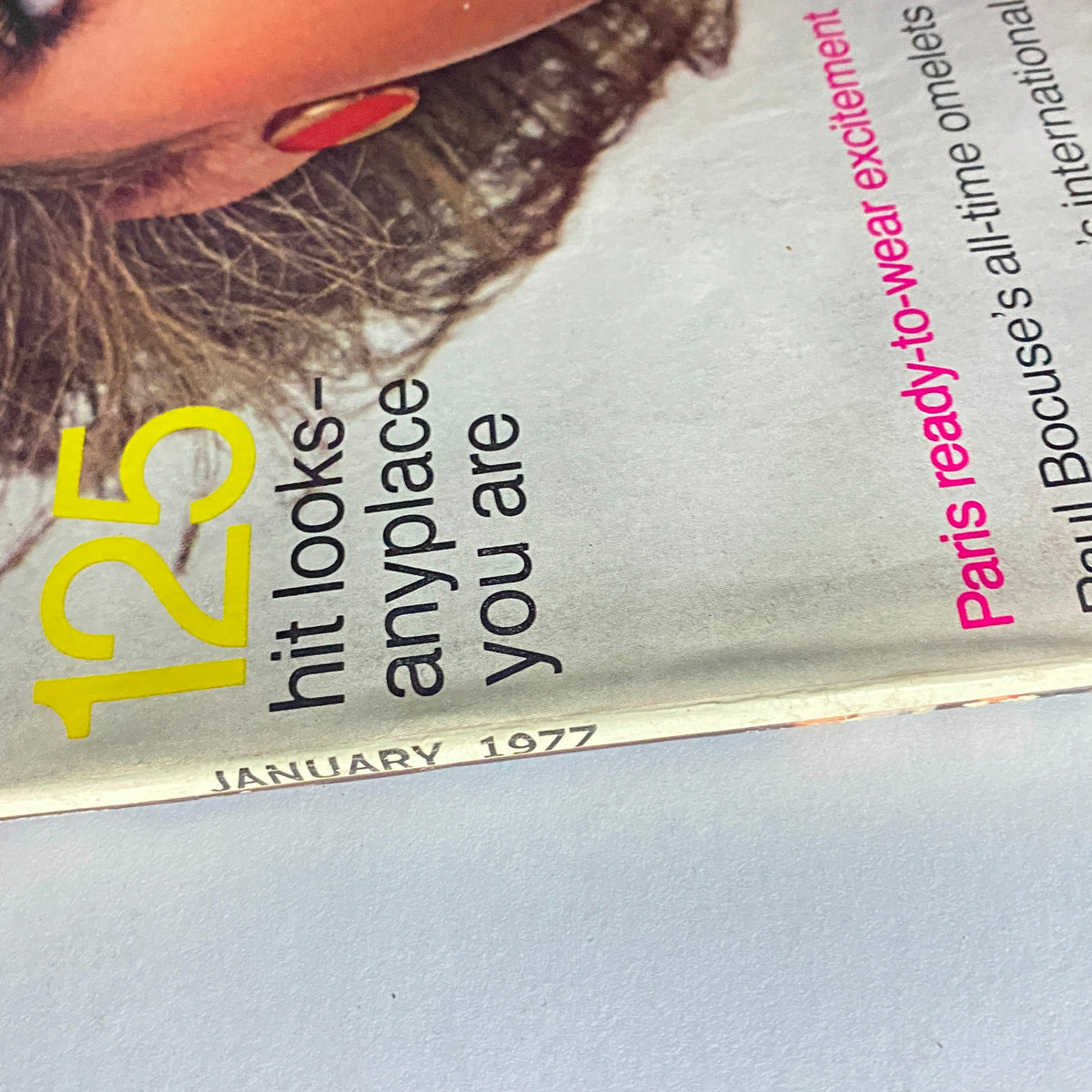
The January 1977 issue of Vogue features model Rosie Vela on its cover, arriving at a moment when Vela was an established presence within mid-1970s fashion editorial work. A January issue carried particular weight within Vogue's annual calendar, traditionally serving as the magazine's first major statement on the year ahead, and this issue leans directly into that role with its "Point of View: What to Look for in Fashion '77" feature, explicitly framing the contents as a forecast for the coming year's style direction. The issue's fashion coverage extends across multiple international fashion capitals, with dedicated reporting on the Paris collections in pieces titled "Paris '77 — The News" and "Paris '77 — Vive La...!", alongside a feature titled "The Italians Are Coming!" spotlighting Italian design's growing prominence on the international stage during this period. This breadth of geographic coverage reflects how thoroughly Vogue positioned itself as a global authority on fashion direction at the start of each new year.
This issue gives particular attention to designer Geoffrey Beene, with both a feature titled "It's a Beene!" and a more substantial profile, "Beene: The 'Quiet Man,'" written by Jerry Bowles. Devoting two separate pieces to a single designer within one issue reflects the level of editorial significance Vogue attached to Beene's work at this point in his career, a designer known for his minimalist, sculptural approach to American fashion throughout the 1970s. The issue's "People Are Talking About..." section further extends its cultural reach well beyond fashion, including a profile of Sylvester Stallone titled "Love & Loving: Sylvester Stallone," written by Blair Sabol, arriving in the immediate aftermath of Stallone's breakthrough with *Rocky*, which had premiered just weeks before this issue's cover date. The same section includes "Indira Gandhi Talks," an interview conducted by Kate Lloyd with the Indian prime minister, reflecting Vogue's continued willingness during this period to extend its profile subjects into major international political figures alongside its entertainment and fashion coverage.
The issue's "At Home" section offers an additional layer of cultural access, featuring a profile of the Rome apartment belonging to Marella and Gianni Agnelli, written in part by Joan Juliet Buck, alongside an omelet recipe feature credited to renowned chef Paul Bocuse. The Agnelli family's prominence within Italian industrial and social life during this period makes a profile of their private living space a particularly notable piece of access, while the Bocuse-credited culinary content reflects Vogue's mid-1970s pattern of pairing fashion coverage with substantial lifestyle and culinary features. Together with the issue's travel coverage, including a feature on Israel by George Hartman, this issue offers a notably wide editorial scope extending well past seasonal fashion reporting alone.
Taken together, this issue offers a richly documented cross-section of early-1977 Vogue, anchored by Rosie Vela's cover presence and extended by substantial designer profile writing, a major political interview, and access to prominent international social figures. It sits within the broader context of 1977 magazines and the long editorial history of Vogue itself, capturing a specific, well-documented moment at the start of a year now remembered for major cultural and political shifts. Few single issues combine a designer profile, a head-of-state interview, and a fresh-off-Rocky celebrity feature within the same set of pages. That breadth of specific, attributable content is precisely what gives this issue lasting reference value for collectors of 1970s fashion and culture media.
About the Publication
Vogue has stood as one of the most influential fashion publications in the world since its founding in the late nineteenth century, evolving into the definitive record of high fashion, photography, and style for an international readership well before this 1977 issue's publication. By the mid-to-late 1970s, the magazine's editorial format combined extensive fashion forecasting, particularly within its January issues, with substantial designer profiles, wide-ranging celebrity and political features, and dedicated travel and lifestyle content. This structure allowed Vogue to position itself as a comprehensive chronicler of contemporary culture rather than a publication focused on fashion alone, reflected clearly in this issue's interview with Indira Gandhi alongside its profile of Sylvester Stallone and its coverage of the Agnelli family's private life. The magazine's January issues in particular carried significant editorial weight, traditionally framing the year ahead through dedicated forecasting features addressing the season's anticipated trends. Vogue's audience during this period spanned dedicated followers of high fashion as well as readers drawn to its broader engagement with politics, international affairs, and prominent social and cultural figures. The magazine maintained a consistent structural rhythm across issues during this period, typically organizing content into clearly defined fashion, beauty and health, features, at-home, and travel sections. That consistent format is part of what allows an issue like this one to be so precisely dated and contextualized within the magazine's broader 1970s output.
Key Highlights Inside
- Cover feature on model Rosie Vela, photographed for a January issue that traditionally served as Vogue's first major fashion forecast of the year. Vela's presence reflects her standing within mid-1970s fashion editorial work. January covers held particular significance within Vogue's annual editorial calendar.
- "Point of View: What to Look for in Fashion '77," an explicit forecasting feature framing the issue's fashion content as a preview of the coming year's style direction. This piece anchors the issue's role as Vogue's first major editorial statement of 1977. It reflects the magazine's established pattern of using January issues for year-ahead trend forecasting.
- "Beene: The 'Quiet Man,'" a substantial profile of designer Geoffrey Beene written by Jerry Bowles, paired with a companion feature titled "It's a Beene!" Devoting two separate pieces to a single designer reflects the significant editorial weight placed on Beene's work at this point in his career. Together, the two pieces offer an unusually thorough look at a single designer within one issue.
- "Love & Loving: Sylvester Stallone," a feature on the actor written by Blair Sabol, arriving in the immediate aftermath of Stallone's breakthrough with the film *Rocky*. This piece captures Stallone at a pivotal, career-defining moment shortly after the film's release. Its inclusion reflects Vogue's willingness to extend its cultural coverage into major entertainment moments beyond fashion.
- "Indira Gandhi Talks," an interview with the Indian prime minister conducted by Kate Lloyd. This piece reflects Vogue's continued engagement with major international political figures during this period. Its inclusion alongside the issue's fashion and entertainment content underscores the breadth of subjects the magazine covered.
- A profile of the Rome apartment belonging to Marella and Gianni Agnelli, written in part by Joan Juliet Buck. This piece offers a notable glimpse into the private life of a prominent Italian industrial and social family. It reflects the issue's broader lifestyle content alongside its core fashion and feature reporting.
- "Fitness Is... Seven Experts Tell How to Get It," a beauty and health feature gathering perspectives from seven different fitness experts. This piece reflects the issue's substantial health and wellness content alongside its fashion and beauty coverage. Its multi-expert format gives the piece a notably broad range of perspectives on the subject.
Condition & Rarity
Condition for fashion magazines of this type and era is generally assessed through cover gloss retention, spine and binding integrity, page completeness, and the absence of significant creasing, tearing, or soiling. An issue described as excellent condition with light wear typical for its age generally indicates a cover that retains strong color saturation and gloss, with binding and interior pages intact and free from significant structural damage. A protective plastic covering plays a meaningful preservation role for glossy fashion magazines of this kind, guarding against humidity, handling wear, and gradual fading of the cover's color and gloss over time. Issues from the mid-to-late 1970s, now approaching five decades old, are old enough that cover gloss degradation, page yellowing, and binding softening become considerably more common, even among carefully stored examples. Binding integrity is an especially important factor for an issue with this much interior editorial content, since a complete and intact set of fashion, designer profile, and feature pages adds considerably to the issue's reference value for collectors. Given the issue's combination of a notable cover model and an unusually substantive set of designer and political features, well-preserved copies are likely to hold particular interest among collectors focused on 1970s fashion and cultural journalism specifically. Collectors evaluating any surviving copy of this issue should weigh overall structural completeness and the legibility of its extensive interior content as the primary indicators of long-term collectible condition.
Looking for More Issues Like This?
An issue combining a January fashion forecast with a substantial Geoffrey Beene designer profile and feature content on figures as varied as Sylvester Stallone and Indira Gandhi represents a particularly well-documented piece of fashion publishing history, making it an interesting target for collectors focused on this specific period. If this exact January 1977 issue isn't what you're looking for, the broader Vogue collection spans decades of the magazine's history, offering a wide range of covers, designer profiles, and editorial eras for collectors interested in the publication's long-running legacy. For those more focused on this specific year, the full range of 1977 magazines brings together material from across that year, spanning multiple publications beyond fashion alone. Browsing the Vogue collection can be especially useful for collectors building a set around specific designers or specific cultural moments, given how distinctly this issue's political and entertainment features read compared to standard seasonal fashion coverage. Browsing by year, on the other hand, suits collectors more interested in capturing a broader cultural snapshot of 1977 across different types of publications. Either approach offers a practical way to continue exploring material connected to this issue's particular combination of cover and content. Both collections represent solid starting points for finding comparable issues from this period in Vogue's editorial history.