


Description
Collector's Note – Why This Issue Matters
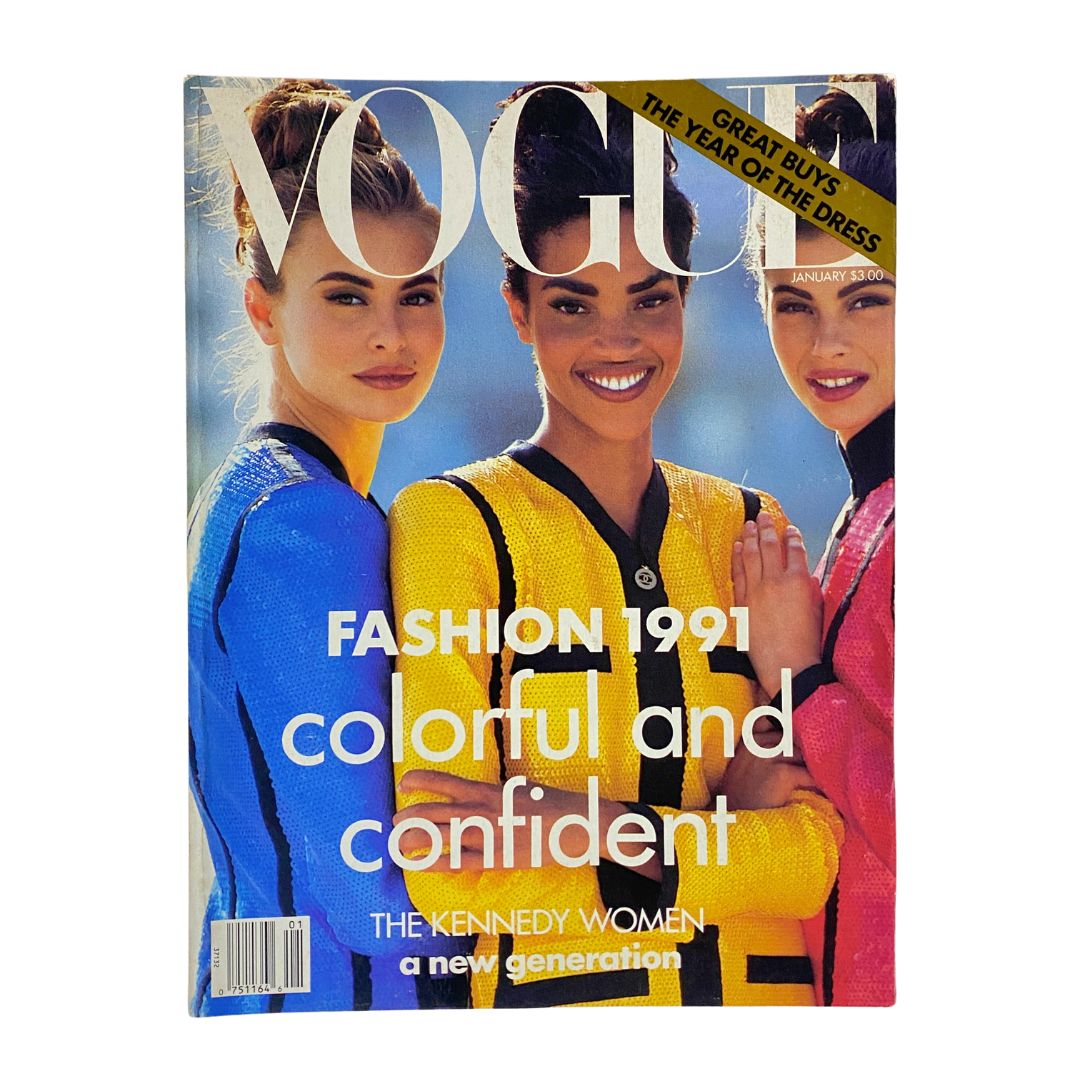
The January 1991 issue of Vogue featuring Niki Taylor, Stephanie Roberts, and Audrey Benoit on the cover is a document of the supermodel era at a specific transitional moment — the opening month of the decade that would carry that era to its commercial and cultural peak before its eventual dissolution. Niki Taylor's presence on this cover is particularly significant in retrospect: she was seventeen years old in January 1991, at the very beginning of a career that would make her one of the most recognized faces of the decade's first half. A multi-model cover at the opening of 1991 reflects Vogue's editorial recognition that the supermodel phenomenon — the simultaneous elevation of a small group of models to celebrity status, driven by advertising campaigns, music videos, and the fashion press — was reshaping what a magazine cover could communicate and who it could make famous. The no-label status of this issue confirms the cover portrait survives intact, which for an issue whose cover is a primary collector interest is the most meaningful condition attribute. Collectors focused on Niki Taylor's career documentation will find the Niki Taylor magazine archive at OriginalMagazines.com an essential resource for her presence across publications and years.
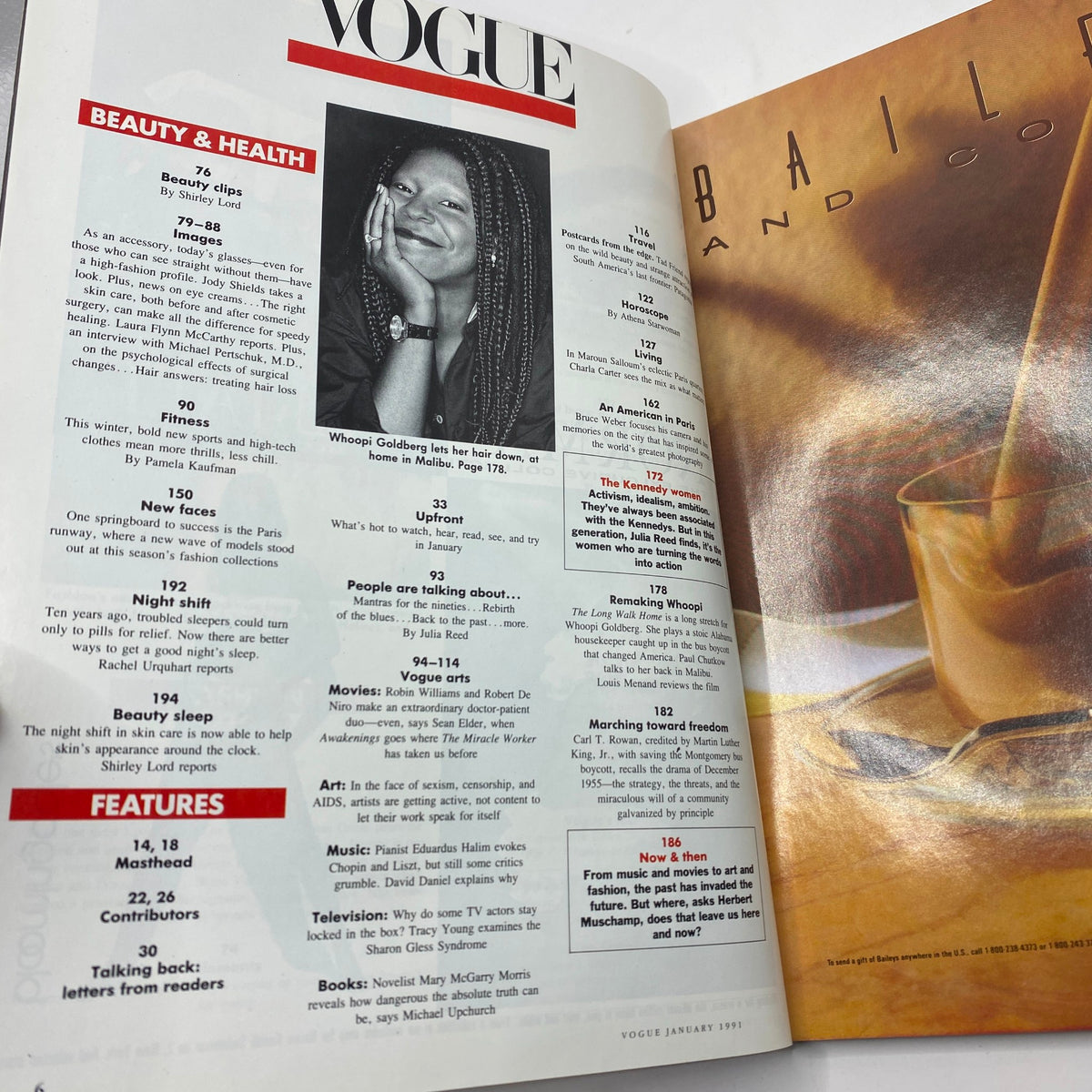
The editorial contents of this issue are unusually rich and historically specific, particularly for a January issue. The confirmed feature on the Kennedy women by Julia Reed — documenting the generation of Kennedy women channeling family idealism into activism — was published just weeks after the November 1990 midterm elections and at a moment when questions about political dynasty, gender, and public service were actively discussed in American culture. The Whoopi Goldberg feature, timed to the release of The Long Walk Home — a film set during the 1955 Montgomery Bus Boycott — is paired with a genuinely extraordinary companion piece: a first-person account of the Montgomery Bus Boycott by Carl T. Rowan, credited by Martin Luther King Jr. with saving the boycott itself. That Vogue's January 1991 issue contains both a celebrity profile and a primary historical testimony about the civil rights movement's founding moment, in the same issue, reflects the magazine's consistent late-Wintour-era practice of treating its readership as capable of sustained engagement with serious historical and political content alongside fashion. Collectors and researchers building a picture of early-1990s American culture will find the Vogue archive at OriginalMagazines.com essential for tracing the magazine's editorial engagement across this period, and the 1991 magazines collection offers broad context across publications from this specific year.
The Bruce Weber photography feature on Paris — "An American in Paris" — and the Herbert Muschamp "Now & Then" essay examining the past's invasion of contemporary culture both reflect the magazine's cultural ambitions at the opening of the 1990s. Weber was one of the most significant fashion photographers working in the early 1990s, and his engagement with Paris as a subject carries the weight of his position within the visual culture of the period. Muschamp's essay on the relationship between past and present in music, movies, art, and fashion is itself a period document — the nostalgia and retro revival that would define much of 1990s popular culture was just becoming visible as a phenomenon, and Vogue publishing a serious cultural essay about it in January 1991 captures that emerging conversation at its earliest mainstream articulation.
About the Publication
Vogue was founded in 1892 and acquired by Condé Nast in 1909, developing over the following century into the world's preeminent fashion magazine. By January 1991, under editor Anna Wintour — who had led the American edition since 1988 — the magazine had established the editorial identity that would define it through the decade: aggressive fashion coverage anchored by model and celebrity cover subjects, sophisticated cultural commentary from significant writers and critics, and the authority on fashion and culture that no competitor could match. Its monthly format produced issues of substantial editorial investment, with the January issue functioning as the magazine's annual reset and forward declaration for the coming year.
Key Highlights Inside
- Niki Taylor, Stephanie Roberts, and Audrey Benoit cover — a three-model January 1991 cover documenting the supermodel era at the opening of the decade that would carry it to its peak, with Taylor at seventeen beginning a career that would make her one of the decade's most recognized faces.
- Carl T. Rowan on the Montgomery Bus Boycott — a confirmed first-person historical account by the journalist credited by Martin Luther King Jr. with saving the 1955 boycott, appearing alongside the Whoopi Goldberg profile for The Long Walk Home as a primary historical document within a mainstream fashion magazine.
- The Kennedy Women by Julia Reed — a confirmed feature on the generation of Kennedy women channeling family idealism into activism, published at the opening of a decade in which political dynasty, gender, and public service would remain active cultural conversations.
- Bruce Weber's Paris photography feature — a confirmed visual essay by one of the most significant fashion photographers of the early 1990s, reflecting Vogue's sustained investment in high-quality photography as editorial content rather than purely commercial imagery.
- Herbert Muschamp on the past's invasion of contemporary culture — a confirmed cultural essay examining retro revival and nostalgia in music, movies, art, and fashion, published at the moment this phenomenon was emerging as a defining characteristic of early-1990s American culture.
- Whoopi Goldberg profile by Paul Chutkow for The Long Walk Home — confirmed celebrity feature documenting Goldberg at a specific moment in her career as she moved into more dramatically serious roles in the early 1990s.
Condition & Rarity
The noted condition describes a no-label copy with a plastic protective sleeve. The absence of a mailing label is the most significant positive condition attribute: subscriber copies of Vogue from this era routinely received address labels applied directly to the front cover, and their removal creates adhesive residue or surface paper damage that permanently affects the cover photography. A no-label copy preserves the Taylor-Roberts-Benoit cover portrait in its original printed state, the preferred configuration for collectors of early-1990s Vogue. Specific overall condition grade beyond the no-label designation is not detailed in the listing, and prospective collectors should assess the listing photographs for standard additional variables: cover scuffing or surface wear, spine condition, page tanning, and structural integrity. The plastic sleeve confirms deliberate protective storage. For a monthly fashion magazine now more than thirty years old, a no-label copy in displayable condition represents the collector-preferred configuration for an issue whose multi-model cover and unusually rich cultural contents both reward close attention.
Looking for More Issues Like This?
Early-1990s Vogue issues featuring Niki Taylor in no-label condition are actively sought by collectors of the supermodel era, and the January 1991 issue's combination of a significant cover lineup with the Carl T. Rowan civil rights testimony and Kennedy women feature makes it editorially richer than most issues of its year. If this issue has already been claimed, the Niki Taylor magazine collection at OriginalMagazines.com is the best starting point for other issues documenting her career across publications. The full Vogue archive is worth exploring for other early Wintour-era issues from the decade's opening years, and collectors drawn to the specific cultural energy of 1991 will find the 1991 magazines collection rich with period material.