




Description
Collector's Note – Why This Issue Matters
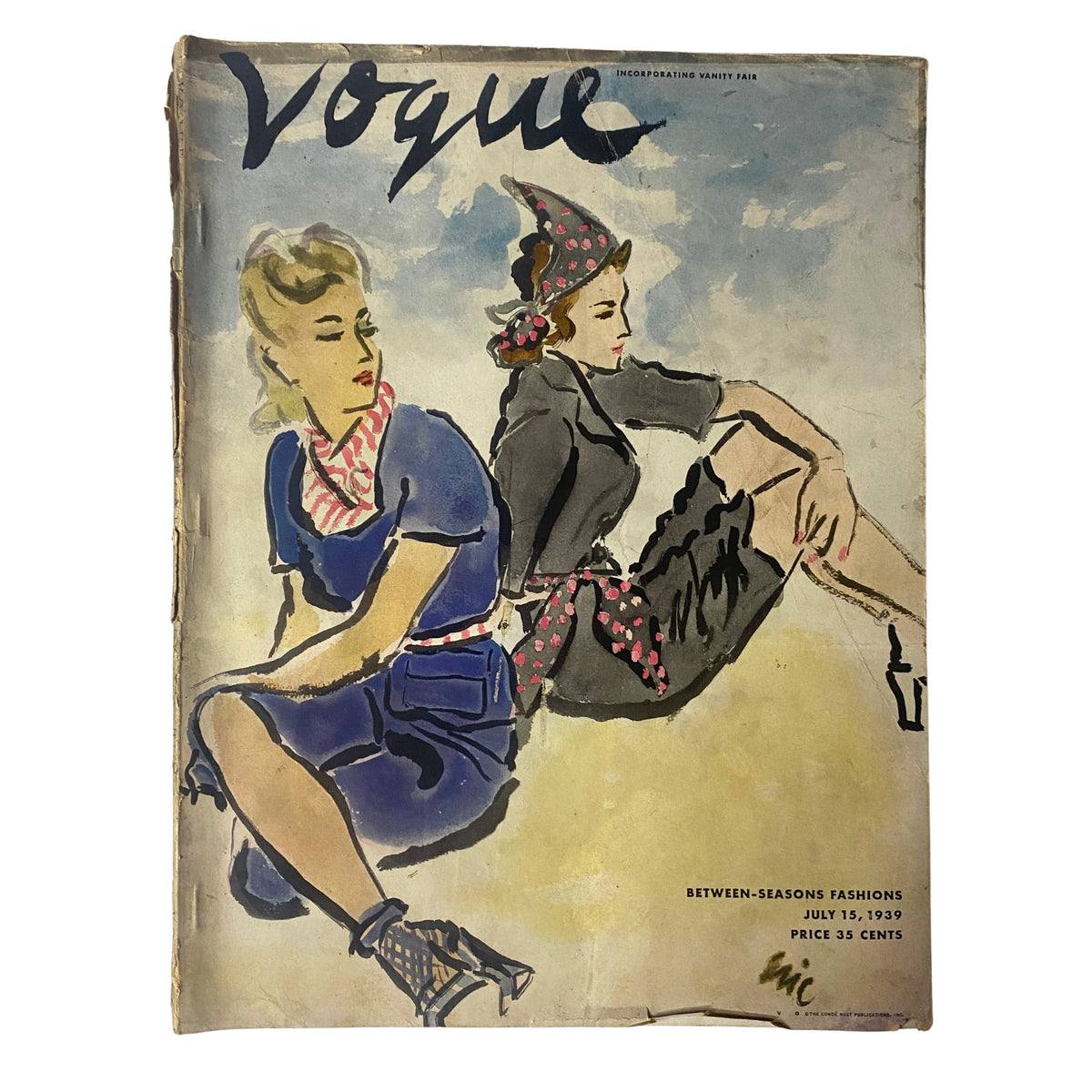
The July 15, 1939 issue of Vogue arrived on newsstands at one of the most charged moments of the twentieth century. Europe was weeks away from catastrophe, yet the pages of this issue breathe with the full confidence of a civilization that had not yet absorbed what was coming. That tension — between the poise of late prewar couture and the gathering darkness of 1939 — is precisely what makes issues from this narrow window so historically resonant. Fashion does not pause for history, but history gives fashion its meaning, and this issue captures both in one elegant artifact. The cover illustration, rendered by Carl "Eric" Erickson in his characteristically fluid, gestural style, embodies the visual language Vogue had refined through the 1930s: sophisticated, effortless, deeply cosmopolitan. Erickson was among the most admired commercial illustrators of his era, and his Vogue covers from this period are now considered landmark works of mid-century graphic art. Collectors seeking his work alongside the broader visual culture of the period will find the Vogue magazine archive at OriginalMagazines.com an essential reference point.
Inside, the issue moves between the worlds of high fashion, fine art, theater, and leisure with the ease that defined Vogue's editorial voice under its long-standing creative leadership. The feature on Elsa Schiaparelli — here under the affectionate heading "Gogo Schiaparelli" — documents one of fashion's most intellectually audacious figures at the height of her influence. Schiaparelli's collaborations with Surrealist artists and her theatrical approach to dress had made her a genuine cultural force, and any primary-source coverage of her work from the late 1930s carries real documentary weight. Equally notable is the spread on Helen Hayes and Charles MacArthur, occupying four full pages. Hayes was among the most acclaimed stage actresses of her generation — the "First Lady of the American Theatre" — and MacArthur was a celebrated playwright and screenwriter. Their appearance in Vogue speaks to the magazine's sustained interest in blurring the lines between couture culture and the broader performing arts world. For those building a collection around 1939 magazine issues, this date sits at an irreplaceable crossroads of art, fashion, and impending world history.
The table of contents confirms a rich mix of editorial content: Paris fashion reportage on summer black, tweeds, and hip-emphasizing silhouettes; travel features on Bermuda, Nassau, and the village of Cagnes in the south of France; music coverage from the Berkshires; and a feature on the Old Masters exhibition at the 1939 World's Fair in New York — itself a remarkable cultural event. Taken together, these pages document the aspirational, globalist vision that Vogue held for its readers even as that world was being dismantled in real time.
About the Publication
Vogue was founded in 1892 as a New York society weekly and transformed into a high-fashion authority after Condé Nast acquired it in 1909. By the late 1930s, the magazine had fully established its editorial identity: bi-monthly issues combining couture fashion reportage, society portraiture, travel writing, cultural criticism, and fine illustration. Its readership was affluent, cosmopolitan, and culturally literate — women who regarded fashion as part of a broader engagement with art and ideas. The magazine's commitment to commissioning original cover illustrations from artists of genuine stature, rather than relying on photography alone, gave issues from this era a visual distinction that sets them apart from later decades. The July 15, 1939 issue was published in the standard between-seasons format, addressing the practical and aesthetic challenges of transitional dressing while maintaining the magazine's characteristic editorial ambition.
Key Highlights Inside
- Cover illustration by Carl "Eric" Erickson — one of Vogue's most celebrated contributing artists, whose fluid line work defined the visual identity of the magazine through much of the 1930s and 1940s.
- "Gogo Schiaparelli" feature (pages 34–35) — primary-source coverage of Elsa Schiaparelli, one of the defining designers of the interwar period, documented in Vogue at the peak of her creative influence.
- Helen Hayes and Charles MacArthur profile (pages 44–47) — a four-page feature on two of the era's most prominent figures in American theater and film, reflecting Vogue's consistent engagement with performing arts culture.
- Paris fashion reportage — multiple features including "Summer black from Paris" (pages 26–27) and "Paris high-lights hips" (pages 40–41), offering contemporaneous documentation of late prewar Parisian couture direction.
- "Old Masters at the World's Fair" (pages 16–20) — coverage of the landmark loan exhibition of European masterworks shown at the 1939 New York World's Fair, one of the most significant public art events of the decade.
- Travel and society features — dispatches from Bermuda, Nassau, and Cagnes, France, alongside Berkshire music coverage, illustrating Vogue's sustained vision of cosmopolitan leisure culture in the final summer before the war.
Condition & Rarity
Surviving copies of Vogue from the late 1930s present specific challenges that collectors should understand when evaluating any example. The coated stock used for covers was prone to surface oxidation and edge toning over decades of storage, and the staple-bound spine — standard for the period — typically shows binding wear or minor splits in older issues. Honest vintage traits such as staple-rust halos, light shelf toning at the page edges, and a residual paper aroma are normal and expected in issues of this age; their presence does not diminish documentary or display value. What matters most for collector evaluation is interior legibility, structural integrity of the pages, and the condition of the cover illustration itself, since Erickson's covers are a primary reason this generation of Vogue is sought. Issues sourced from private, long-term archives rather than public lending collections tend to retain better interior condition, as they were never subjected to institutional handling. Any copy that has been dry-cleaned at the spine, sleeved in archival material, and stored upright represents responsible stewardship of a nearly ninety-year-old periodical.
Looking for More Issues Like This?
A July 1939 Vogue with an Erickson cover is a genuinely difficult find — issues from this precise prewar window don't surface often, and when they do, they move quickly among serious collectors. If this particular issue is no longer available, the full Vogue collection at OriginalMagazines.com is the best place to browse other issues from this era, including additional 1930s and 1940s numbers with original cover illustration art. For collectors building by year rather than by title, the complete 1939 magazine archive covers the full range of publications from this extraordinary twelve-month period — one of the most historically significant years of the twentieth century.