
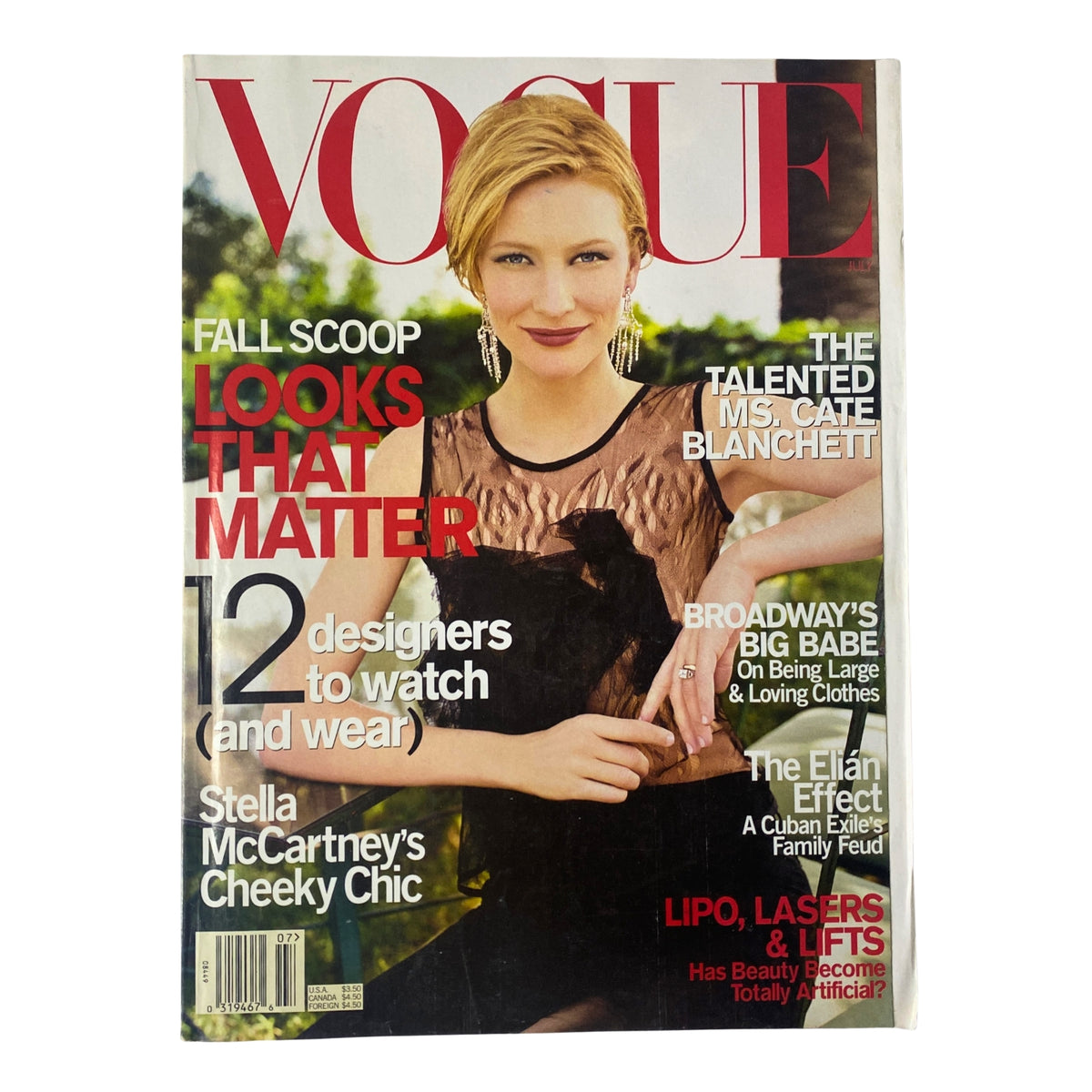


Description
Collector's Note – Why This Issue Matters
The July 2000 issue of Vogue places Cate Blanchett on its cover at a precise and interesting moment — two years after her breakthrough in Elizabeth (1998) had announced her as one of the most compelling screen presences of her generation, and well before the full arc of her career had made that assessment seem obvious. Blanchett had already demonstrated a range and a seriousness that set her apart from the conventional Hollywood starlet, and Vicki Woods's interior profile, "Cate Modern," engages directly with that quality — her deliberate distance from the machinery of celebrity, her commitment to craft over image management. A Vogue cover profile that treats its subject as an artist rather than a product is rarer than the magazine's reputation might suggest, and this one rewards reading as a document of how the industry was beginning to understand what Blanchett represented.
The fashion context is equally rich. July 2000 sits precisely at the millennium's cultural hinge point — the Y2K anxiety had dissolved, the dot-com boom was at its apex before its imminent collapse, and fashion was in the middle of its own transition, processing the maximalism of the late 1990s and reaching toward something less defined. This issue captures that restlessness directly. Amy Larocca's feature on Net-a-Porter.com — then a genuinely novel experiment in online luxury retail — is a remarkable primary document, written at the moment the entire architecture of fashion commerce was beginning to shift in ways that would take another decade to fully register. For collectors focused on vintage Vogue issues that sit at genuine cultural inflection points, this issue delivers that quality across multiple editorial threads simultaneously.
Jonathan Van Meter's profile of Stella McCartney, then establishing her own identity beyond the long shadow of her father's fame, adds another layer of cultural specificity. McCartney had taken over at Chloé in 1997 and was becoming a genuine fashion force in her own right by 2000. The combination of Blanchett, McCartney, and the Net-a-Porter feature in a single issue makes this a particularly dense artifact of the millennial cultural moment. Among surviving magazines from 2000, issues that document both celebrity culture and structural shifts in the fashion industry with this degree of specificity are the ones that hold collector relevance longest.
About the Publication
Vogue, published by Condé Nast and operating under the editorial direction of Anna Wintour since 1988, was by July 2000 the uncontested center of gravity in American fashion media. Its July issue traditionally bridged the spring season's retrospective and the fall collections' anticipation, and its editorial mix in this period combined celebrity cover profiles, long-form cultural journalism, designer features, and beauty coverage aimed at a fashion-literate, culturally engaged readership. Wintour's Vogue had sharpened the magazine's celebrity focus without abandoning its fashion authority, and the result — particularly in issues from the late 1990s and early 2000s — was a publication that could credibly claim both cultural and commercial centrality in a way few magazines managed.
Key Highlights Inside
- Cate Modern — Vicki Woods's in-depth profile of Cate Blanchett examines her talent, her approach to fame, and her deliberate refusal of Hollywood's more synthetic demands — one of the more substantive celebrity profiles Vogue published in this period.
- Virtually Fabulous — Amy Larocca's feature on Net-a-Porter.com documents the very earliest days of online luxury fashion retail, written before its dominance was inevitable — an extraordinary primary source for anyone researching the history of fashion e-commerce.
- Stella McCartney's Cheeky Chic — Jonathan Van Meter profiles McCartney at the moment she was definitively establishing her own creative identity, capturing a designer in transition from famous surname to independent force.
- The Moving Image — Kennedy Fraser revisits a significant bridal moment from Diana Vreeland's era at Vogue, connecting the issue to the magazine's own history and the Vreeland legacy.
- Style Fax — André Leon Talley's seasonal dispatch, a fixture of the magazine's fashion coverage during this period.
- Up Front — Achy Obejas reflects on her Cuban-American family's experience during the Elian Gonzalez saga, a reminder that Vogue under Wintour consistently carried culturally and politically engaged personal essays alongside its fashion content.
Condition & Rarity
The absence of an address label on the front cover is a genuine positive for a Vogue issue of this vintage. While the magazine maintained substantial newsstand distribution in 2000 alongside its subscription base, clean label-free copies are meaningfully preferred by collectors focused on display condition and cover integrity. Very good condition with minor edge wear is an accurate grade for a twenty-five-year-old glossy periodical — Vogue used heavy coated stock in this era that ages well but remains susceptible to edge softening and corner rounding with handling. A protective plastic sleeve indicates deliberate preservation. When evaluating any surviving copy of this issue, the priority attributes are the color saturation and surface condition of the Blanchett cover image, the flatness of the spine, and the absence of moisture warping or interior page adhesion in the glossy advertising sections.
Looking for More Issues Like This?
Cate Blanchett's Vogue covers are collected seriously, and this particular issue — dense with culturally significant content beyond the cover itself — is among the more rewarding finds from the millennial era of the magazine. If it has already moved on, the Vogue collection at OriginalMagazines.com regularly surfaces strong Wintour-era covers worth close attention. The broader 2000 magazine collection is also worth exploring — it was a culturally loaded year across multiple titles, and there is more from that transitional moment than most collectors expect to find.