







Description
Collector's Note – Why This Issue Matters
By June 1942, the United States had been at war for six months, and the effect on American civilian life was already profound. Rationing was tightening. Fabric restrictions under War Production Board regulations were beginning to reshape what fashion could and couldn't do. And yet Vogue kept publishing — twice monthly, without apology — insisting, as it always had, that elegance and intelligence were not luxuries to be suspended in hard times but necessities to be defended. This particular issue, dated June 15, 1942, is one of the clearest surviving documents of how the American fashion press navigated that exact tension.
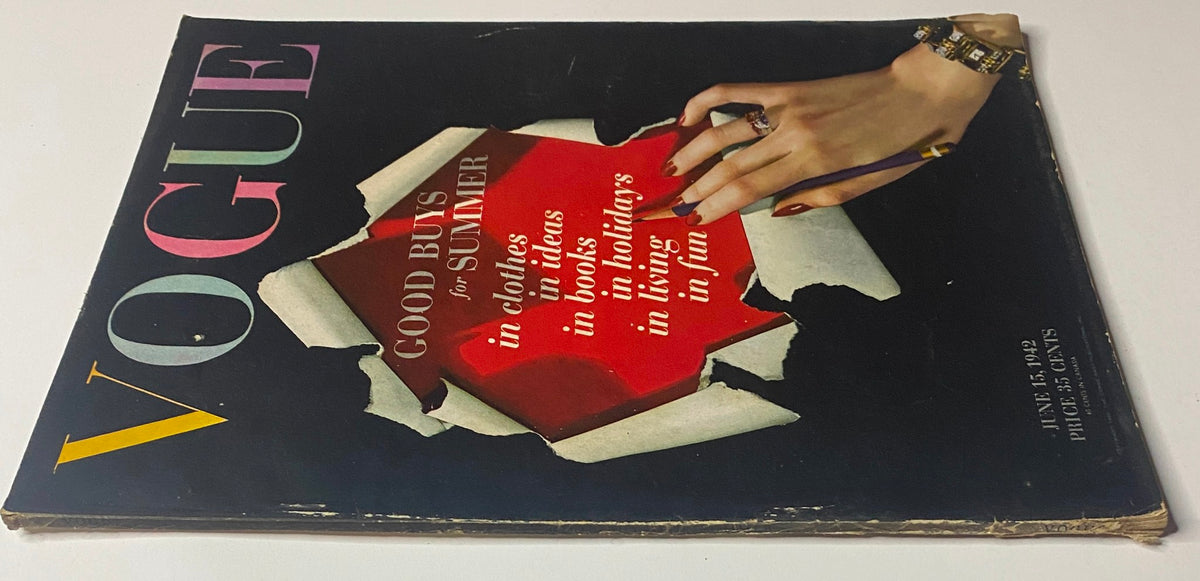
The cover photograph is the work of Horst P. Horst, which alone marks it as something serious collectors take note of. Horst was already, by 1942, one of the defining photographers of the twentieth century — his work for Vogue across the 1930s and 1940s established a visual language of controlled glamour that has never fully gone out of currency. A cover bearing his credit from this wartime period is a specific and meaningful artifact, not simply a vintage magazine. For anyone building a Vogue magazine archive focused on the publication's visual and editorial history, the Horst covers of the early 1940s occupy a distinct and well-documented place.
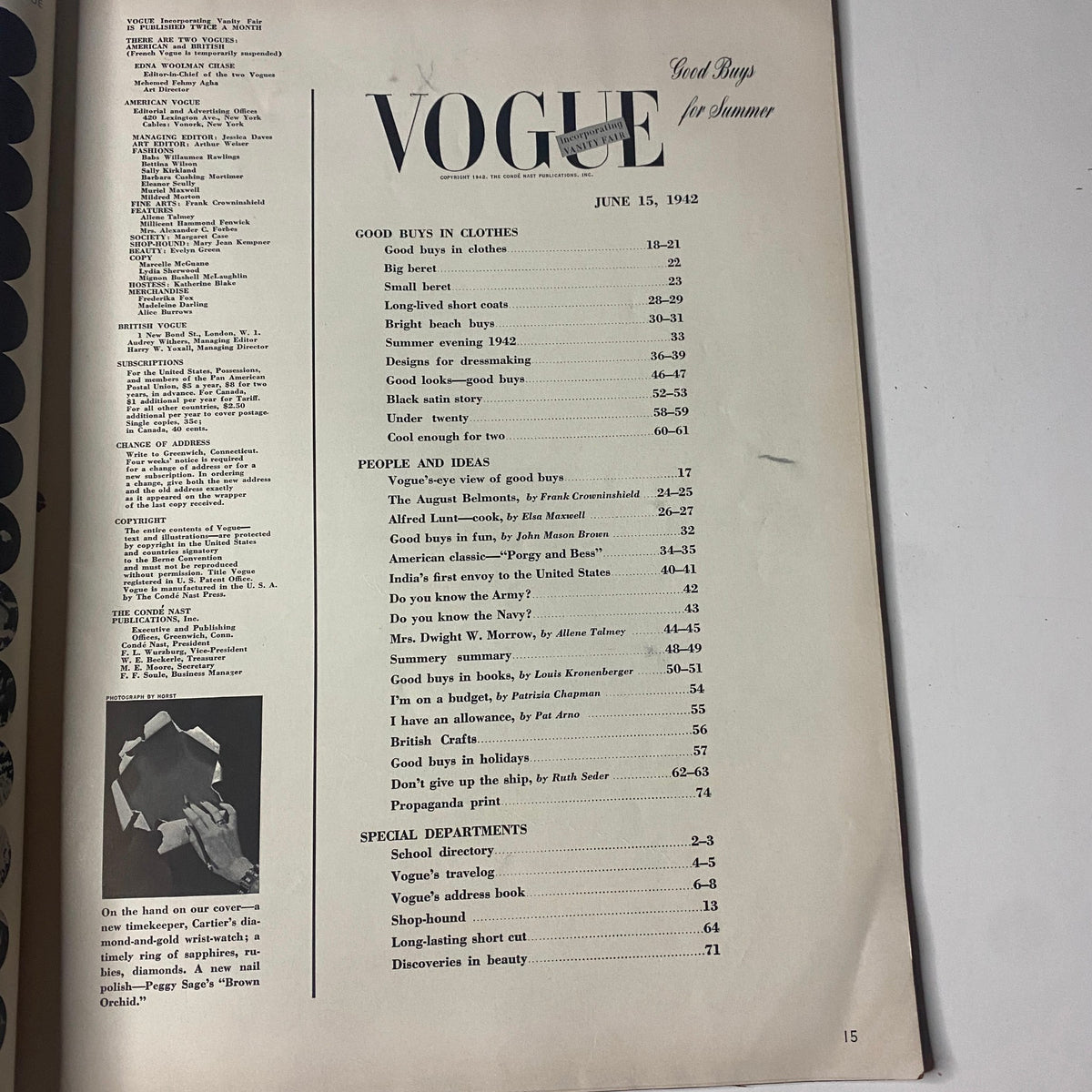
The editorial content inside deepens the historical value considerably. Contributions from Frank Crowninshield — the legendary founding editor of Vanity Fair — and from Elsa Maxwell, the era's most famous professional hostess and social columnist, appear alongside pieces on "Porgy and Bess" as an American classic, a profile of India's first envoy to the United States, and wartime civic features on the Army and Navy. That combination of high fashion, cultural commentary, and frank wartime pragmatism is precisely what makes 1942 magazines so consistently rewarding for researchers and collectors working in twentieth-century American history. This issue captures a specific, unrepeatable cultural moment with unusual completeness.
About the Publication
Vogue, founded in 1892 and acquired by Condé Nast in 1909, was by the 1940s the authoritative voice of American fashion and one of the most influential periodicals in the world. Publishing twice monthly, it addressed an educated, affluent female readership with a distinctive blend of fashion photography, social portraiture, cultural criticism, and lifestyle editorial. During the Second World War, the magazine faced the same material constraints as its readers — paper shortages, advertising shifts, and the fundamental challenge of maintaining aspirational content in an era of national sacrifice — and its response to those pressures produced some of the most interesting editorial work in its long history. The wartime issues are among the most studied in the Vogue archive.
Key Highlights Inside
- Cover photography by Horst P. Horst: The "Good Buys for Summer" cover is the work of one of the twentieth century's most celebrated fashion photographers, whose Vogue commissions from this era are widely reproduced in photographic histories and retrospective exhibitions.
- "The August Belmonts" by Frank Crowninshield (pp. 24–25): A contribution from the founder and longtime editor of Vanity Fair, whose byline in any 1940s publication carries significant cultural weight.
- "Alfred Lunt — Cook" by Elsa Maxwell (pp. 26–27): A piece by Maxwell — the era's most famous social chronicler — on the celebrated Broadway actor Alfred Lunt, blending celebrity profile with the domestic turn that wartime imposed on public life.
- "American Classic — 'Porgy and Bess'" (pp. 34–35): Coverage of Gershwin's opera at a moment when its status as an American cultural landmark was still being actively argued and established.
- "India's First Envoy to the United States" (pp. 40–41): A timely piece reflecting the shifting geopolitics of 1942, when India's relationship with Britain and the Allied cause was a subject of genuine international debate.
- Wartime fashion across multiple spreads (pp. 18–61): The issue's extensive fashion coverage — beach buys, short coats, summer evening wear, dressmaking designs — documents in precise visual detail how American fashion responded to wartime utility requirements without abandoning style.
- "Good Buys in Books" by Louis Kronenberger (pp. 50–51): Literary criticism from one of the era's respected cultural journalists, rounding out an issue that treated its readers as engaged participants in wartime intellectual life, not merely fashion consumers.
Condition & Rarity
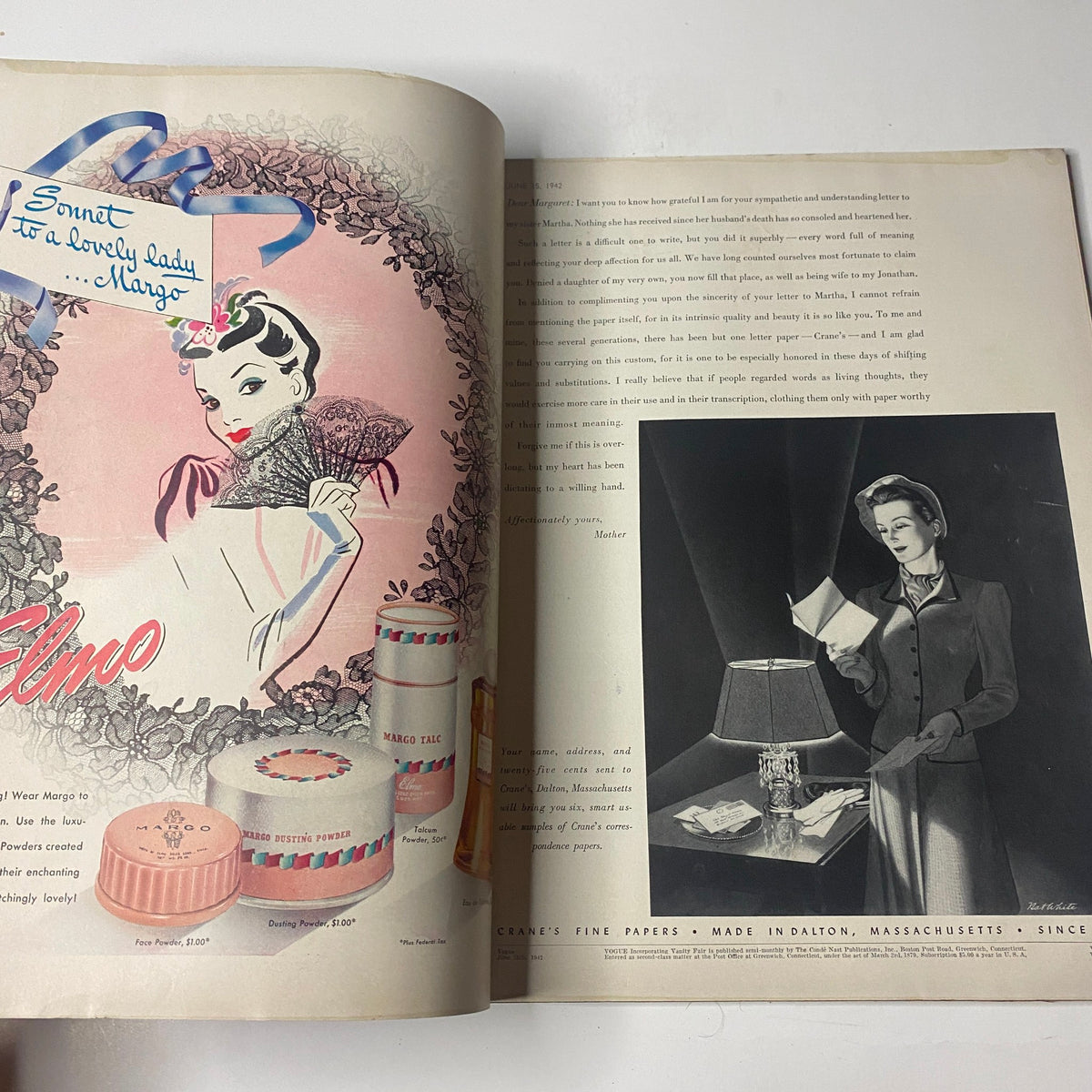
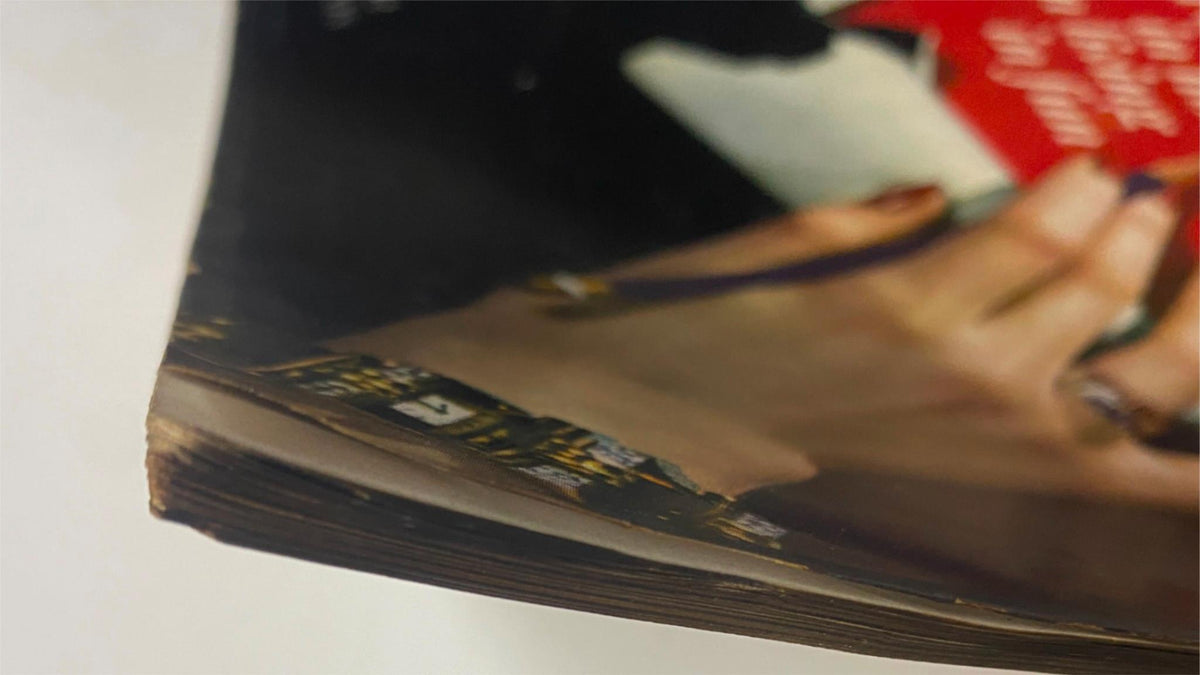
This issue originates from a privately held Vogue archive spanning the 1920s through 1970s — a provenance that matters in evaluating condition. Decades of static, private storage produce a predictable and well-understood set of characteristics: binding wear, possible small spine splits, staple-rust halos at the staple points, and edge toning consistent with mid-century coated paper stock. These are honest vintage traits, not defects — they are what archivists expect and what serious collectors have learned to read accurately. Light surface cleaning using dry methods only (vacuum, brush, and smoke sponge) preserves the integrity of the paper and ink without introducing moisture damage, which is the correct conservation approach for periodicals of this age and paper type. Interiors described as dry and legible represent the most important condition variable for research and display purposes. A light vintage paper aroma, when present, is characteristic of mid-century magazine stock and carries no negative preservation implication. Archival sleeve housing, applied after cleaning, is the appropriate long-term storage standard for issues of this significance.
Looking for More Issues Like This?
A wartime Vogue with a Horst cover and this depth of editorial content is a genuinely uncommon find, and if this issue has already been claimed, the broader collections are well worth exploring. The Vogue archive at OriginalMagazines.com covers many decades of the magazine's run, including other issues from the wartime years. For collectors working specifically through this period of American history, the full 1942 magazine collection brings together surviving issues from across major publications — an invaluable resource for anyone documenting what the home front actually looked like, week by week, in the year the war came home.