




Description
Collector's Note – Why This Issue Matters
The June 1998 issue of Vogue, featuring Sandra Bullock on the cover, documents one of Hollywood's most commercially successful and genuinely beloved actresses at a specific and career-defining moment in the late 1990s. By June 1998, Bullock had firmly established herself as one of the most bankable stars in American cinema following the extraordinary success of Speed (1994) and While You Were Sleeping (1995), and was navigating the specific challenge that faces every actor who breaks through via a massive commercial hit: how to define a sustained career identity that isn't simply repetition of the formula that worked. Her Vogue cover in June 1998 was part of that identity-construction — using the authoritative cultural platform of the most prestigious American fashion magazine to signal that her public persona encompassed something broader than action movie heroism or romantic comedy charm. Vogue cover selections in this period were among the most carefully considered in American publishing, and a Bullock cover in June 1998 reflected both her genuine mainstream celebrity standing and the magazine's assessment that she embodied a kind of approachable yet aspirational femininity that resonated with the readership. For collectors building archives around Sandra Bullock's magazine cover history, the June 1998 Vogue is a primary document of her career's late-1990s consolidation as a genuine cultural institution rather than a passing phenomenon.
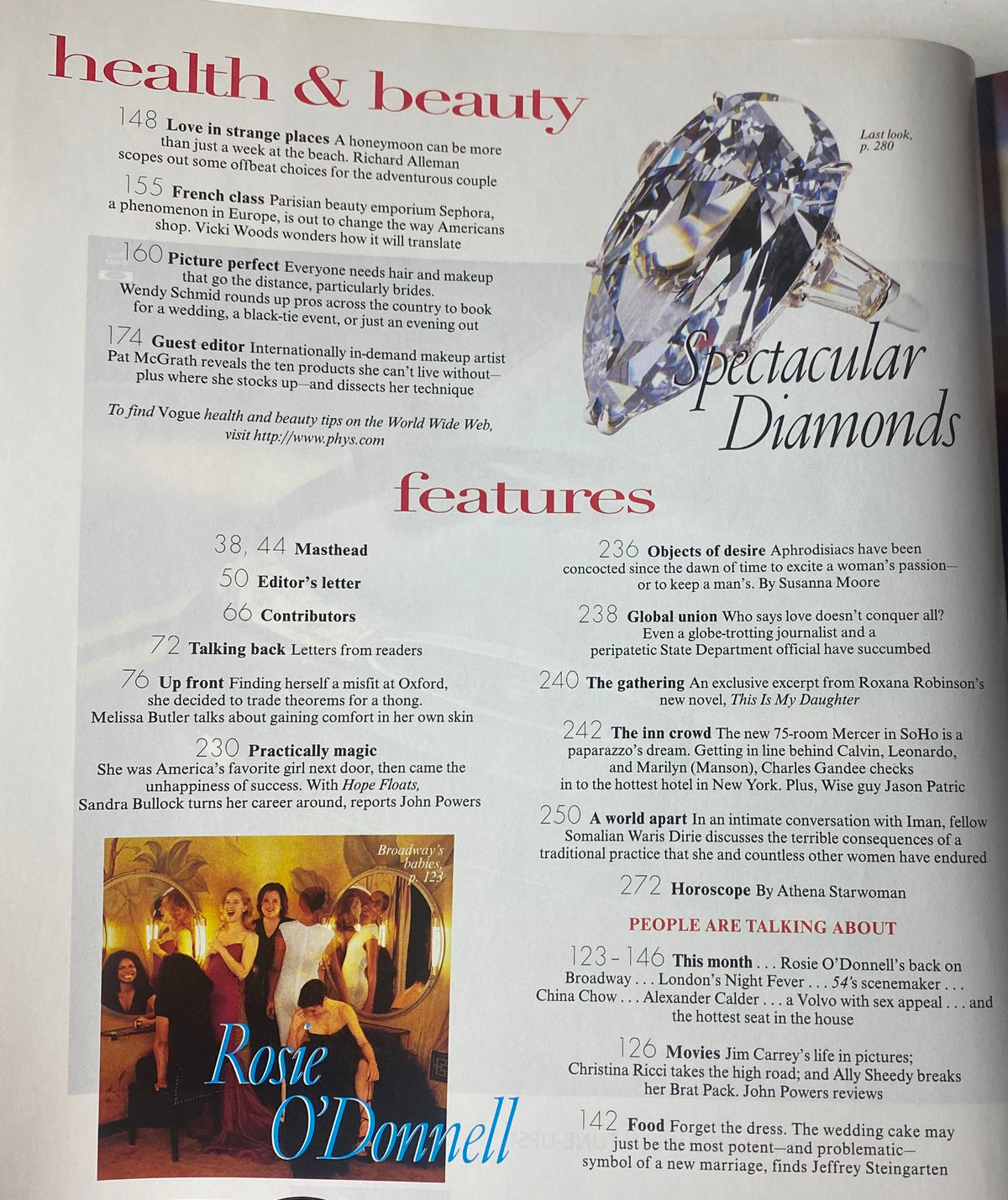
The confirmed editorial content of this issue reveals a June 1998 Vogue with a particularly strong editorial identity organized around weddings, romance, and bridal fashion — a thematic coherence that was itself a deliberate editorial choice reflecting both the June publication date and the late-1990s cultural moment's specific relationship with weddings as a mainstream cultural preoccupation. The confirmed features — "A Renaissance Romance," "Scenes from a Wedding," "Veiled Promises," "The Grand Tour," and "Something Borrowed, Something New" — constitute a sustained meditation on wedding aesthetics and romantic imagery that represents Vogue's characteristic approach of elevating a seasonal editorial theme into a fully realized visual and cultural statement. André Leon Talley's confirmed "Style Fax: Naming Names" column establishes this issue within the specific creative directorship context that defined Vogue's late-1990s editorial identity, and the "Generation Next" feature highlighting rising names in fashion's future is a primary document of the publication's engagement with the next wave of fashion talent at a specific moment in the industry's late-decade evolution. Collectors researching Vogue's editorial history of the late 1990s will find this issue a richly documented primary source, and those building archives of American celebrity and fashion publishing from 1998 will recognize it as a representative example of the publication's approach to celebrity cover features paired with thematically unified editorial content.
The "Generation Next" feature's documentation of rising fashion names in June 1998 is worth specific note as a historical artifact. The late 1990s were a genuine moment of generational transition in fashion, with the established supermodel era giving way to a new wave of designers, models, and aesthetic voices that would define the following decade's industry. A Vogue feature explicitly engaging with that transition in June 1998 is a primary document of how the publication was processing and presenting the fashion world's changing of the guard to its readership at a specific and historically interesting moment in the industry's evolution.
About the Publication
Vogue was founded in 1892 and acquired by Condé Nast in 1909, developing over the following century into the definitive American fashion authority. Under editor-in-chief Anna Wintour, who had led the magazine since 1988, American Vogue by June 1998 was operating at the height of its late-1990s cultural authority — a publication whose cover choices and editorial decisions carried genuine mainstream cultural weight beyond the fashion industry itself. The confirmed André Leon Talley Style Fax column establishes this issue within the specific creative partnership that defined Vogue's visual and editorial identity during this period. The magazine's June issues typically anchored major editorial themes around the late-spring and early-summer fashion moment, with weddings as a perennial June editorial focus that received the full production investment the Condé Nast infrastructure could deploy.
Key Highlights Inside
- Sandra Bullock appears on the cover in June 1998 — documented here at the late-1990s consolidation of her Hollywood career following the breakthrough successes of Speed and While You Were Sleeping, with the Vogue cover placement reflecting both her commercial standing and the magazine's assessment of her cultural resonance with its readership.
- André Leon Talley's "Style Fax: Naming Names" on the season's standout fashion names establishes this issue within the specific creative directorship context of late-1990s Vogue, with Talley at the height of his influence as the publication's most distinctive editorial voice alongside Wintour's editorial leadership.
- The comprehensive bridal editorial framework — "A Renaissance Romance," "Scenes from a Wedding," "Veiled Promises," "The Grand Tour," and "Something Borrowed, Something New" — constitutes a thematically unified wedding fashion statement that represents Vogue's characteristic approach of elevating seasonal editorial themes into fully realized visual and cultural productions.
- "Generation Next" documenting rising names in fashion's future provides a primary source record of how Vogue was engaging with the generational transition occurring in the late-1990s fashion industry, at a moment when the supermodel era was giving way to the next wave of design and modeling talent.
- The "Bombay Bliss" global influences feature and "Personal Shopper: Foreign Affairs" global finds section document the late-1990s fashion industry's intensifying engagement with international and multicultural aesthetic influences — a primary record of how Vogue was processing and presenting globalization's impact on fashion to its readership.
Condition & Rarity
Surviving copies of this issue are graded at the Very Good level with only minor edge wear — a strong condition designation for a twenty-eight-year-old fashion magazine that indicates careful preservation and minimal aging. For a Vogue from June 1998, Very Good with minor edge wear means a copy that retains cover gloss, spine integrity, and interior page quality without the significant tanning, surface scuffing, or structural damage that affects lower-grade copies. The confirmed absence of a mailing label indicates newsstand rather than subscriber origin, preserving the full visual integrity of the Sandra Bullock cover without the adhesive surface disruption of subscriber labels — a meaningful positive condition attribute for a publication whose cover photography is the primary visual collector consideration. The confirmed detailed table of contents allows collectors and researchers to verify specific editorial features before acquisition, making this issue more specifically documentable than most surviving late-1990s Vogue issues. The plastic protective covering provides appropriate stabilization for a publication of this age, maintaining cover surface quality and preventing further edge deterioration during handling and storage.
Looking for More Issues Like This?
Vogue issues featuring Sandra Bullock from her late-1990s career peak — particularly those with confirmed detailed editorial content and Very Good condition label-free covers — are among the more specifically documented entries in both her magazine archive and in the Vogue late-1990s collector category. The Sandra Bullock magazine collection at OriginalMagazines.com is the most focused place to explore her cover history across multiple titles and career phases. The Vogue collection offers the broadest view of the publication's remarkable archive, and the 1998 magazines collection provides a wide cross-section of American celebrity and fashion publishing from that year's distinctive late-decade cultural moment.