



Description
Collector's Note – Why This Issue Matters
The March 15, 1954 issue of Vogue is a primary document of postwar fashion at its most internationally ambitious and visually refined — and the cover alone, photographed by Erwin Blumenfeld, places it in the upper tier of mid-century fashion photography collecting. Blumenfeld was one of the most technically innovative and artistically daring photographers in the history of the medium, his surrealist-influenced visual experiments having made him one of the defining figures of postwar fashion imagery. His Vogue covers from the late forties and early fifties are among the most studied and reproduced in the magazine's long publishing history, and a March 1954 cover by Blumenfeld — featuring the socialite and fashion figure Fern Tailer — represents his mature style at its most controlled and elegant. The specific visual language of a Blumenfeld Vogue cover is unmistakable: the precise relationship between light and shadow, the graphic clarity, and the sense that every element of the image has been considered with complete intentionality. For collectors working on Blumenfeld's career, the fashion photography of the early 1950s, or the visual history of Vogue's cover art, this issue is a primary source of genuine significance. The full scope of the magazine's cover photography history across this period is documented in the Vogue magazine collection, which allows collectors to trace the visual evolution of the publication decade by decade.
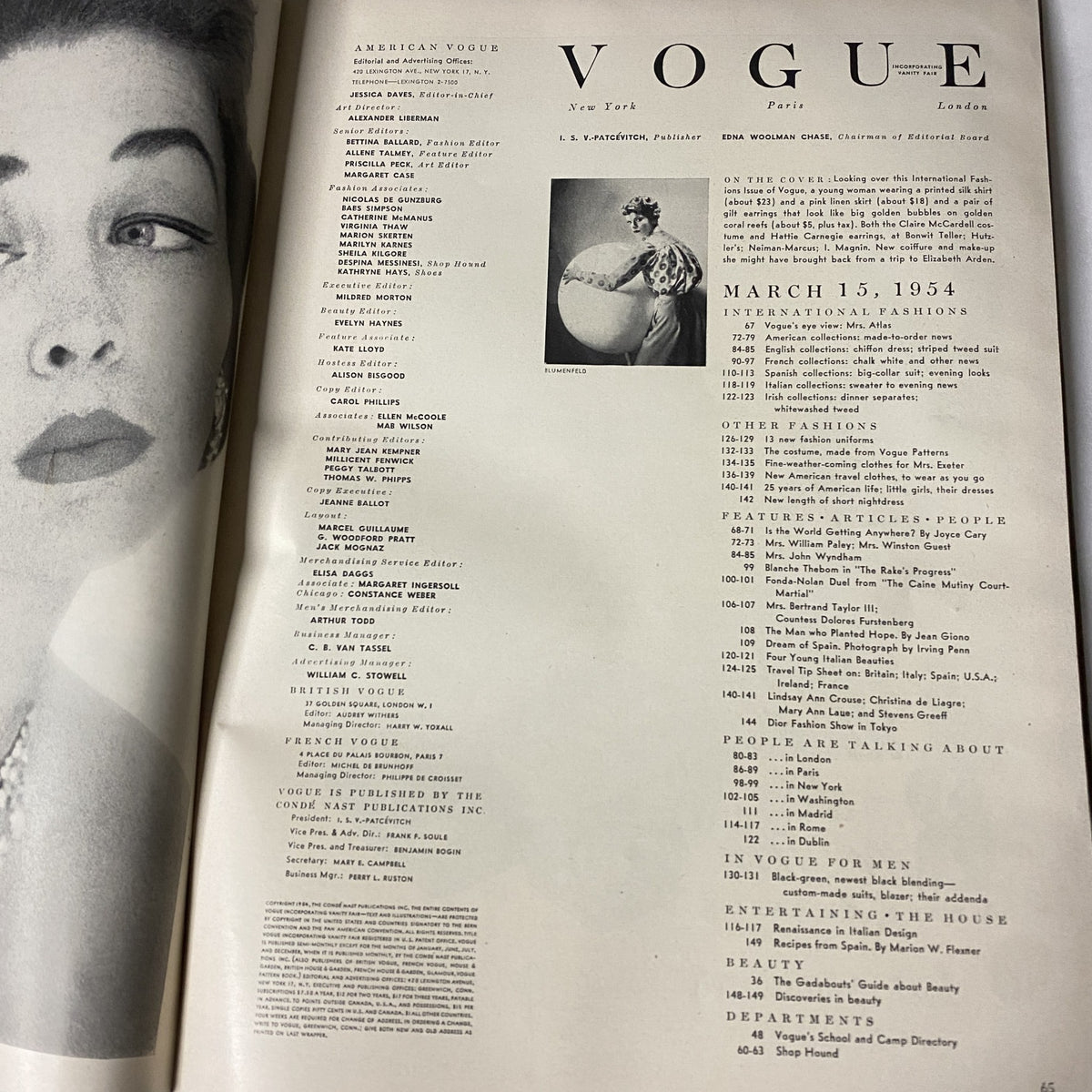
The editorial content of this issue is extraordinarily rich as a document of international fashion in the spring of 1954. The table of contents reads as a complete survey of postwar couture: American, English, French, Spanish, Italian, and Irish collections are all given dedicated coverage, with specific garments and looks identified for each. The French collections section — covering pages 90 through 97 — arrives just four years after Dior's New Look had restructured international fashion, at a moment when Paris was reasserting its authority as the center of couture innovation and when the specific vocabulary of early-fifties fashion — the defined waist, the full skirt, the restrained elegance — was at its most fully developed. The Spanish and Italian collections coverage, and the closing note on a Dior fashion show in Tokyo, reflect the postwar expansion of fashion's geographic reach that Vogue was documenting in real time. The "People Are Talking About" section — covering London, Paris, New York, Washington, Madrid, and Rome simultaneously — documents the specific social and cultural conversations of the international fashion world in the spring of 1954 with unusual breadth. For collectors building a cross-title archive of mid-century fashion culture, the 1954 magazine collection provides essential context for the larger publishing landscape this issue inhabited.
Several individual features in this issue carry specific research value beyond the fashion content. The Irving Penn photograph of Spain — a single image on page 109, credited directly in the table of contents — documents Penn contributing to a single issue that also carried a Blumenfeld cover, a concentration of major mid-century fashion photography talent that is itself worth noting. Joyce Cary's essay "Is the World Getting Anywhere?" provides intellectual and cultural context alongside the fashion coverage, consistent with Vogue's mid-century practice of publishing significant literary and essayistic content alongside its fashion material. The social profiles — Mrs. William Paley, Mrs. Winston Guest, the Countess Dolores Furstenberg, and others — constitute a primary document of the specific social world that postwar American and European Vogue was speaking to and about in the spring of 1954, a world of social forms and hierarchies that would begin to dissolve significantly within the following decade.
About the Publication
American Vogue, founded in 1892 and acquired by Condé Nast in 1909, is the flagship publication of the global fashion media industry and the standard against which all other fashion magazines have historically measured themselves. In March 1954, the magazine was operating under the editorship of Jessica Daves, who had succeeded Edna Woolman Chase in 1952 and was navigating the transition from the postwar reconstruction era into the settled prosperity of the Eisenhower years. The early-to-mid fifties Vogue was producing some of its most visually distinguished issues, the combination of exceptional cover photographers like Blumenfeld and Irving Penn with the specific elegance of early-fifties couture creating a visual record of unusual quality. Its audience was affluent, educated, and socially elite, and its semi-monthly publication schedule — this issue is dated March 15, indicating the second issue of the month — allowed it to produce more editorial content per year than its monthly competitors. The early-fifties issues of Vogue are among the most actively sought in the collector market, reflecting both the quality of the photography and the specific historical interest of the postwar couture moment they document.
Key Highlights Inside
- Erwin Blumenfeld cover photograph of Fern Tailer — a primary document of one of the most technically innovative and artistically significant photographers in fashion history, his work for Vogue in this period representing the mature expression of a surrealist-influenced visual sensibility that had been developed across two decades of fashion photography.
- Complete international collections coverage — American, English, French, Spanish, Italian, and Irish spring 1954 collections documented across dedicated sections, with specific garments identified, constituting one of the most comprehensive single-issue surveys of postwar international couture available in surviving magazine form.
- Irving Penn photograph of Spain (p.109) — a single image by Penn appearing in the same issue as a Blumenfeld cover, documenting two of mid-century fashion photography's most significant practitioners contributing to a single issue at a peak moment for both careers.
- "People Are Talking About" sections covering London, Paris, New York, Washington, Madrid, and Rome — a simultaneous cross-section of the international social and cultural world that mid-fifties Vogue addressed, providing primary documentation of the specific conversations and personalities of the postwar fashion elite across six cities in the spring of 1954.
- "Is the World Getting Anywhere?" by Joyce Cary — an essay by the celebrated Anglo-Irish novelist, whose literary fiction had earned him significant critical recognition in the postwar years, contributing to the intellectual content that mid-century Vogue consistently placed alongside its fashion material.
- Dior Fashion Show in Tokyo (p.144) — documentation of the postwar expansion of French couture's geographic reach into Asia, at a moment when Dior's global influence was at its most expansive and the internationalization of high fashion was still a relatively new phenomenon.
Condition & Rarity
Issues from a privately held Vogue archive spanning the 1920s through 1970s carry a specific and well-understood condition profile for collectors of mid-century periodicals. Extended storage in consistent conditions — even imperfect ones — tends to produce more stable paper than material that has circulated through multiple hands and environments, and archive-sourced issues often retain better interior legibility than exterior wear might suggest. The condition characteristics noted for this issue — creases and marks on the front cover, possible minor rips, binding wear, staple-rust halos, and edge toning consistent with seventy-plus years of paper oxidation — are expected and honest attributes of original, unrestored material from this era. The light dry surface cleaning performed (vacuum, brush, and smoke sponge only, with no wet methods) is the correct conservation approach for paper of this age, preserving the integrity of the inks and paper surface. Good interior condition is a meaningful positive for a 1954 issue: the legibility of the text, the visibility of the photography, and the overall research utility of the magazine are preserved. For a Blumenfeld cover issue with this table of contents, a copy in this condition profile represents a legitimate and research-quality primary source. The archival sleeve is the appropriate housing for a magazine of this age and fragility.
Looking for More Issues Like This?
A March 1954 Vogue with a Blumenfeld cover and this depth of international collections coverage is among the more historically significant entries in the magazine's early-fifties run, and archive-sourced copies in any condition are genuinely uncommon on the market. If this particular issue is no longer available, the full Vogue magazine collection at OriginalMagazines.com is the most comprehensive single source for exploring other issues across the publication's long and visually distinguished publishing history, with particular strength in the mid-century decades where the magazine's photographic legacy is most richly represented. For collectors building a broader archive of postwar couture and mid-century American cultural life, the complete 1954 magazine collection brings together titles from a year that sits at the settled, prosperous center of the Eisenhower era.