
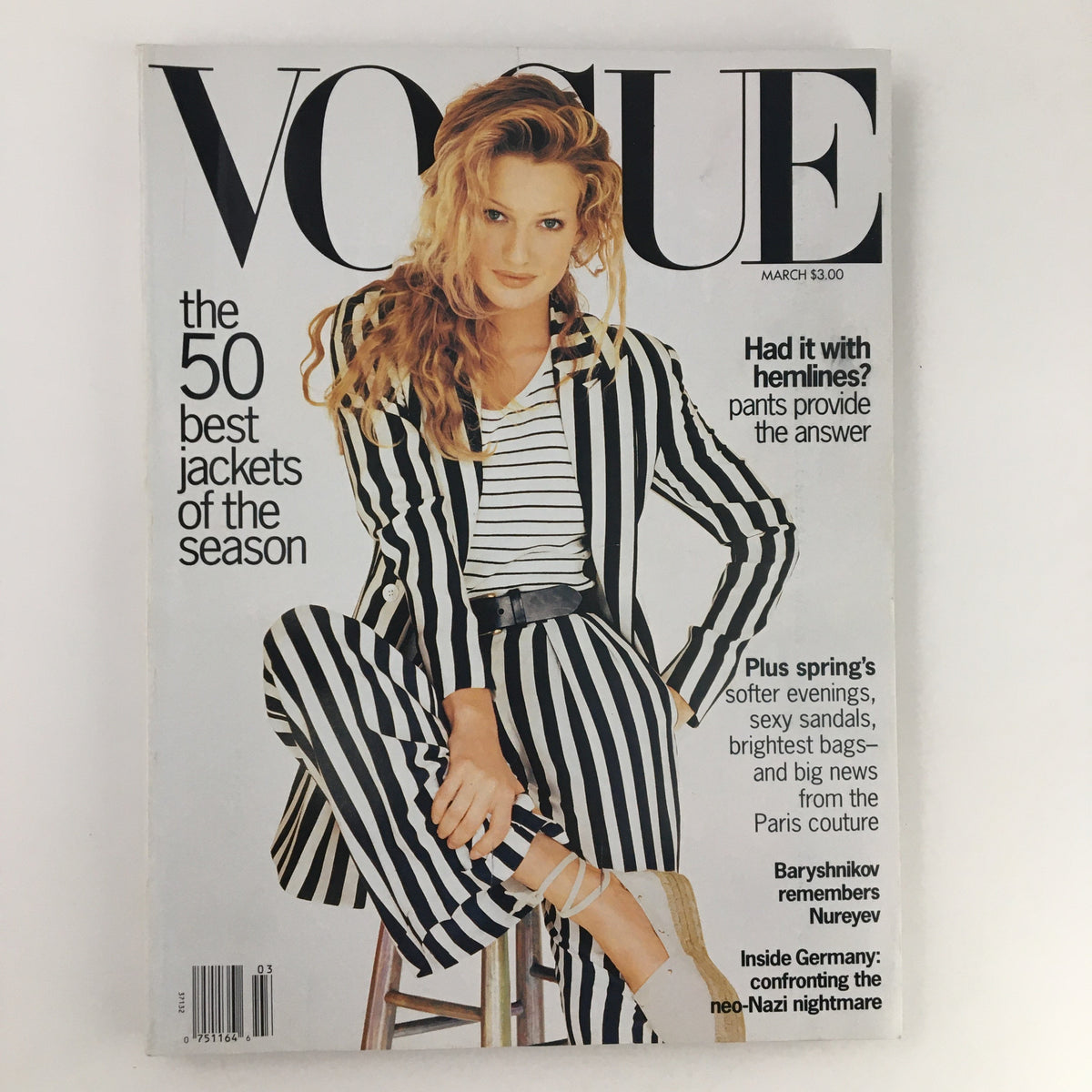


Description
Collector's Note – Why This Issue Matters
The March 1993 issue of Vogue featuring Karen Mulder on its cover is a document of one of the most distinctive and commercially dominant periods in the history of the modeling industry — the era of the supermodel, when a small group of women had achieved a level of name recognition, cultural visibility, and earning power that made them genuinely famous independent of any specific campaign or magazine appearance. Karen Mulder was among the most prominent members of that generation: a Dutch model whose blonde, classically European beauty made her one of the defining faces of early-1990s fashion, a consistent presence in the major European and American collections and a reliably sought-after cover subject for the publications whose covers mattered most. By March 1993, the supermodel phenomenon was at its absolute cultural peak — Naomi Campbell, Linda Evangelista, Cindy Crawford, and Christy Turlington had collectively transformed the public's relationship to modeling as a profession, and Mulder was part of the same ecosystem of elite, highly compensated, internationally recognized figures whose faces defined the visual character of the decade's fashion. For collectors who focus on vintage magazines featuring Karen Mulder, a Vogue cover from this period represents a primary document of her career at its most publicly prominent and commercially commanding moment.
What makes this particular issue especially significant as a cultural artifact is the coexistence of its fashion content with the "Neo-Nazi Nightmare" article noted in the listing description. This juxtaposition — Karen Mulder's blonde, high-fashion cover alongside a feature on neo-Nazism — is not incidental but characteristic of Vogue's editorial ambition under Anna Wintour, who had consistently pushed the magazine to engage with serious social and political subjects alongside its fashion coverage in ways that expanded the publication's cultural authority and relevance. March 1993 falls in the period of heightened anxiety about the resurgence of far-right political movements in Europe — particularly in Germany, where a series of violent attacks on immigrant communities in Rostock-Lichtenhagen and Mölln in 1992 had shocked the international community and generated intense media scrutiny of neo-Nazi activity in the years following German reunification. A Vogue feature on neo-Nazism in this context was serious journalism placed in an unexpected editorial setting, and the contrast between the cover's aesthetic confidence and the interior's political urgency gives this issue a cultural complexity that distinguishes it from routine fashion magazine fare. Collectors building archives around the magazines of 1993 will find this issue a document of early-1990s fashion culture and political anxiety in unusual and productive combination.
The broader editorial context of the March 1993 Vogue reflects the magazine's specific identity at a particular moment in its Wintour era evolution. By 1993, Wintour had been editor-in-chief for five years and had transformed the publication from the somewhat staid Mirabella-era incarnation into something more aggressive, more politically engaged, and more willing to court controversy in the service of expanding the magazine's cultural reach. The decision to pair a canonical supermodel cover — the visual shorthand for fashion's most aspirational and commercially polished dimension — with interior journalism on one of the most disturbing political phenomena in contemporary Europe was an editorial statement about what Vogue considered itself capable of and responsible for. That ambition, and the specific historical moment in which it was exercised, makes this issue a more interesting and historically textured document than its cover alone would suggest. For collectors focused on vintage Vogue issues from the Wintour era, this March 1993 edition is a particularly revealing example of the magazine's editorial identity at a formative moment in its modern history.
About the Publication
American Vogue, founded in 1892 and shaped into its modern form under Condé Nast ownership since 1909, entered the early 1990s under editor-in-chief Anna Wintour's increasingly confident and culturally ambitious leadership — a period when the magazine was redefining what a fashion publication could be by expanding its editorial scope to include serious political, social, and cultural journalism alongside its core fashion and beauty coverage. Wintour's Vogue of the early 1990s operated at the intersection of the supermodel era's commercial and visual peak and a genuine editorial ambition to be taken seriously as a cultural authority on subjects that extended well beyond seasonal collections and beauty trends. Its readership encompassed both the fashion industry insiders and professionals who had always been its core audience and a broader educated general readership who valued the magazine's combination of visual excellence, celebrity access, and the kind of serious feature journalism that the "Neo-Nazi Nightmare" article exemplifies.
Key Highlights Inside
- A cover featuring Karen Mulder — one of the most prominent European models of the supermodel era, photographed at the height of her commercial and cultural prominence in the early 1990s when the modeling industry's top tier had achieved a level of public recognition and earning power unprecedented in the profession's history.
- "Neo-Nazi Nightmare" — a feature article engaging with the resurgence of far-right political movements and neo-Nazi activity in Europe, arriving in the immediate aftermath of the 1992 attacks on immigrant communities in Germany that had shocked the international community and generated urgent journalistic attention to the political extremism emerging in the post-reunification European landscape.
- Fashion editorial content reflecting the specific aesthetic moment of spring 1993 — a season when the decade's defining visual language was fully formed, the major collections were producing the streamlined, body-conscious silhouettes and the luxury minimalism that would characterize the era's high-fashion identity, and the supermodel's face was the primary vehicle through which that aesthetic was communicated to the magazine's audience.
- Beauty and lifestyle coverage consistent with Vogue's early-1990s Wintour era editorial formula — a format that balanced the magazine's traditional fashion and beauty authority with expanded cultural and social content that reflected Wintour's determination to position the publication as a serious voice on subjects beyond the seasonal collections.
Note: Specific interior article titles beyond "Neo-Nazi Nightmare," featured designers, photographer credits, and additional editorial details are unconfirmed for this issue from available sources. The highlights above reflect verifiable historical context drawn from the cover subject, the noted interior article, publication date, and the well-documented editorial character of Vogue under Anna Wintour during this period.
Condition & Rarity
This copy is identified as a no-label newsstand edition in good condition with minor wear consistent with its age — a solid condition profile for a thirty-year-old fashion magazine that indicates careful storage rather than frequent handling. The absence of a mailing label preserves the Karen Mulder cover surface as originally printed, without the subscription label adhesive damage that affects the cover presentation of many surviving copies of early-1990s Vogue issues. The minor wear noted is consistent with a copy that has been stored conscientiously, and the plastic protective sleeve provides ongoing conservation value that will help prevent further surface deterioration and light exposure damage. For a Vogue issue with the specific combination of supermodel cover and serious political interior journalism that characterizes this March 1993 edition, a no-label newsstand copy in good condition with both the cover presentation and interior content intact represents a well-preserved example of a document whose cultural complexity gives it additional collecting significance beyond its fashion content alone.
Looking for More Issues Like This?
A no-label Karen Mulder Vogue cover from the height of the supermodel era, with a serious political interior feature, is a more historically layered find than most early-1990s fashion magazine covers — and if this March 1993 issue has already moved, the dedicated Karen Mulder magazine collection at OriginalMagazines.com is the natural first stop for collectors building an archive of her most significant cover appearances. The broader vintage Vogue collection is an excellent resource for other significant Wintour era covers from the magazine's early-1990s run, and collectors focused on the fashion culture and political atmosphere of the period will find it well worth exploring the full 1993 magazine archive, which brings together fashion and general interest publications from one of the most visually distinctive and culturally self-conscious years of the decade.