

Description
Collector's Note – Why This Issue Matters
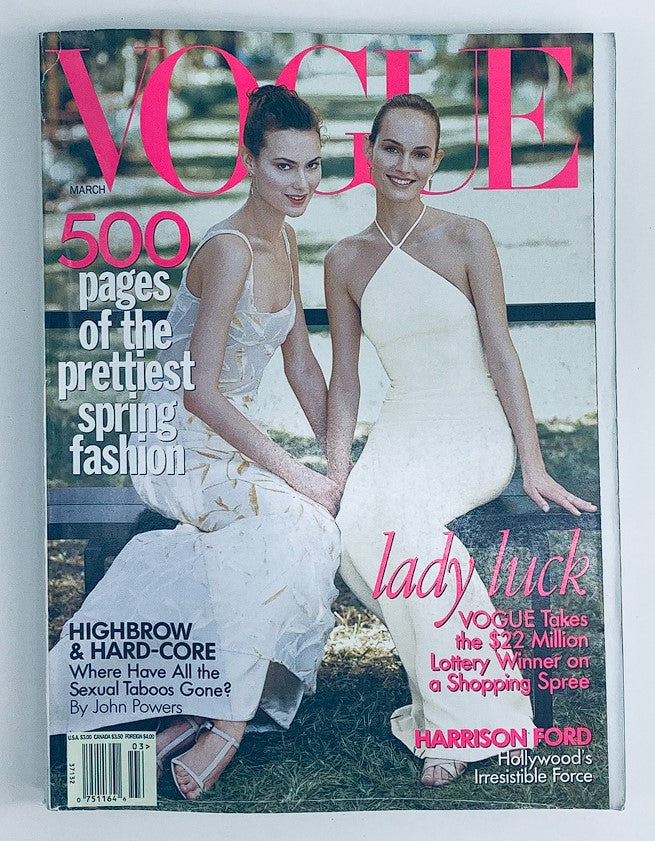
The March 1997 issue of American Vogue featuring Amber Valletta and Shalom Harlow together on the cover documents two of the most significant models of the mid-to-late nineties at a moment when their individual prominence was at its peak and their pairing represented a specific editorial statement about the era's modeling aesthetic. Amber Valletta had by March 1997 established herself as one of the most booked and photographed models in the world — her pale, otherworldly presence and extraordinary photogenic quality had made her the face of choice for the most demanding photographers and designers in the industry, and her Vogue cover appearances across the mid-nineties constitute one of the most significant cover runs of any model in the magazine's history. Shalom Harlow's angular, dramatically expressive face represented a different strain of the nineties aesthetic — more unconventional, more editorial, and more associated with the decade's avant-garde fashion photography — and her pairing with Valletta on a spring cover produced an image that balanced the era's two dominant modeling archetypes against each other in a single frame. This is a different issue from the April 1997 Vogue that also features Harlow alongside Valletta and Carolyn Murphy — the March issue is a distinct editorial entry, and collectors researching either model's cover chronology should treat the two issues as separate primary sources. The full publishing context for this period is traceable through the Vogue magazine collection, which documents how the magazine's cover casting choices evolved across the decade.
March 1997 was a spring issue arriving at a culturally charged moment for the fashion industry. The mid-to-late nineties represented one of the most creatively volatile periods in modern fashion history — the grunge-influenced deconstruction of the early decade had given way to something more complex, with minimalist American luxury, Belgian avant-garde conceptualism, and a renewed glamour all competing for dominance simultaneously. A March Vogue spring issue in this environment was a significant editorial statement: it announced which direction the magazine was endorsing for the season, and the choice of Valletta and Harlow together suggested a desire to hold both the glamorous and the unconventional in productive tension. Gianni Versace would be murdered four months later in July 1997, an event that would mark the end of an era in ways that nobody reading this March issue could have anticipated, making all pre-July 1997 fashion media documents from this year carry a particular retrospective weight. For collectors building a cross-title archive of this extraordinary year, the 1997 magazine collection provides the broader publishing context that makes individual issues like this one legible within the larger cultural conversation of a year that proved, in retrospect, to be one of the most consequential in late-twentieth-century fashion history.
The no-label condition of this issue is a meaningful collector distinction for a cover of this visual significance. The Valletta-Harlow spring cover — its specific photographic composition, styling choices, and the particular visual dynamic between the two models — survives fully intact as designed and printed, without the adhesive marks or obscured photography that subscription labels permanently introduce. For a cover whose collector value rests primarily on the visual presence and pairing of two of the decade's most significant models, the label-free condition preserves that visual integrity in ways that matter both to display-focused collectors and to researchers documenting the careers and media presence of either subject.
About the Publication
American Vogue, founded in 1892 and acquired by Condé Nast in 1909, is the flagship publication of the global fashion media industry and the standard against which all other fashion magazines have historically measured themselves. Under the editorship of Anna Wintour, who took the helm in 1988, the magazine developed an editorial identity that was simultaneously more celebrity-driven and more culturally ambitious than its predecessors — its covers became carefully negotiated statements of cultural currency, its fashion coverage engaged seriously with the economics and sociology of luxury alongside the aesthetics of dress, and its editorial voice maintained the authority and influence that made a Vogue cover one of the most consequential placements in fashion media. By March 1997, Wintour's tenure was approaching its tenth year and the magazine's authority within both the fashion industry and the broader cultural conversation was at a sustained and well-documented peak. Its spring issues — among the year's most editorially ambitious and advertising-supported — carried the full weight of that authority in their seasonal fashion statements.
Key Highlights Inside
- Amber Valletta and Shalom Harlow March 1997 cover — a primary document of the mid-nineties modeling aesthetic at its most concentrated, two of the decade's most significant faces photographed together for a spring cover that captures the era's dual investment in glamorous accessibility and unconventional editorial presence simultaneously.
- Spring 1997 fashion editorial content — the collection previews, trend directions, and styling approaches that Vogue was endorsing for the spring season in a year when the fashion industry's competing aesthetic currents were producing some of the most creatively varied runway output of the decade.
- Beauty and lifestyle content consistent with Vogue's March 1997 spring editorial format — the seasonal beauty directions, feature articles, and cultural commentary that accompanied the fashion content and reflected the specific preoccupations and aesthetic sensibilities of the late-nineties fashion world at its most sophisticated and self-aware.
- Note: Specific article titles, bylines, and additional named interior features beyond those indicated in the listing have not been confirmed from available sources. The highlights above reflect what is documented in the listing and Vogue's well-established editorial format for its major spring issues during this period.
Condition & Rarity
Surviving copies of the March 1997 Vogue in collectible condition represent a clean example of one of the more visually distinctive covers in the magazine's late-nineties run. The absence of a subscriber address label is a meaningful positive in collector evaluation: the Valletta-Harlow cover image survives fully intact as designed and printed, without the adhesive residue or obscured photography that subscription labels permanently leave behind — a distinction that matters particularly for a cover where the models' visual presence and their specific photographic pairing are primary reasons for collecting the issue. The protective plastic sleeve on well-preserved copies is the standard archival measure for a magazine of this paper stock and production quality, stabilizing further deterioration from handling and environmental exposure without requiring any alteration to the original item. Condition details beyond those indicated in the listing are best assessed through the provided photographs, which show the exact state of the surviving issue including any edge wear or surface characteristics consistent with nearly three decades of age.
Looking for More Issues Like This?
A no-label copy of the March 1997 Vogue featuring Amber Valletta and Shalom Harlow is one of the more sought-after entries in the magazine's nineties run — a spring cover pairing two of the decade's most significant models at the height of their individual prominence and cultural influence. If this particular issue is no longer available, the full Vogue magazine collection at OriginalMagazines.com is the most comprehensive single source for exploring other issues across the publication's long run, with strong representation in the nineties decades that fashion historians and collectors are increasingly prioritizing. For anyone building a broader archive of the late-nineties fashion moment, the complete 1997 magazine collection brings together titles from one of the most consequential years in late-twentieth-century fashion and cultural history.