



Description
Collector's Note – Why This Issue Matters
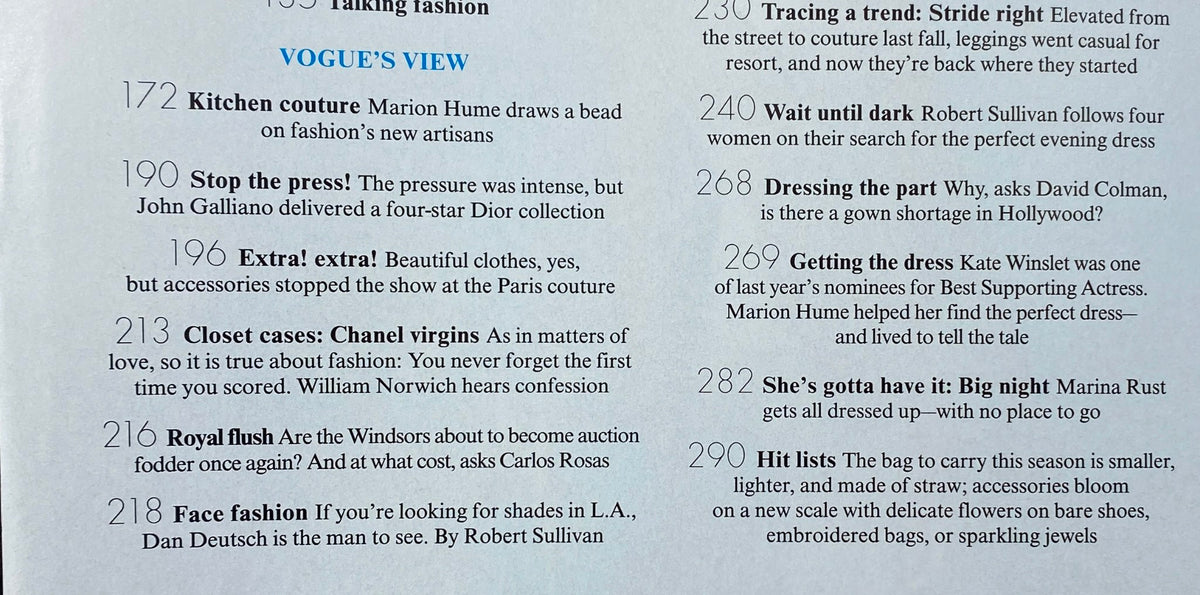
The March 1997 issue of Vogue arrives at one of the most electrifying moments in late-twentieth-century fashion history. Just weeks before this issue's publication, John Galliano had presented his first couture collection for Christian Dior — his debut at the house, following his appointment in October 1996 — and the fashion world's response had been seismic. The confirmed "Stop the press!" feature on pages 190–196 documents that collection and its accessories in real time, making this issue a primary journalistic record of a creative event whose reverberations through the industry lasted for years. Galliano's Dior debut is now understood as one of the defining collections of the decade: theatrical, historically referential, technically extraordinary, and utterly unlike anything the house had produced under its previous directorship. A Vogue issue published in its immediate aftermath, with editorial coverage framed around the urgency of the moment — "the pressure was intense, but Galliano delivered a four-star collection" — captures the fashion establishment's response at the instant of impact. Collectors researching the full scope of 1990s Vogue and its coverage of the decade's major fashion moments will find the Vogue archive at OriginalMagazines.com an essential resource across the Wintour era.
The cover — featuring Shalom Harlow and Amber Valletta together — places this issue at the intersection of two of the defining model careers of the mid-1990s. Amber Valletta had been one of the most prominent faces in fashion since the early part of the decade, her work with major photographers and her consistent presence in the top tier of editorial and campaign bookings establishing her as a genuine industry standard-bearer. Shalom Harlow, the Canadian model whose angular features and theatrical presence made her a particular favorite for avant-garde editorial work, was at the peak of her visibility in 1997 — her runway walk and her willingness to inhabit conceptually demanding fashion imagery had made her one of the decade's most distinctive presences. A dual cover featuring both in the same frame is a deliberate editorial statement about the specific aesthetic of the moment: the mid-1990s supermodel era was giving way to something more varied and more editorially driven, and this cover sits squarely within that transition. Those researching the broader fashion and cultural landscape of the late 1990s will find the 1997 magazines collection at OriginalMagazines.com valuable for context across publications from this year.
The editorial depth of this issue extends well beyond its Galliano coverage. The Kate Winslet Oscar dress story — Marion Hume helping Winslet find her gown for the 1997 ceremony, at which she was nominated for Sense and Sensibility — is a specific and documented piece of fashion and celebrity crossover journalism that places this issue within the specific awards season it covered. The Windsor auction piece by Carlos Rosas and the Chanel virgins confessional by William Norwich reflect Vogue's consistent engagement with the social world its readers inhabited — aristocratic, aspirational, culturally fluent — while David Colman's Hollywood gown shortage piece and the leggings trend feature document the specific aesthetic conversations of the spring 1997 fashion moment with the kind of granular attention that makes late-1990s Vogue particularly valuable as a period document.
About the Publication
Vogue was founded in 1892 and acquired by Condé Nast in 1909, developing over the following century into the world's preeminent fashion magazine. By 1997, under editor Anna Wintour — who had led the American edition since 1988 — the magazine had firmly established the editorial identity it would carry through the rest of the decade and beyond: aggressive fashion coverage anchored by the Paris and New York collections, celebrity integration that treated film and music stars as legitimate fashion subjects alongside professional models, and the kind of cultural and lifestyle writing that served an affluent, educated readership with serious engagement in fashion, beauty, and contemporary life. Its monthly format in this era produced issues of substantial editorial investment, with the March issue typically reflecting the spring collections and the cultural momentum of awards season simultaneously.
Key Highlights Inside
- Cover featuring Shalom Harlow and Amber Valletta — a dual cover pairing two of the mid-1990s' most prominent editorial models at the precise moment the supermodel era was transitioning into the more varied model culture of the late decade.
- "Stop the press!" coverage of John Galliano's debut couture collection for Christian Dior (pp. 190–196) — contemporaneous documentation of one of the most discussed and historically significant fashion presentations of the 1990s, framed with editorial urgency appropriate to the moment.
- Kate Winslet Oscar dress story by Marion Hume — a behind-the-scenes account of dressing Winslet for the 1997 Academy Awards ceremony, where she was nominated for Best Supporting Actress for Sense and Sensibility, placing the piece within a specific and well-documented cultural moment.
- Chanel virgins confessional by William Norwich and Windsor auction piece by Carlos Rosas — two confirmed features that document the specific social and fashion cultural preoccupations of Vogue's late-1990s readership, from aspirational luxury to aristocratic estate sales.
- Leggings trend feature tracing the trajectory from street to couture to resort and back — a period document of a specific fashion conversation that was actively playing out in the spring 1997 season, providing granular evidence of the moment's aesthetic concerns.
- Hollywood gown shortage feature by David Colman alongside the evening dress search narrative by Robert Sullivan — twin pieces reflecting the deepening integration of Hollywood celebrity culture into Vogue's editorial framework that defined the Wintour era.
Condition & Rarity
The noted condition describes a very good copy with minor edge wear, no mailing label, and a plastic protective sleeve. The absence of a subscription label is the most significant positive condition attribute for a Vogue issue of this era: subscriber copies routinely received address labels applied directly to the front cover, and their removal almost invariably results in adhesive residue or surface paper loss that permanently affects the cover photography. A no-label copy retains the Harlow-Valletta cover image in its original state, which for an issue whose cover is a primary collector interest is the defining preservation factor. Minor edge wear on a nearly thirty-year-old monthly magazine is entirely expected and does not typically affect the cover image or interior content. Very good condition indicates a complete, structurally sound copy with a cover that has retained its printed surface — the configuration that serious collectors of 1990s Vogue consistently prioritize when evaluating surviving examples.
Looking for More Issues Like This?
Mid-1990s Vogue issues featuring Shalom Harlow, Amber Valletta, or the first documentation of Galliano's Dior debut are among the more actively sought configurations for collectors of the decade's fashion press, and this March 1997 issue combines all three in a no-label copy — a difficult combination to replicate. If it has already been claimed, the full Vogue archive at OriginalMagazines.com is the best place to search for other landmark issues from the Wintour era across the 1990s. Collectors drawn to the specific energy of late-1990s fashion and celebrity culture will find the 1997 magazines collection worth exploring for related period publications.