




Description
Collector's Note – Why This Issue Matters
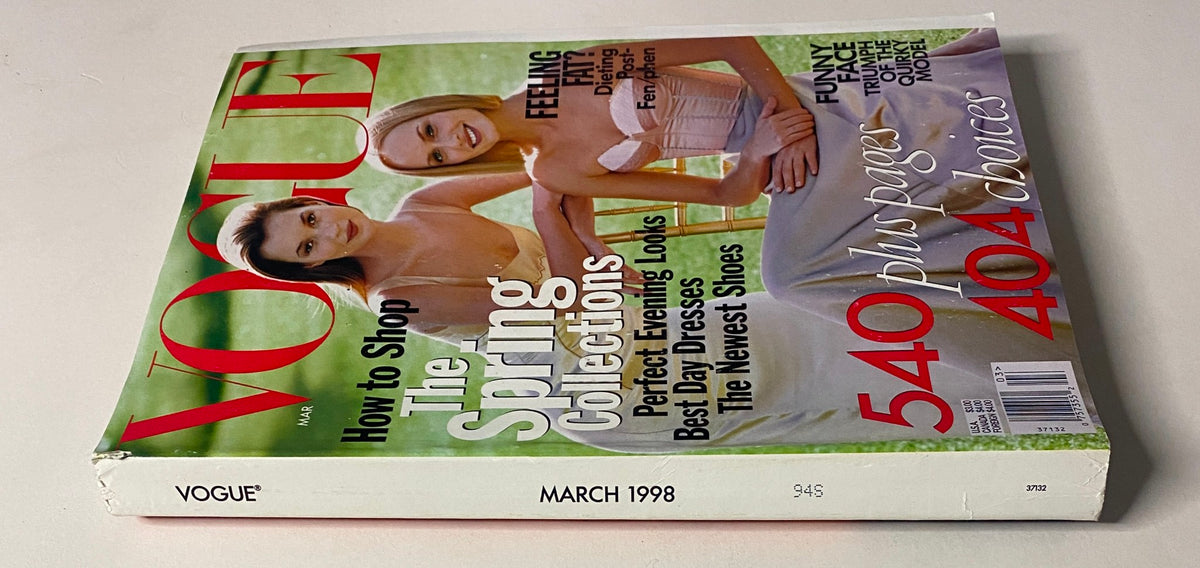
The March 1998 issue of Vogue arrives at a precise and fascinating moment in the history of supermodel culture. Kate Moss and Amber Valletta sharing a cover — photographed by Steven Meisel — is a pairing that captures the late 1990s fashion world at a hinge point between two distinct aesthetic eras. Valletta had been one of the defining faces of the mid-1990s, her presence associated with the glamorous, high-production editorial work that dominated fashion photography in the years between grunge's retreat and the minimalism that followed. Moss, meanwhile, had evolved considerably since her early-nineties waif period — by 1998 she was navigating a more complex cultural position, her image simultaneously ubiquitous and carefully managed. A Meisel cover featuring both of them together in the spring of 1998 was an editorial statement about continuity and transition: two of the decade's most significant faces, documented at the moment their cultural moment was about to give way to something new.
Steven Meisel's role here cannot be overstated. By March 1998 he was the dominant force in fashion photography, his relationship with Vogue giving him an unmatched platform to define how the industry saw itself. His cover shoots were not neutral documentation — they were active constructions of fashion's self-image, and his choice to frame Moss and Valletta together in this specific issue carries the weight of that curatorial authority. For collectors who follow vintage Kate Moss magazine appearances, Meisel-shot covers occupy a distinct tier of significance within the broader archive of her print career. The confirmed no-label status — newsstand origin preserving the cover art without subscription marking — makes any surviving copy of this issue particularly desirable for collectors who prioritize cover presentation as an evaluation criterion.
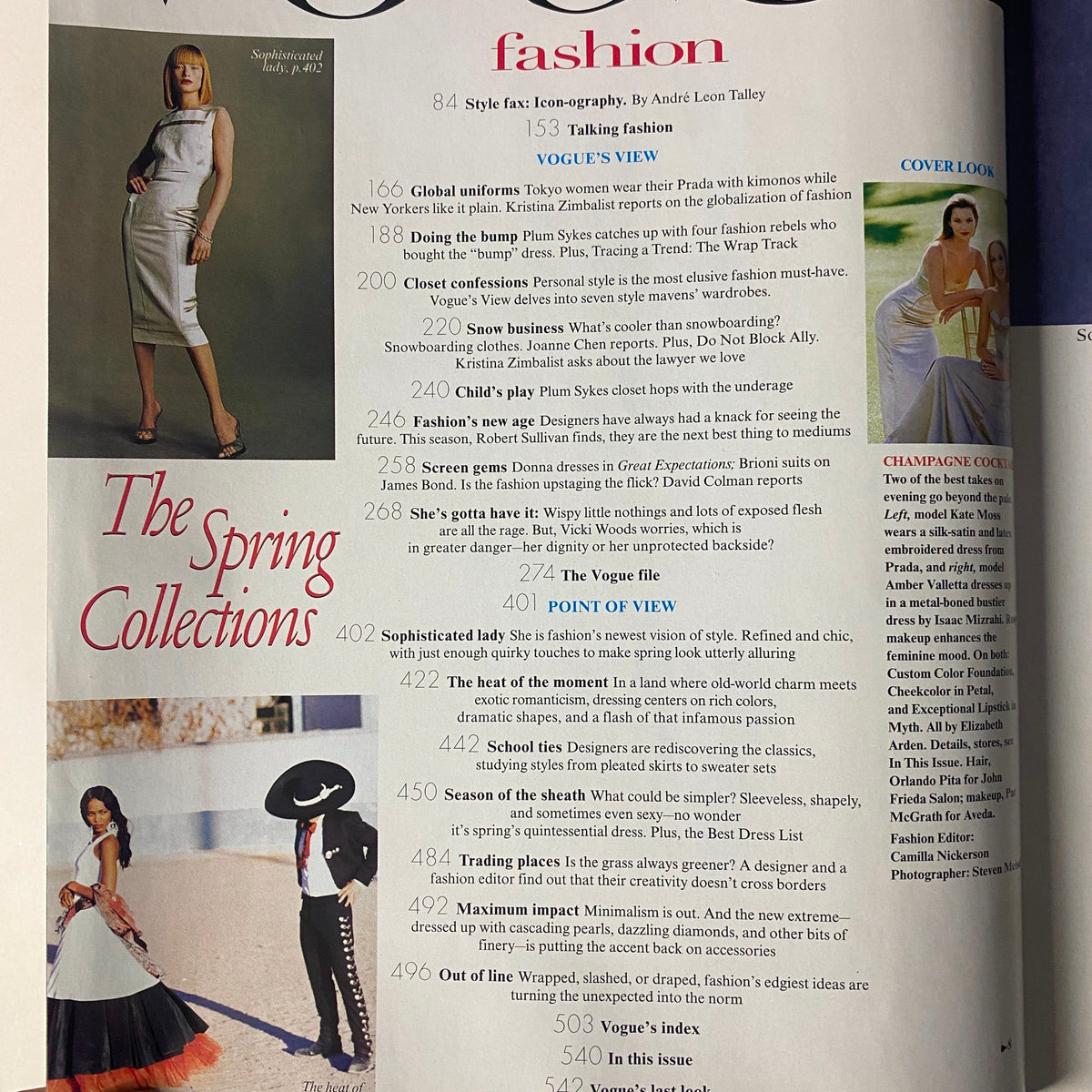
The editorial content documented in the table of contents gives this issue exceptional depth beyond its cover. The André Leon Talley "Icon-ography" piece and the globalization of fashion feature by Kristina Zimbalist speak to the specific preoccupations of late-1990s fashion journalism — the industry was actively processing its own internationalization, its relationship with street culture (the snowboarding feature is a pointed example), and the tension between minimalism and maximalism that defined spring 1998's runway season. The Ally McBeal lawyer-chic sidebar is a precise cultural timestamp: the show was at its peak cultural influence in 1997-98, and its aesthetic crossover into fashion journalism documents how thoroughly it had penetrated the mainstream. Collectors building focused archives around vintage Vogue issues from the late 1990s will find this March 1998 edition among the most content-rich of the decade's final years. Those focused on magazines from 1998 specifically will find it a vivid document of fashion culture at the century's turn.
About the Publication
Vogue was founded in 1892 and had been under Anna Wintour's editorial direction since 1988. By March 1998 the American edition was operating at the peak of its cultural authority — its cover selections were events, its fashion portfolios set seasonal agendas, and its long-form features attracted writers of genuine literary distinction. The late 1990s issues represent a specific and creatively fertile editorial phase: the magazine was simultaneously engaged with the globalization of fashion, the crossover between street and luxury culture, and the broader question of what style meant in the years immediately preceding the digital transformation that would reshape the entire industry. Steven Meisel's decade-long dominance of the publication's visual identity gives issues from this period a coherent photographic character that later decades, with more diverse contributor rosters, would not replicate.
Key Highlights Inside
- Cover by Steven Meisel featuring Kate Moss and Amber Valletta — a pairing of two of the decade's most significant fashion figures, photographed by the era's most influential fashion photographer, confirmed no-label newsstand provenance.
- "Icon-ography" by André Leon Talley (p. 84) — a Style Fax feature from one of American fashion journalism's most distinctive voices, at the height of his influence at Vogue.
- "Global Uniforms" by Kristina Zimbalist (p. 166) — a contemporaneous account of fashion's internationalization from Tokyo to New York, documenting the industry's self-conscious globalization at a specific historical moment.
- "Snow Business" by Joanne Chen with Kristina Zimbalist (p. 220) — coverage of snowboarding culture's crossover into mainstream fashion, alongside a feature on Ally McBeal's lawyer-chic aesthetic, placing both at their peak cultural visibility in early 1998.
- "Fashion's New Age" by Robert Sullivan (p. 246) — designers predicting the future of fashion at the close of the millennium, a feature with particular historical resonance given how thoroughly the industry would be transformed in the years immediately following.
- Multiple Point of View fashion portfolios (pp. 402–496) documenting spring 1998's defining tension between minimalism and maximalism, with specific focus on the season's sheath dress, statement accessories, and the return of classic collegiate references.
Condition & Rarity
The listing grades this issue as very good with only minor edge wear and confirms no address label — indicating newsstand rather than subscription origin, the preferred provenance for collectors prioritizing cover presentation. For a Vogue issue now approaching thirty years old, very good condition with no label represents a well-preserved example; the heavy coated stock Vogue used holds up better than standard newsmagazine paper over time, but corner wear, spine stress, and surface abrasion from handling accumulate regardless. A clean cover face — particularly significant for a Meisel-shot cover with two major subjects — survives without the adhesive residue that subscription labels leave permanently on the cover art. The protective plastic sleeving reflects appropriate current storage practice. For any surviving copy of this issue, the primary condition assessment points are spine integrity across the substantial March issue page count, the state of the Moss/Valletta cover image, and the quality of the interior fashion portfolio pages, which were printed on premium coated stock and hold their visual quality well when properly stored.
Looking for More Issues Like This?
A no-label, very good condition copy of the March 1998 Vogue with a Meisel cover featuring both Moss and Valletta is a specific and worthwhile find — the combination of cover talent, photographer, and editorial depth makes this one of the more substantive late-1990s Vogue issues for serious collectors. If this one has already been claimed, the Kate Moss vintage magazine archive is the best starting point for other cover appearances across titles and years. The full vintage Vogue collection spans decades of landmark covers and editorial work, and the focused 1998 magazine archive covers the full year for collectors building a late-nineties fashion library.