




Description
Collector's Note – Why This Issue Matters
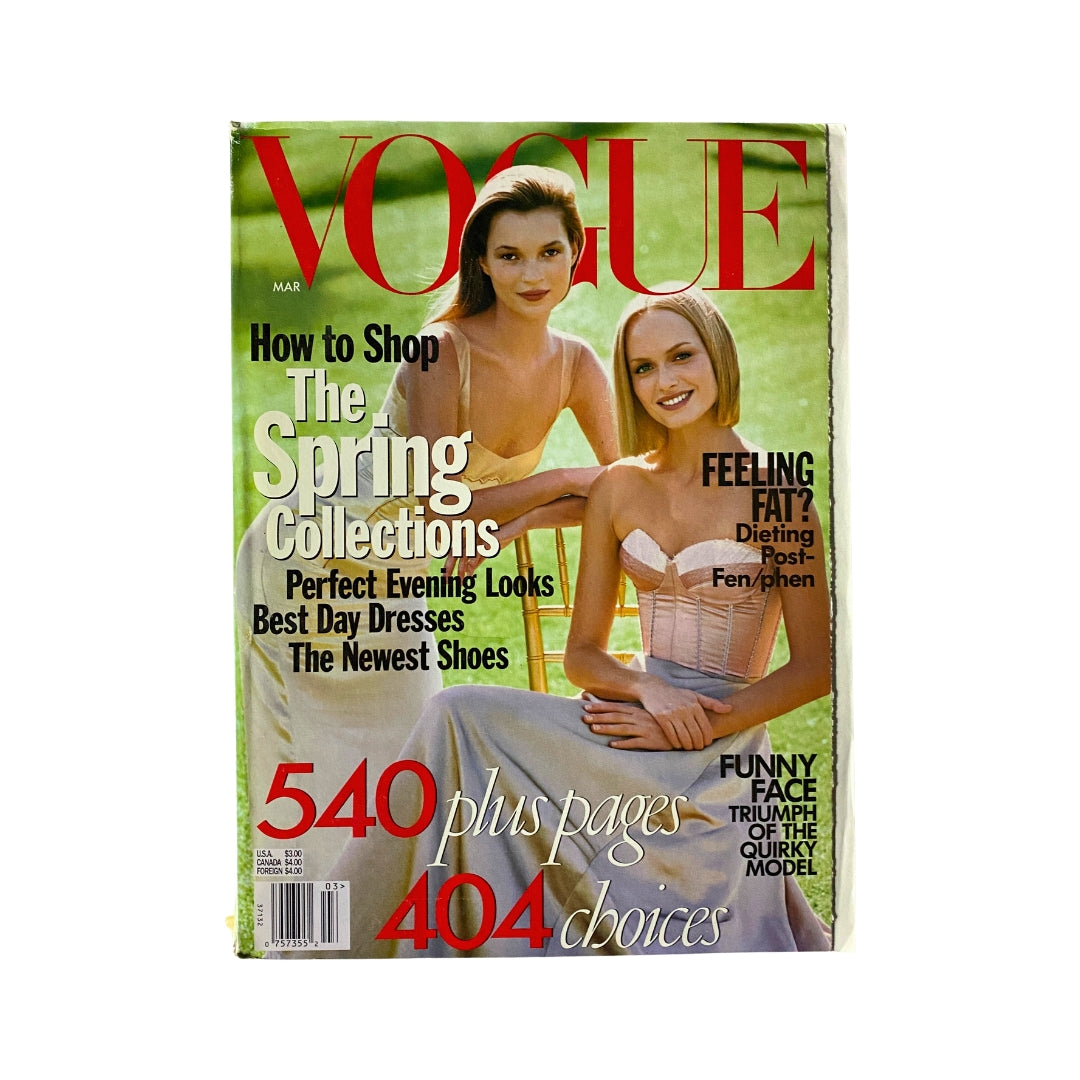
The March 1998 issue of Vogue featuring Kate Moss and Amber Valletta on the cover documents the two most commercially prominent models of the mid-to-late nineties at a specific and historically well-defined aesthetic moment — the precise point when the nineties fashion narrative was shifting from minimalism to something more maximalist, more ornamented, and more visually assertive. The confirmed "Maximum Impact: Minimalism is out" feature — with cascading pearls, dazzling diamonds, and accessories returning to prominence — is a primary editorial statement of that transition, published in the spring 1998 season that the magazine explicitly identifies as the moment when the decade's defining minimalist aesthetic was being formally declared finished. Moss and Valletta as joint cover subjects represent the two dominant visual identities of nineties fashion — the waif-era heroin chic that Moss had defined and the more athletic, commercial glamour that Valletta embodied — captured together on a cover at the exact moment when the aesthetic framework that had given both of them their specific cultural meanings was being superseded. For collectors building archives of Kate Moss magazine covers, this March 1998 joint appearance with Valletta is among the most historically specific and aesthetically transitional of her documented Vogue placements.
The confirmed editorial content of this issue documents the late-nineties fashion and cultural moment with unusual named specificity across several dimensions. The "Global Uniforms" feature by Kristina Zimbalist — on Tokyo women wearing Prada with kimonos and New Yorkers wearing it plain — is a primary document of Prada's specific cultural moment in early 1998, when the brand's influence was simultaneously global and locally inflected in ways that fashion journalism was just beginning to articulate. The confirmed Great Expectations and Brioni-on-Bond film fashion feature documents the specific moment in late-nineties cinema when fashion's relationship to Hollywood was being scrutinized as competitive rather than merely promotional. The "Fashion's New Age" feature by Robert Sullivan — describing designers as "mediums" for future cultural visions — and the confirmed snowboarding fashion piece by Joanne Chen reflect the specific late-nineties cultural negotiation between luxury fashion and action sports culture that was one of the decade's most commercially significant brand crossovers. The Ally McBeal television reference — "Do Not Block Ally" — situates this issue within the specific cultural moment of early 1998, when the legal drama was one of the most discussed television programs in America. Collectors of vintage Vogue magazines will find this issue unusually rich in confirmed named cultural content. The broader 1998 magazine collection provides context within the year's full fashion and cultural landscape.
The André Leon Talley "Icon-ography" Style Fax column and the multiple confirmed Plum Sykes bylines — including the bump dress feature and the underage closet-hopping piece — anchor this issue within the specific Wintour-era editorial voice that defined late-nineties American Vogue. The "Closet Confessions" feature documenting seven style mavens' wardrobes reflects the specific late-nineties fashion press fascination with personal style as a subject of serious editorial investigation — a format that the magazine was developing toward its most commercially successful form during exactly this period.
About the Publication
Vogue, published by Condé Nast and founded in 1892, was by March 1998 operating under Anna Wintour's editorship — which had run continuously since 1988 and had made the magazine the globally dominant fashion authority it remains. Its audience was fashion-literate, affluent, and culturally engaged, with expectations that the March issue would deliver both the season's most important spring fashion editorial and substantive coverage of the cultural forces and figures defining the moment. The March spring preview issue was one of the most carefully assembled numbers in the annual calendar, and the confirmed "Minimalism is out" editorial argument in this March 1998 number gives it the specific historical significance of a publication formally announcing a major aesthetic transition at the moment of its occurrence.
Key Highlights Inside
- Kate Moss and Amber Valletta joint cover — A confirmed dual cover pairing the two most commercially dominant models of the nineties at the specific transitional moment when the aesthetic framework that had given each of them their cultural meaning was being declared finished by the magazine itself.
- "Maximum Impact: Minimalism is out" (page 492) — A confirmed primary editorial statement declaring the end of nineties minimalism as a fashion dominant, published in the spring 1998 season — a precisely dated primary source for researchers of the decade's aesthetic arc.
- "Global Uniforms" — Prada in Tokyo and New York, by Kristina Zimbalist (page 166) — A confirmed feature documenting Prada's specific global cultural moment in early 1998, when the brand's influence was being articulated as simultaneously universal and locally differentiated.
- "Screen Gems" — Donna Karan in Great Expectations, Brioni on James Bond, by David Colman (page 258) — A confirmed feature examining fashion's competitive relationship with late-nineties Hollywood at a specific moment in the luxury brand and film crossover.
- "Fashion's New Age" — designers as cultural mediums, by Robert Sullivan (page 246) — A confirmed fashion cultural criticism feature placing spring 1998 designers within a specific interpretive framework that documents the era's fashion journalism at a transitional creative moment.
- Snowboarding fashion feature by Joanne Chen (page 220) with Ally McBeal reference — Confirmed cultural content situating this issue within the specific late-nineties negotiation between luxury fashion and action sports, alongside a television reference that dates the issue's cultural moment precisely.
Condition & Rarity
The listing defers to photographs for specific condition assessment beyond confirming no subscription label and plastic protective covering. The no-label status confirms the full Moss-Valletta cover image is unobstructed — the preferred state for display-grade collecting of a dual cover whose visual composition and historical significance make full visual integrity a primary collector attribute. The plastic protective covering indicates deliberate preservation. For collectors evaluating any surviving copy of this issue, the primary assessment factors are the cover's surface condition and the completeness and legibility of the spring fashion editorial content — particularly the "Maximum Impact" accessories spread and the spring collections features — which form the primary fashion content whose documentary value depends on interior completeness.
Looking for More Issues Like This?
Late-nineties Kate Moss Vogue covers are among the most consistently sought in the fashion magazine collector market, and a March 1998 joint cover with Amber Valletta at the confirmed "Minimalism is out" aesthetic transition moment is historically specific in ways that most comparable covers from this period are not. The dedicated Kate Moss magazine collection at OriginalMagazines.com is the most direct place to search for other landmark cover appearances across her career. The broader Vogue archive and the full 1998 collection are both worth exploring for other issues that document the nineties fashion world at its most consequential aesthetic turning point.