




Description
Collector's Note – Why This Issue Matters
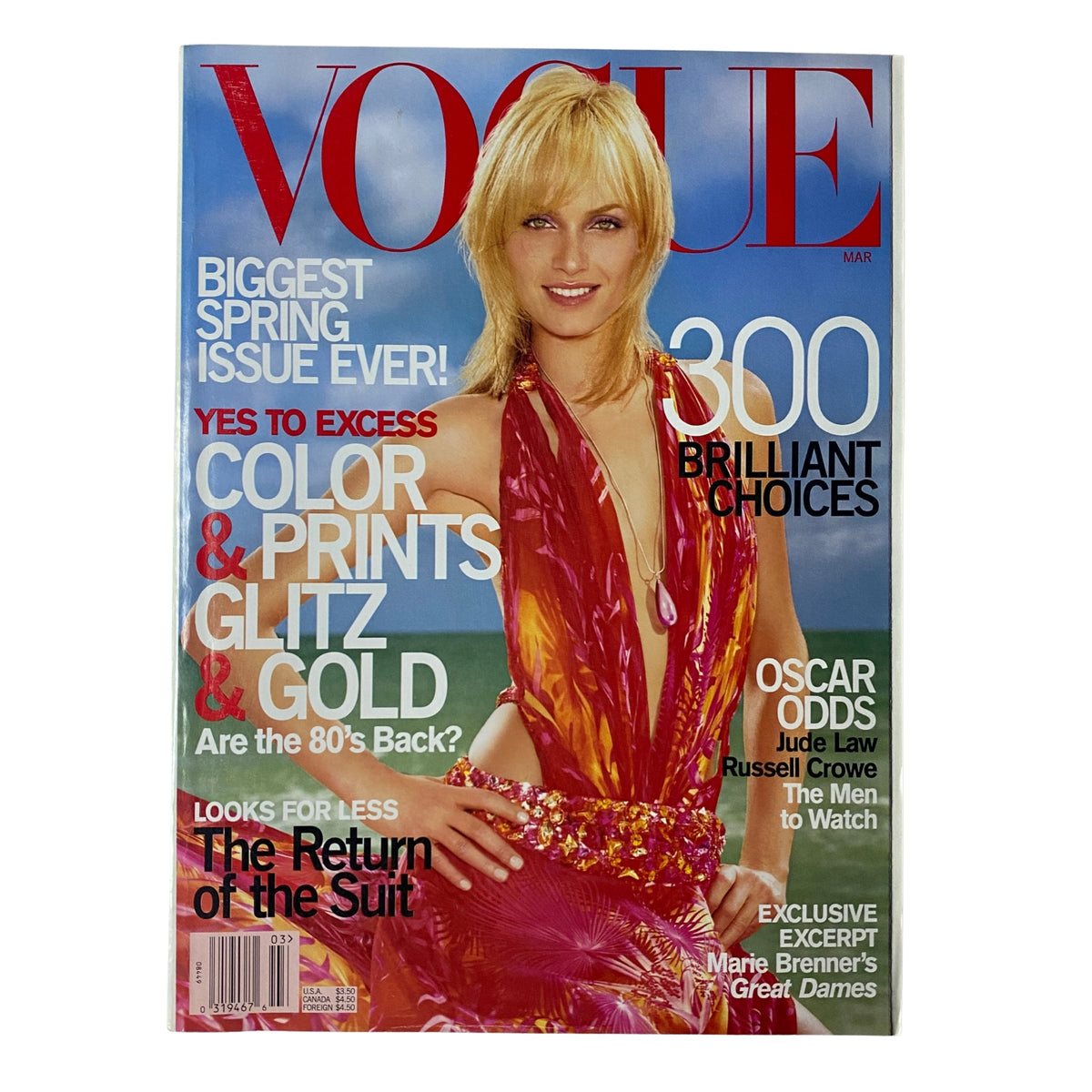
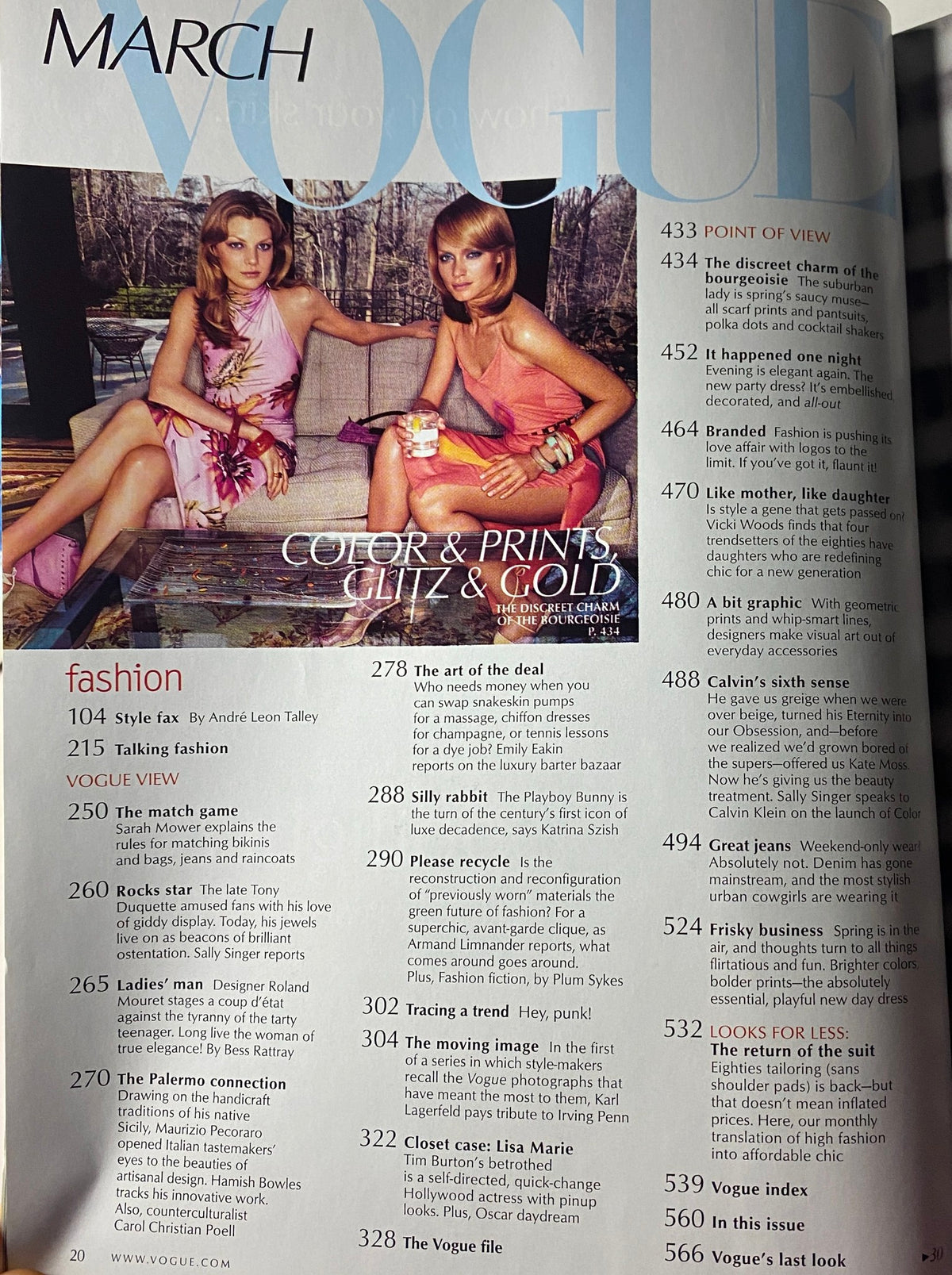
The March 2000 issue of Vogue featuring Amber Valletta on its cover is a document of fashion at one of its most self-consciously transitional moments — the opening months of a new millennium, when the industry was simultaneously looking backward at the century it had just closed and forward into a future whose aesthetic contours were not yet fully defined. Amber Valletta had been one of the defining supermodel faces of the mid-to-late 1990s, her combination of versatility, intelligence, and an almost architectural beauty having made her a consistent presence in the major collections and on the covers of the most important fashion publications throughout the decade. A March 2000 Vogue cover appearance places her at the hinge between the decade she had helped define and the one just beginning — a document of continuity in a moment of change. The table of contents reveals an issue of unusual editorial depth and cultural ambition, reaching across fashion, cinema, visual art, and social history in ways that reflect Vogue's turn-of-the-millennium attempt to assess not just the season's trends but the cultural inheritance the new century was receiving. For collectors who focus on vintage Vogue issues from the turn-of-the-millennium era, this March 2000 cover is a primary document of the publication at a specific and historically interesting moment of cultural stocktaking.
The editorial content of this issue is exceptionally rich and specifically revealing of the moment's preoccupations. The Calvin Klein interview on his new beauty line documents one of the decade's most influential designers at a point of creative transition; the Sofia Coppola feature by Marilyn Bethany captures a filmmaker at the threshold of the career that would produce The Virgin Suicides and Lost in Translation, not yet the canonical figure she would become; and the Russell Crowe and Jude Law comparative feature by John Powers documents two actors whose trajectories — Crowe's toward Oscar glory, Law's toward mid-decade cultural saturation — were at that precise moment of their emergence into full mainstream prominence. The "Branded" feature on fashion's logo obsession and the "Please Recycle" piece on avant-garde designers working with reconstructed fashion both engage directly with the aesthetic tensions that would define the early 2000s fashion conversation: maximalism versus minimalism, heritage versus innovation, luxury signaling versus anti-fashion critique. Collectors building archives around the culture magazines of 2000 will find this issue a document of the cultural and aesthetic landscape of the millennium's opening month with unusual completeness and specificity.
The "Karl Lagerfeld pays tribute to Irving Penn" feature deserves particular attention from collectors who approach this issue as a document of fashion history. The pairing of Lagerfeld — the era's most prolific and culturally omnivorous designer-photographer — with Penn, whose career had spanned the entire postwar history of fashion photography and who remained one of the medium's supreme practitioners, captures something characteristic of the turn-of-the-millennium fashion moment: its hunger to situate the present within a tradition, to acknowledge the century of visual sophistication that had preceded the new one, and to honor the figures whose work had made contemporary fashion culture possible. That impulse, reflected across multiple features in this issue, gives the March 2000 Vogue a quality of cultural retrospection that distinguishes it from the ordinary seasonal fashion document and makes it a more historically interesting collecting target than its cover date alone would suggest.
About the Publication
American Vogue, founded in 1892 and operating under editor-in-chief Anna Wintour since 1988, entered the year 2000 as the unchallenged authority of the American fashion press and one of the most culturally influential publications in the world — a magazine whose editorial decisions shaped the industry's direction, whose cover choices announced cultural significance, and whose features consistently reached across the boundaries between fashion and broader cultural commentary to engage with cinema, art, politics, and society. The March issue — traditionally one of the year's most substantial and carefully edited — represented the magazine's annual statement about the season and, in the case of March 2000, about the cultural inheritance of the new millennium's opening months. The breadth and quality of contributors on display in this issue — André Leon Talley, Hamish Bowles, Sally Singer, Plum Sykes, Marie Brenner, and others — reflects a masthead assembled with genuine editorial intelligence and operating at full creative capacity.
Key Highlights Inside
- Calvin's Sixth Sense — Sally Singer's interview with Calvin Klein on his new beauty line, documenting one of the decade's most influential American designers at a point of creative transition and capturing the specific quality of Klein's minimalist aesthetic vision as it was being extended from fashion into the beauty market.
- Being Sofia Coppola — Marilyn Bethany's profile of Coppola as a rising cultural force, published at the precise moment of her emergence as a filmmaker of serious ambition, before The Virgin Suicides's wide release had fully established her canonical status — making this a primary document of an important cultural figure at the threshold of her defining creative period.
- The Bad & the Beautiful — John Powers's comparative assessment of Russell Crowe and Jude Law, capturing both actors at the specific moment of their simultaneous rise to maximum cultural visibility in early 2000, before their respective trajectories had diverged in the ways that the decade would reveal.
- The Moving Image — Karl Lagerfeld's tribute to Irving Penn, a feature that engages directly with the history of fashion photography and the relationship between the current generation of fashion's practitioners and the twentieth-century masters whose work defined the visual standards they inherited.
- Branded and Please Recycle — two features that engage directly with the aesthetic tensions defining early-2000s fashion: the former examining the peak of logo culture and luxury signaling, the latter documenting the avant-garde designers working against that current with reconstructed and reconfigured materials — together constituting a primary document of fashion's most significant internal debate at the millennium's opening.
- Closet Case: Lisa Marie — a profile of Tim Burton's muse that reflects Vogue's consistent practice of using personal style profiles to illuminate the relationship between fashion and creative identity, here engaging with one of the more distinctive aesthetic presences in early-2000s cultural life.
Condition & Rarity
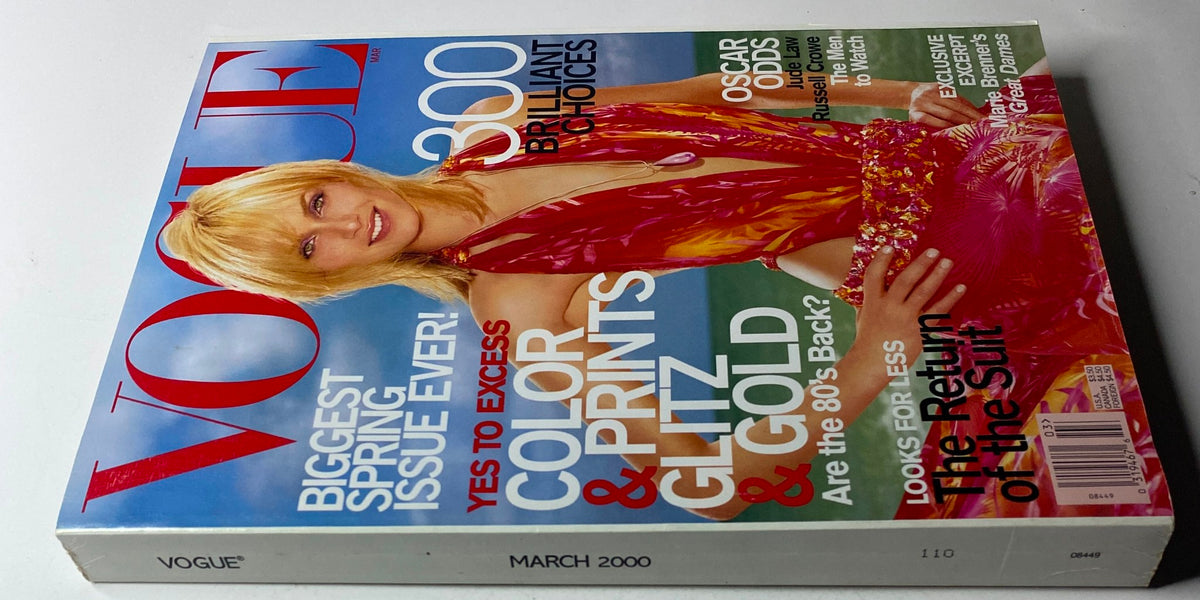
This copy is identified as a no-label newsstand edition in very good condition with only minor edge wear — a strong condition profile for a twenty-five-year-old fashion magazine that indicates careful storage rather than active handling. The absence of a mailing label preserves the Amber Valletta cover surface as originally printed, without the subscription label adhesive damage that affects the cover presentation of mailed copies — a meaningful distinction for a cover whose photographic quality is central to its collectible appeal. The very good grade with minor edge wear only indicates a copy stored consistently rather than frequently handled, with cover and interior page integrity well maintained. The plastic protective sleeve provides ongoing conservation value and indicates deliberate preservation-conscious storage. For a Vogue issue of this editorial richness and historical specificity — the millennium's opening March, with its Calvin Klein, Sofia Coppola, and Irving Penn features alongside Amber Valletta's cover — a no-label newsstand copy in very good condition represents the type of well-preserved and complete example that serious turn-of-the-millennium fashion magazine collectors actively seek.
Looking for More Issues Like This?
A no-label Amber Valletta Vogue from March 2000 — with its exceptional editorial depth, its Sofia Coppola and Calvin Klein features, and its turn-of-the-millennium cultural stocktaking — is a more substantive collecting target than most fashion magazine covers from this era, and if this issue has already found a home, the broader vintage Vogue collection at OriginalMagazines.com is an excellent resource for other significant turn-of-the-century covers and editorially rich issues from the Wintour era. Collectors focused on the specific cultural moment of the year 2000 — its aesthetic inheritances, its emerging figures, and its particular combination of retrospection and anticipation — will also find it rewarding to browse the full 2000 magazine archive, which brings together fashion, culture, and general interest publications from a year whose self-conscious position at the millennium's opening gave its editorial content an unusual quality of historical self-awareness.