




Description
Collector's Note – Why This Issue Matters
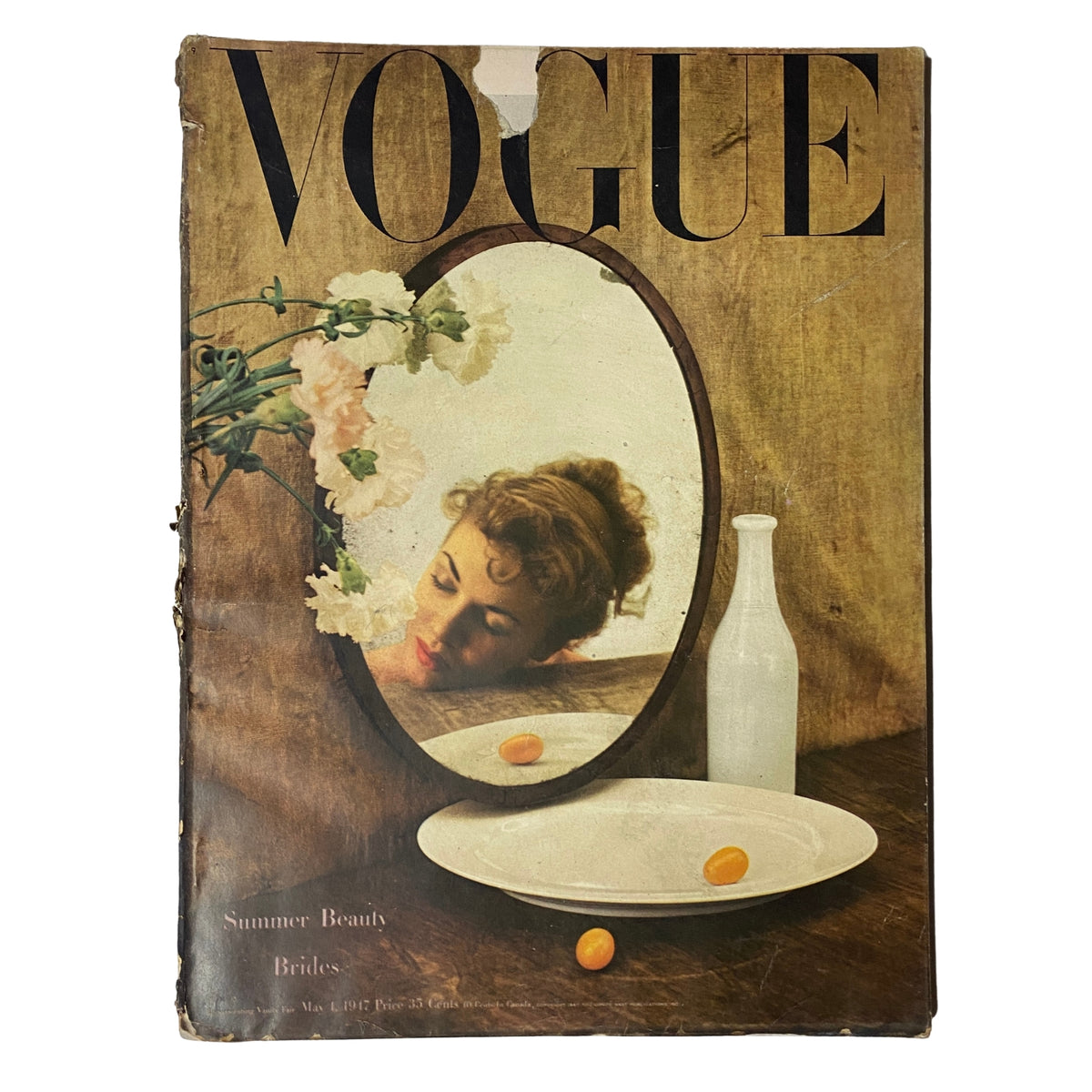
May 1, 1947 sits at one of the most luminous moments in Vogue's twentieth-century history. The war was two years over, Paris couture was reasserting itself after the occupation years, and American fashion photography was in the middle of a quiet revolution. Irving Penn had joined Vogue's staff in 1943 and by 1947 was producing cover work that would define the magazine's visual identity for decades — clean, formally precise, deeply attentive to light and surface, with a psychological stillness that set his images apart from the more theatrical glamour photography that had preceded him. A Penn cover on a bridal and summer beauty issue from this specific year represents one of the cleaner intersections of his developing aesthetic and Vogue's postwar editorial ambitions.
The editorial content documented in the full table of contents makes this issue substantially richer than a typical single-theme number. The summer beauty coverage is extensive — running across more than fifty pages with dedicated sections on complexion, coiffure, fashion, and bridal styling — but the "People and Ideas" section reveals the magazine's broader cultural reach. A feature on Joyce's Dublin by Constantine P. Curran, who was a personal friend of James Joyce and one of the few people photographed at his side in the famous 1904 image, sits alongside a medical feature on heart disease and a social commentary piece on youth. The presence of Baroness Eric de Rothschild in the society coverage and the Paris fashion notes reflect Vogue's role as a bridge between American and European cultural life at the precise moment when that bridge was being rebuilt after years of wartime rupture.
For collectors focused on Irving Penn's magazine work, this issue falls within his most creatively active early period — the years before his first solo exhibition in 1952 when his Vogue covers were establishing the visual language he would refine for the rest of his career. Penn covers from 1947 in collector-grade condition are meaningful finds for anyone building a serious Penn archive or a broader collection of magazines from 1947 that document the postwar cultural recovery in fashion, art, and public life.
About the Publication
Vogue, founded in 1892 and acquired by Condé Nast in 1909, was by 1947 the unquestioned authority in American fashion publishing and one of the most visually sophisticated magazines in the world. Its May 1 issue was a semi-monthly publication — Vogue published twice monthly during this era — and the May 1 date traditionally anchored the magazine's transition into summer fashion and beauty coverage, making it one of the more editorially significant issues of the annual calendar. Under editor Edna Woolman Chase, who led the magazine from 1914 to 1952, Vogue maintained its identity as both a fashion authority and a serious cultural publication, commissioning writers, artists, and photographers at the highest levels of their fields. The postwar years under Chase represented a particularly rich editorial period as the magazine navigated the transition from wartime constraints to the renewed luxury and optimism of the late 1940s.
Key Highlights Inside
- Irving Penn cover celebrating summer beauty and bridal fashion — one of his early Vogue covers from the period when he was establishing the precise, light-sensitive visual language that would define his decades-long association with the magazine.
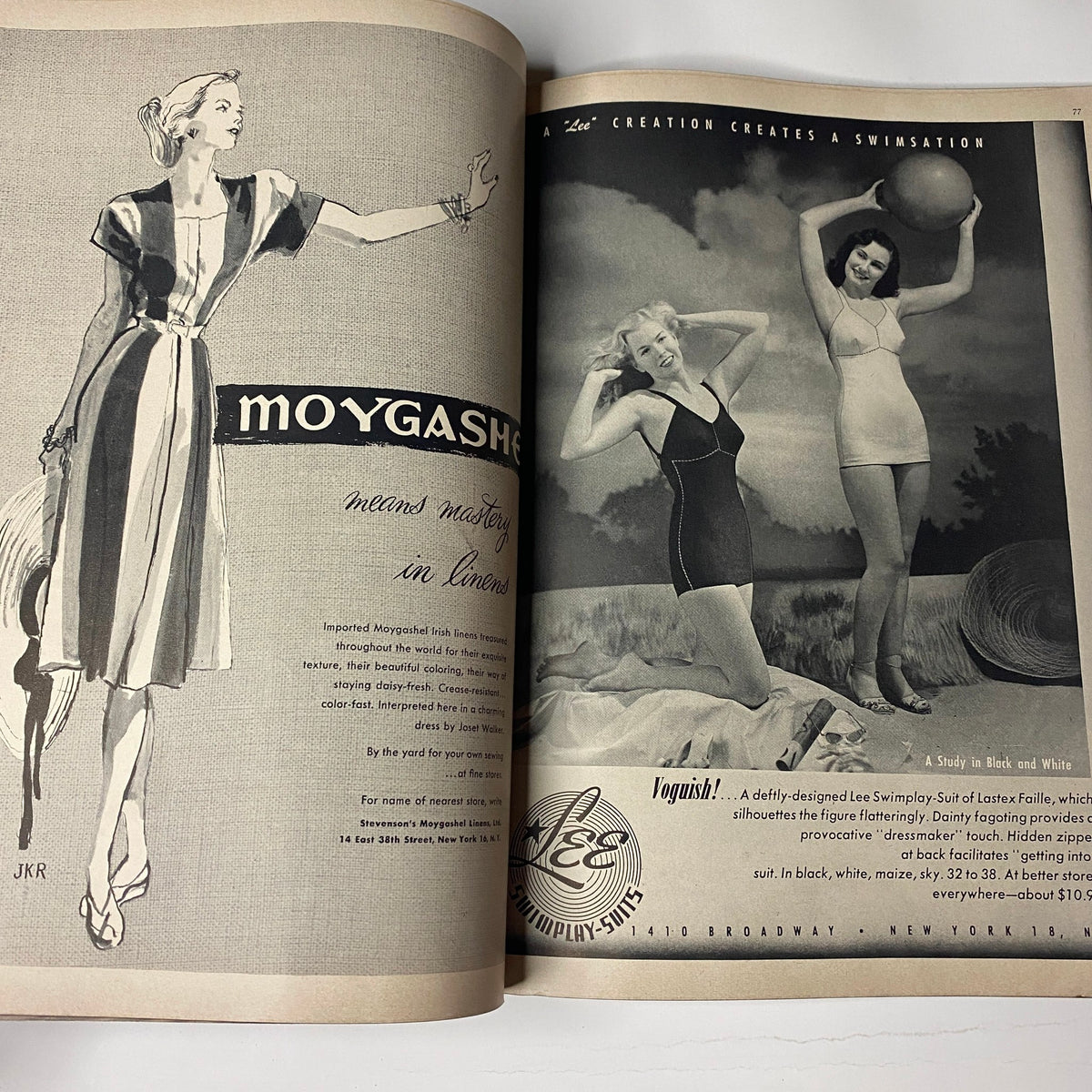
- An extensive summer beauty package running across more than fifty pages, covering complexion care, coiffure, pink-and-white fashion, sea-shell shades, bridal and bridesmaid styling, and the season's twelve most photographed beauties.
- Paris fashion notes and Paris fashions coverage, documenting the reassertion of French couture in the first full postwar years — a moment of genuine historical significance for the relationship between American and European fashion.
- "Joyce's Dublin" by Constantine P. Curran — a literary and cultural feature by one of James Joyce's closest personal friends, representing the depth of non-fashion editorial content that distinguished Vogue from purely commercial fashion publications.
- Society coverage featuring the Baroness Eric de Rothschild, alongside Allene Talmey's "Vogue's Spotlight" — the magazine's regular survey of cultural and social figures of the moment.
- Bridal editorial content including sterling silver for the bride and season's bridal fashion coverage, alongside Vogue's original dressmaking designs — a combination that made this issue a practical resource as well as an aspirational one for its original readership.
Condition & Rarity
This issue comes from a privately held Vogue archive spanning the 1920s through 1970s, stored away for decades before recently being brought back into circulation. The collector handling these issues performed light, dry surface cleaning — vacuum, brush, and smoke sponge only, no wet methods — and placed each issue in a new archival sleeve before offering it. What to expect in any surviving copy of this issue: honest vintage traits consistent with long mid-century storage, including binding wear or small spine splits, staple-rust halos around the staples, edge toning, and period shelf dust that may appear as black residue along the spine. Interiors are described as dry and legible — the most consequential condition factor for research and reading use. Some copies from this archive retain a light vintage paper aroma typical of mid-century magazines. The archival sleeve and upright storage provide ongoing stabilization. For a semi-monthly Vogue from 1947, Good condition with these documented vintage traits represents a sound and honest survival, and the provenance from a single long-held private archive adds coherence to the condition narrative.
Looking for More Issues Like This?
Irving Penn covers from Vogue's late-1940s run are among the more purposefully collected items in the magazine's long archive, and a May 1947 issue with a complete documented table of contents this rich is a find that fashion history collectors and Penn enthusiasts will recognize immediately. If this issue has already found a home, the Vogue collection at OriginalMagazines.com is the best place to explore other available issues from across the magazine's century of publication. The 1947 magazine collection is also worth browsing for collectors building a broader archive of postwar American cultural and fashion publishing.