





Description
Collector's Note – Why This Issue Matters
May 15, 1942 is a publication date of specific and historically concentrated significance, and this Vogue issue — photographed by John Rawlings, featuring Maureen Zollman, organized around "The Look-Alive Look in Beauty" — is a primary document of American fashion and women's culture at the most acute phase of wartime mobilization. The United States had been at war for just five months following Pearl Harbor's December 7, 1941 attack, and the specific atmosphere of May 1942 was one of total wartime reorganization — rationing was being implemented, women were being recruited into the workforce and military auxiliary roles, and the question of how a fashion magazine should address its readership in conditions of genuine national emergency was being actively answered by publications like Vogue in real time. The "Look-Alive Look in Beauty" thematic concept — the specific framing of beauty as vitality, energy, and morale rather than luxury or adornment — is a primary document of how Vogue was navigating that editorial challenge, constructing a vocabulary of appearance that was simultaneously aspirational and practically wartime-appropriate. The "Will American Women Be Like These British?" feature by Lesley Blanch on pages 70-71 is a primary source document of particular significance: Blanch was a major British cultural writer — her later The Wilder Shores of Love (1954) would establish her as one of the most significant travel and cultural writers of the century — and her May 1942 Vogue feature comparing British and American women's wartime roles is a primary document of the transatlantic wartime conversation about gender, duty, and civilian participation from a specifically British insider perspective. For collectors building an archive of Vogue magazine issues from the wartime period, this May 15, 1942 edition is among the most specifically historically documented entries in the publication's early-wartime catalog.
John Rawlings's cover photography of Maureen Zollman is a primary visual document of one of the most accomplished Vogue photographers of the mid-century period working in the specific conditions of early wartime American fashion photography. Rawlings had been shooting for Vogue since 1936 and his wartime work represents a specific adaptation of his technical and aesthetic intelligence to a commercial and cultural context in which luxury signaling had become politically problematic and the editorial brief had shifted toward energy, confidence, and practical beauty. A Rawlings cover from May 1942 is therefore a primary document of fashion photography navigating that specific adaptation at the beginning of the American wartime experience rather than in its middle or late phases. The Frank Crowninshield "Talent Scouts for Art" feature on pages 54-55 is a primary bibliographic document of the founding editor of the original Vanity Fair contributing to Vogue — a primary source of one of the most significant figures in American cultural journalism at a specific wartime career moment. The "Stage Door Canteen" feature on pages 44-45 is a primary document of the legendary New York entertainment venue that had opened in March 1942 at the 44th Street Theatre, where Broadway performers entertained Allied servicemen — a May 1942 Vogue engagement with the Stage Door Canteen just two months after its opening is a contemporaneous primary source of that institution at its inaugural moment. Collectors researching Vogue and fashion magazines from 1942 will find this May 15 edition a primary source of unusual depth across fashion photography, cultural journalism, and wartime women's history.
"The Lady Is an Engineer — Patricia Strauss" on page 52 and "Will American Women Be Like These British?" by Lesley Blanch collectively constitute a primary source record of the specific wartime gender role conversation that was redefining American women's public identity in May 1942. Strauss's engineering profile is a primary document of the professional role expansion that wartime labor demands were forcing on American society at a historically specific moment — just months into the war when the civilian workforce transformation was beginning but not yet complete. The "No Hits, No Runs, No Women" feature on pages 50-51 adds a further dimension of the wartime workplace gender conversation, and the "Second Helpings of Energy" feature by Mona Gardner on pages 66-67 reflects the specific wartime nutritional and physical vitality discourse that gave the "Look-Alive" thematic concept its practical grounding. This issue comes from a privately held Vogue archive spanning the 1920s through the 1970s, stored for decades before conservation treatment and archival resleeving.
About the Publication
Vogue was founded in 1892 and has been published by Condé Nast since 1909, operating continuously as the most authoritative fashion magazine in the American market across more than a century of publication. The wartime Vogue of May 1942 was navigating the most significant editorial challenge in its modern history — addressing a readership whose lives had been completely transformed by the war while maintaining the fashion authority and cultural intelligence that gave the publication its identity. The specific combination of John Rawlings's photography, Lesley Blanch's British wartime perspective, Frank Crowninshield's cultural journalism, and the Stage Door Canteen documentary content in a single May 1942 issue reflects the publication's characteristic response to that challenge: bringing the full range of its contributor relationships to bear on the specific questions of beauty, role, and culture that the war was generating for its readership. This issue comes from a privately held Vogue archive spanning the 1920s through the 1970s.
Key Highlights Inside
- John Rawlings cover photograph of Maureen Zollman — a primary visual document of one of Vogue's most accomplished mid-century photographers adapting his aesthetic intelligence to the specific conditions of early wartime American fashion photography, produced just five months after Pearl Harbor at the moment when the editorial brief for beauty and fashion imagery was being fundamentally rewritten by wartime necessity.
- "Will American Women Be Like These British?" by Lesley Blanch on pages 70-71 — a primary document of the future author of The Wilder Shores of Love contributing a transatlantic wartime gender comparison to Vogue in May 1942, constituting a primary source of the British insider perspective on American women's wartime role transformation at the specific early-mobilization moment of May 1942.
- "Stage Door Canteen" feature on pages 44-45 — a contemporaneous primary document of the legendary New York wartime entertainment venue just two months after its March 1942 opening, constituting a primary source record of that institution at its inaugural moment and reflecting Vogue's engagement with the specific cultural infrastructure of civilian wartime support.
- Frank Crowninshield "Talent Scouts for Art" on pages 54-55 — a primary bibliographic record of the founding editor of the original Vanity Fair contributing cultural journalism to Vogue in May 1942, constituting a primary source of one of the most significant figures in American cultural journalism at a specific wartime career moment.
- "The Lady Is an Engineer — Patricia Strauss" on page 52 and "No Hits, No Runs, No Women" on pages 50-51 — primary documents of the specific wartime gender role conversation redefining American women's professional and public identity in May 1942, the professional role expansion forced by wartime labor demands documented at the specific early-mobilization moment when that transformation was beginning.
- "The Look-Alive Look in Beauty" complete editorial architecture across pages 25-43 and 74, summer fashion and beach content across pages 46-73, and Loretta Young fashion feature on page 37 — the full wartime beauty, fashion, and celebrity documentation range of a May 15, 1942 Vogue documented with the page-level specificity that makes this table of contents an unusually complete primary source of American wartime fashion culture at its most historically specific inaugural moment.
Condition & Rarity
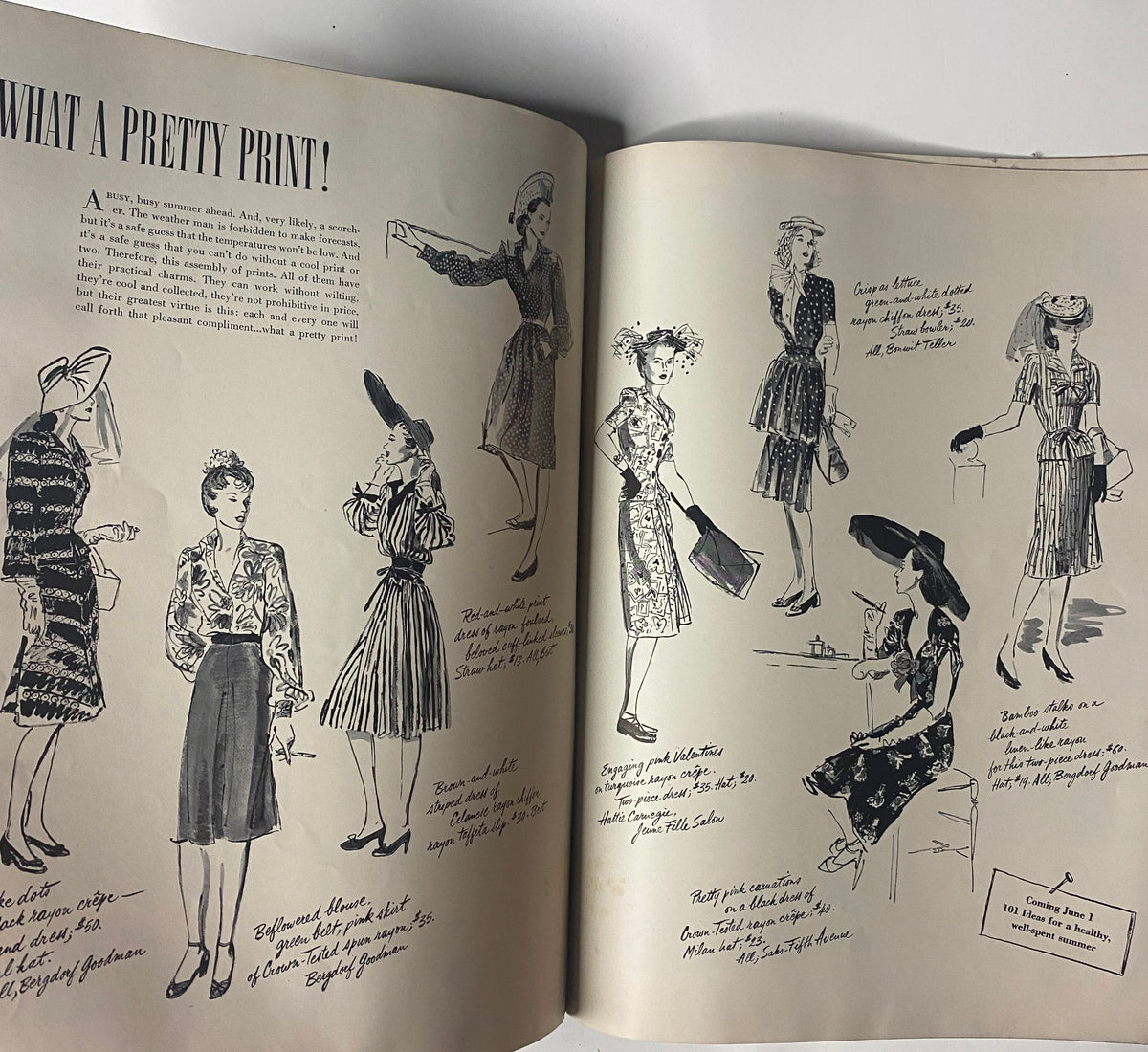
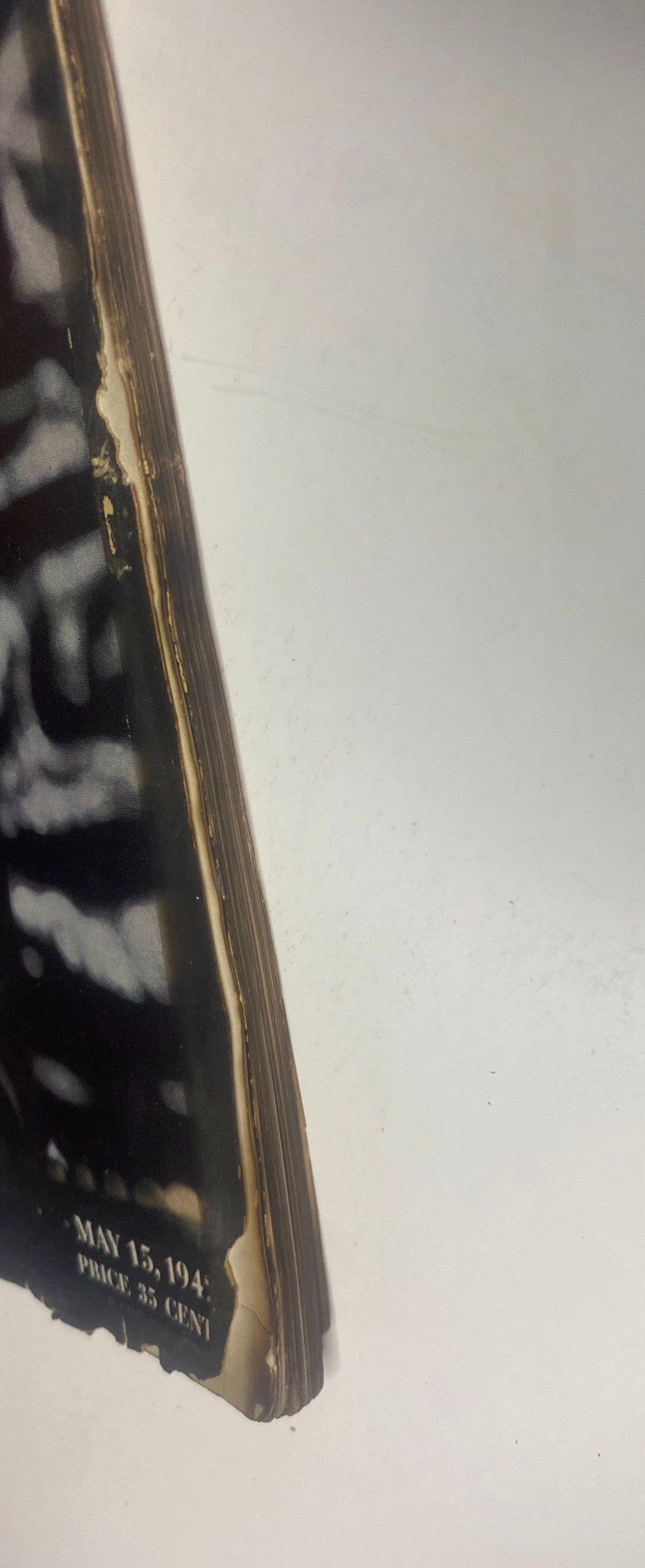
This issue comes from a privately held Vogue archive spanning the 1920s through the 1970s, stored away for decades before being brought back into circulation with light dry surface cleaning and archival resleeving. The binding wear, staple-rust halos, edge toning, and period shelf dust noted in the collection description are honest and expected characteristics of an eighty-four-year-old bimonthly fashion magazine from long-term archival storage. Good condition with legible interiors is an appropriate and meaningful descriptor for a publication of this age — it confirms that the Rawlings cover portrait and the full documented editorial contents, including the Lesley Blanch wartime gender essay, the Stage Door Canteen feature, and the Crowninshield cultural journalism, remain structurally intact and visually accessible despite the external evidence of more than eight decades of existence. The plastic protective sleeve provides ongoing archival protection for a publication whose paper chemistry makes continued careful storage essential. Collectors evaluating surviving examples should prioritize the Rawlings cover image integrity, the completeness of the Lesley Blanch and Crowninshield essays, and the overall structural soundness of the staple binding as primary condition criteria for a publication of this historical significance and age.
Looking for More Issues Like This?
An archive copy of Vogue May 15, 1942 with John Rawlings cover photography, Lesley Blanch's transatlantic wartime gender essay, the Stage Door Canteen inaugural documentation, Frank Crowninshield's cultural journalism, and the full "Look-Alive Look in Beauty" wartime editorial concept is among the most specifically historically documented early-wartime Vogue entries in the publication's archive — the convergence of Rawlings photography, Blanch's future literary significance, Crowninshield's cultural history, and the Stage Door Canteen's opening-months documentation gives this issue a primary source profile extending across fashion photography history, wartime women's history, and American cultural institution history simultaneously. If this issue is no longer available, the full Vogue collection at OriginalMagazines.com is the most comprehensive place to browse surviving issues from across the magazine's history and locate other Rawlings wartime covers, early-wartime editions, or significant issues from Vogue's most historically challenging decade. The 1942 magazine collection brings together issues from across that year's major publications for collectors interested in the full range of American fashion and cultural print journalism during the first full year of American wartime mobilization.