





Description
Collector's Note – Why This Issue Matters
The May 1991 issue of Vogue Magazine featuring Kim Basinger, photographed by Herb Ritts, arrives at a remarkable convergence of three forces that defined the visual culture of the early 1990s: a major Hollywood actress at the peak of her cultural visibility, one of the most celebrated photographers of his generation, and a fashion magazine navigating the transition from the maximalism of the 1980s into the cleaner, more body-conscious aesthetic that would define the decade ahead. Herb Ritts was, by 1991, one of the most recognizable names in fashion and celebrity photography — his distinctive black-and-white aesthetic, his ability to combine classical sculptural references with contemporary sensuality, and his specific talent for making his subjects look both idealized and deeply present had made him the defining photographer of a particular Hollywood glamour tradition. A Ritts cover for Vogue was never merely a photograph; it was a visual argument about how a particular woman should be seen, and his May 1991 Kim Basinger cover belongs to the canon of his most significant published work.
Kim Basinger's presence on this particular cover is worth examining in its specific context. The interior feature — Jonathan Van Meter's profile titled "Kim Up Close" — is described in the table of contents as engaging with "the Oscars uproar, the Prince period, the marrying man mellow, and now the good news." This framing references a series of high-profile events in Basinger's public life: her notorious withdrawal from the film Boxing Helena, which resulted in a lawsuit and a bankruptcy filing; her relationship with the musician Prince; and her marriage to Alec Baldwin, which had taken place in 1993 — though the "marrying man mellow" reference and the May 1991 date suggest this was likely anticipatory or referred to their relationship at the time. Basinger was one of Hollywood's most discussed and genuinely complex public figures in this period, and a Vogue cover profile allowed her to address her public image directly in the most prestigious fashion media context available. Collectors who follow Basinger's magazine presence across her career will find related material in the Kim Basinger magazine collection at OriginalMagazines.com.
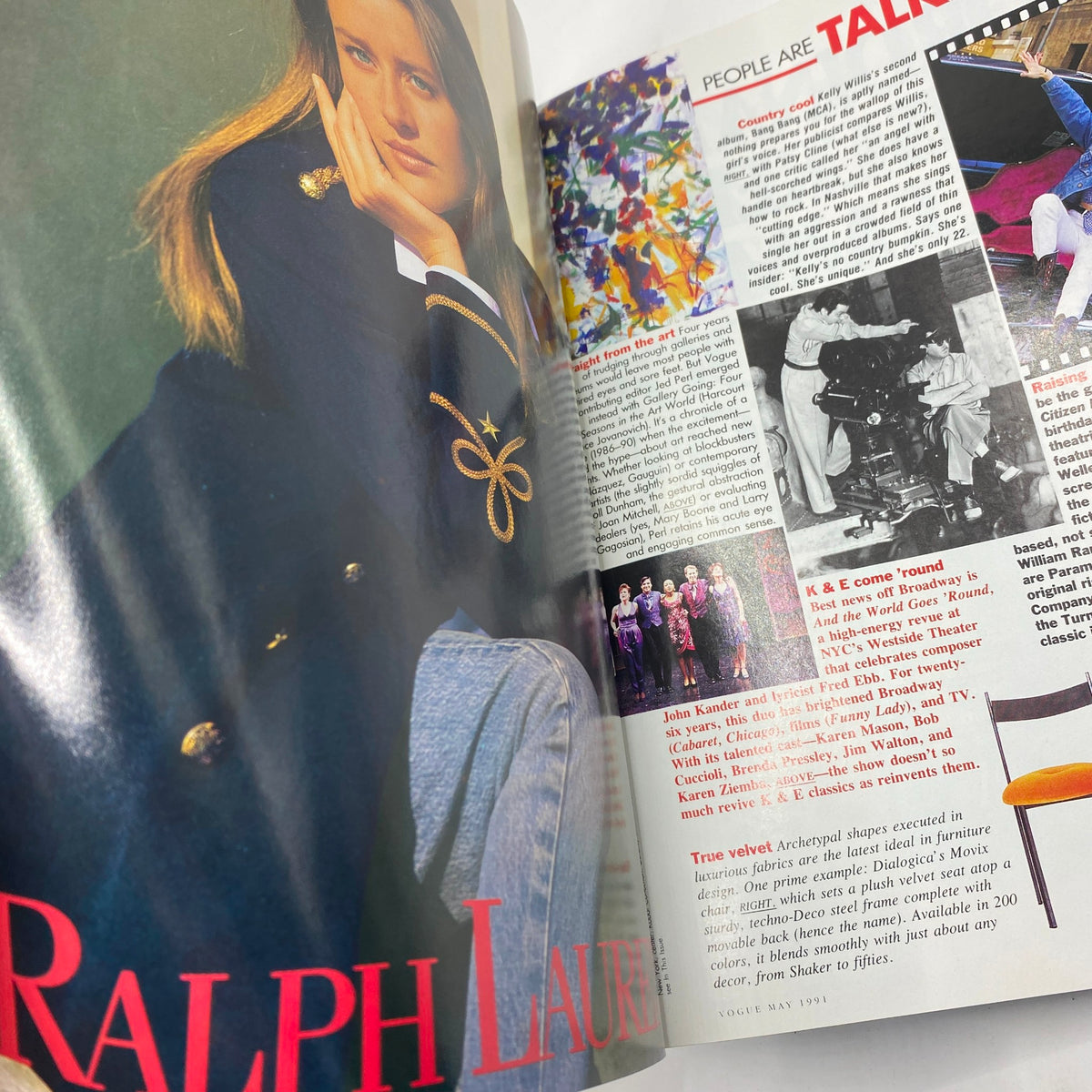
The table of contents for this issue reveals a Vogue operating at the full breadth of its editorial ambition in the spring of 1991. Alongside the fashion and beauty coverage that anchored every issue, this May edition includes a substantive investigation of the American healthcare crisis by Steve Fishman — a piece that was, in 1991, engaging with a policy debate that would culminate in the Clinton administration's failed healthcare reform effort two years later. The profile of Mick Jagger and Jerry Hall in Mustique, the Broadway coverage of The Will Rogers Follies, and Maureen Dowd's piece on Kitty Kelley's Nancy Reagan biography round out a table of contents that reflects Vogue's consistent ambition to be something more than a fashion magazine — a document of cultural life in its full complexity. For collectors assembling a picture of early-1990s American cultural life, the Vogue Magazine archive at OriginalMagazines.com and the complete 1991 magazine collection both provide essential surrounding context.
About the Publication
Vogue Magazine was founded in 1892 and had established itself by 1991 as the world's most authoritative fashion magazine — the publication against which all other fashion media measured itself and the cover of which represented the highest tier of recognition for any model, actress, or public figure in its pages. Under the editorship of Anna Wintour, who had taken the helm in 1988, the magazine was in the process of a significant editorial transformation — broadening its cultural scope, integrating celebrity and entertainment culture more deliberately into its fashion coverage, and commissioning the most significant photographers and writers working in any genre. The Herb Ritts association was central to this era's visual identity, and the magazine's willingness to commission serious journalism alongside its fashion features gave issues from this period a cultural weight that distinguished them from purely aspirational lifestyle publications.
Key Highlights Inside
- Cover photograph of Kim Basinger by Herb Ritts — one of the defining celebrity-fashion photographer collaborations of the early 1990s, produced at the peak of both subjects' cultural visibility and representing a significant document in the visual archives of both Ritts's published work and Basinger's public image.
- "Kim Up Close" by Jonathan Van Meter — an extended profile engaging with Basinger's public controversies, her Hollywood career, and her personal life, representing the kind of substantive celebrity journalism that distinguished Vogue's editorial approach under Anna Wintour from the purely reverential celebrity coverage that dominated competing publications.
- "In Sickness and in Debt" by Steve Fishman — a cross-border investigation of the American versus Canadian healthcare systems, published in May 1991 at the beginning of the national conversation that would culminate in the Clinton healthcare reform debate, demonstrating the magazine's consistent ambition to address serious policy questions alongside its fashion coverage.
- "The Jagger Mystique" by Stephanie Mansfield — a profile of Mick Jagger and Jerry Hall at their private retreat on Mustique, capturing the specific register of early-1990s celebrity culture at its most glamorously international.
- Broadway coverage of The Will Rogers Follies by John Heilpern, alongside Maureen Dowd on Kitty Kelley's Nancy Reagan biography — editorial range that reflects Vogue's deliberate positioning as a cultural magazine of record as well as a fashion authority.
- Comprehensive beauty, fragrance, fitness, and lifestyle coverage including contributions from Jeffrey Steingarten on water, Mary Roach on bone health, and travel journalism on Costa Rica — the full cross-section of the educated American woman's cultural life that Vogue documented in every issue of this era.
Condition & Rarity
Surviving copies of this issue are described as carrying no mailing label — the consistently preferred configuration among serious Vogue collectors, for whom the visual integrity of the cover photograph is the primary collector consideration. The absence of an address label preserves the Herb Ritts Basinger cover image in its printed form, without the adhesive damage and paper disruption that subscription labels introduce to the cover surface — a particularly significant detail for a cover whose photographic quality is itself the primary collector value. The protective plastic covering reflects deliberate archival care. When evaluating any surviving copy of this issue, collectors should prioritize the surface clarity and color integrity of the Ritts cover photograph, the absence of label damage, the completeness of all interior pages against the documented table of contents, and the overall integrity of the spine and binding — the combination of factors that determines whether a given copy fully delivers on the visual and editorial significance this issue represents.
Looking for More Issues Like This?
A label-free copy of this specific issue — with its Herb Ritts cover, its Kim Basinger profile, and its full table of contents intact — is a strong find for collectors at the intersection of fashion photography history, early-1990s celebrity culture, and Vogue's editorial peak under Anna Wintour. If this one has already moved on, the Kim Basinger magazine collection at OriginalMagazines.com is the most focused starting point for related material. The Vogue archive covers the publication's long run of landmark covers and fashion journalism, and the 1991 magazines collection brings together material from across multiple publications documenting the cultural landscape of the early decade.