
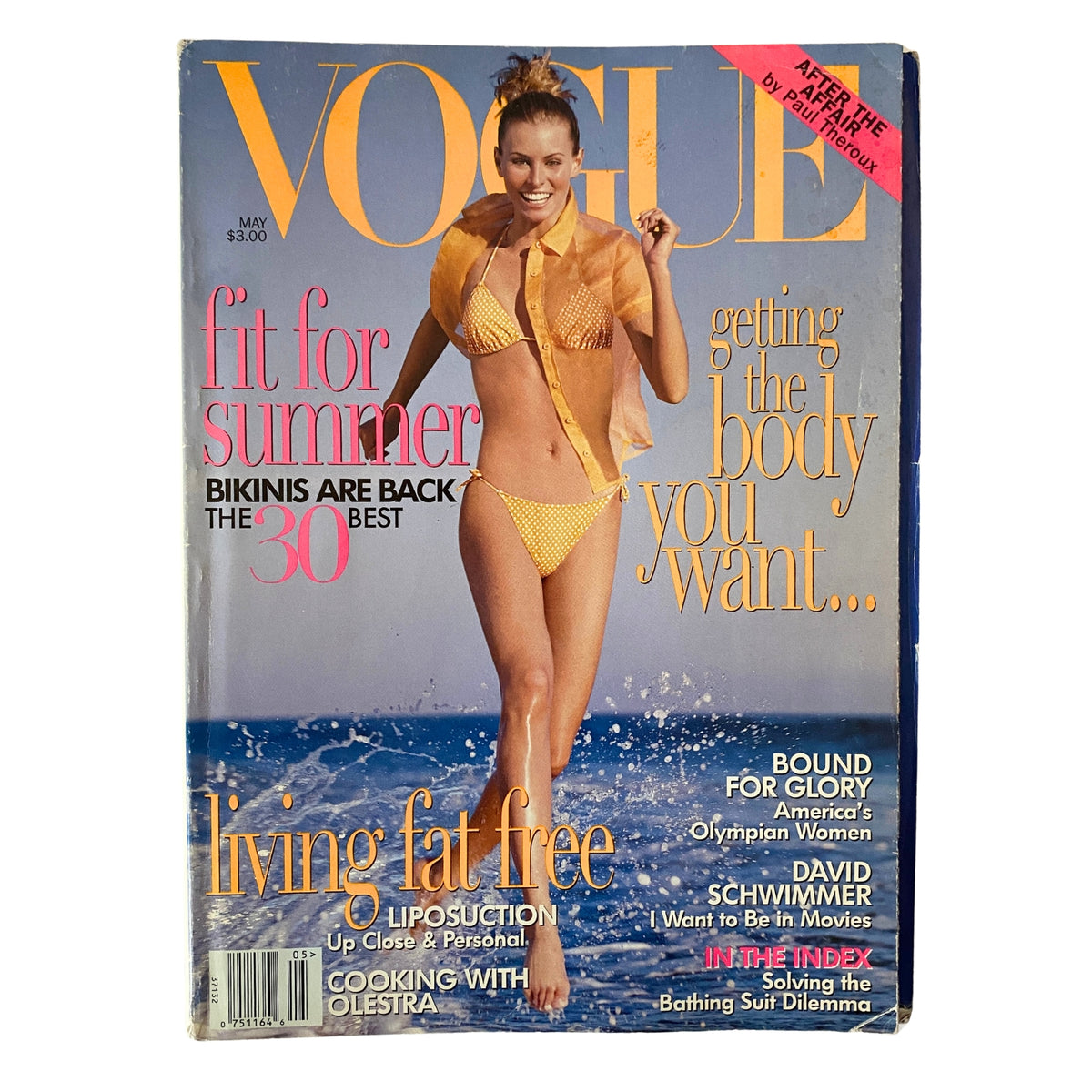


Description
Collector's Note – Why This Issue Matters
The May 1996 issue of Vogue featuring Naomi Campbell and Niki Taylor on the cover documents the supermodel era at a specific and historically interesting moment in its arc. By spring 1996 the classic supermodel configuration — the simultaneous, mutually reinforcing dominance of a small group of models whose names were as recognizable as their faces — was beginning to show the first visible signs of the fragmentation that would characterize the late 1990s modeling landscape. Campbell and Taylor on the same cover is a deliberate editorial statement: two of the era's most prominent names presented together, the classic supermodel formula applied in its most concentrated form. Campbell's career had been defined by controversy and achievement in roughly equal measure through the first half of the decade, and her continued presence on the highest-profile covers confirmed that the industry's investment in her was undiminished. Taylor, whose career had begun with an extraordinary early trajectory — a Vogue cover at seventeen — was by 1996 a fully established presence in the highest tier of editorial work. Together they represent, on this cover, the late supermodel era's commercial and editorial confidence at the moment before the cultural shift toward less name-branded modeling began to reshape the industry's priorities. Collectors focused on Niki Taylor's career documentation will find the Niki Taylor magazine archive at OriginalMagazines.com an essential resource, and those building a comprehensive record of Vogue's supermodel era covers will find the Vogue archive equally valuable.
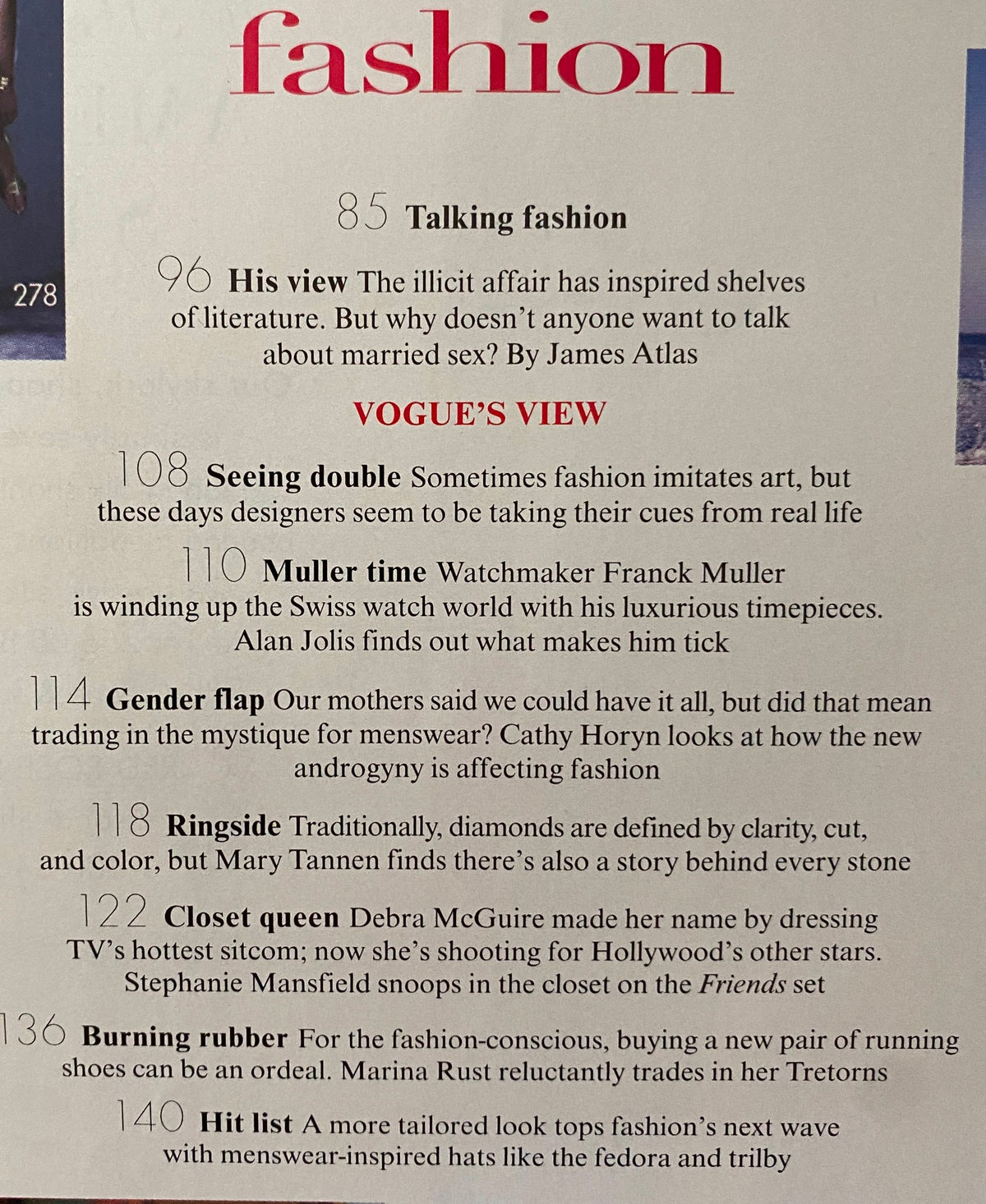
The editorial contents of this issue are particularly well-documented and reward close reading as period cultural analysis. Cathy Horyn's "Gender Flap" — explicitly framed as an examination of how the new androgyny is affecting fashion — is a primary document of one of the mid-1990s' most actively discussed aesthetic developments. The androgynous and gender-fluid looks that had emerged from designers including Helmut Lang, Jil Sander, and Calvin Klein in the early-to-mid 1990s were by 1996 the subject of mainstream fashion press engagement, and Horyn — one of the most respected fashion critics of the decade — bringing her analytical attention to the question in Vogue marks the moment that conversation had moved from specialist discussion to the center of fashion's mainstream editorial agenda. The confirmed "Closet queen" feature on Debra McGuire and the Friends set is a specific and historically interesting piece of fashion-entertainment crossover journalism: Friends was at its commercial and cultural peak in the 1995–96 season, and the magazine's engagement with television costume design as a fashion subject reflects the deepening integration of Hollywood celebrity culture into Vogue's editorial framework. The 1996 magazines collection at OriginalMagazines.com provides broad context across publications from this specific year in fashion and popular culture.
The confirmed "Muller time" feature on Franck Muller watchmaking and the "Ringside" piece on diamond culture by Mary Tannen place this issue within a specific and well-documented mid-1990s luxury consumer moment: the post-recession recovery of the early Clinton years had produced a new appetite for luxury goods among the affluent readership that Vogue served, and the magazine's engagement with watches and diamonds as serious editorial subjects reflects the Wintour-era practice of treating its readers' luxury consumption as worthy of the same analytical seriousness as their fashion choices. The James Atlas piece on married sex, published in the same issue as the androgyny and luxury content, reflects the magazine's characteristic late-1990s breadth — fashion, culture, personal life, and consumer aspiration as a single continuous conversation.
About the Publication
Vogue was founded in 1892 and acquired by Condé Nast in 1909, developing over the following century into the world's preeminent fashion magazine. By May 1996, under editor Anna Wintour — who had led the American edition since 1988 — the magazine had firmly established the editorial identity that defined it through the decade: aggressive fashion coverage anchored by supermodel and celebrity cover subjects, sophisticated cultural commentary, and the authority on what mattered in fashion and culture that no competitor could match. Its monthly format produced issues of substantial editorial investment, and the confirmed contributor roster here — including Cathy Horyn, Mary Tannen, and James Atlas — reflects the quality of the writing the magazine attracted consistently across this period.
Key Highlights Inside
- Naomi Campbell and Niki Taylor cover — a dual supermodel cover documenting two of the era's most prominent names in the classic configuration of mid-1990s Wintour-era Vogue, appearing at the late peak of the supermodel format's dominance in mainstream fashion publishing.
- "Gender Flap" by Cathy Horyn (p. 114) — a confirmed critical feature examining the new androgyny's impact on fashion by one of the decade's most respected fashion critics, published at the moment this aesthetic conversation moved from specialist to mainstream editorial attention.
- "Closet queen" on Debra McGuire and the Friends set — a confirmed feature documenting the intersection of television costume design and fashion influence at the peak of Friends' cultural dominance in the 1995–96 season.
- "Muller time" on Franck Muller watchmaking and "Ringside" on diamond culture by Mary Tannen — confirmed luxury consumer features reflecting the mid-1990s recovery of high-end consumer appetite and Vogue's engagement with watches and jewelry as serious editorial subjects.
- James Atlas on married sex — a confirmed cultural feature reflecting the magazine's characteristic practice of treating its readership's personal and intimate lives as worthy of the same serious editorial attention as their fashion choices.
Condition & Rarity
The noted condition describes a good-condition copy with no mailing label and a plastic protective sleeve. The no-label status is the most significant positive condition attribute: subscriber copies of Vogue from this era routinely received address labels applied directly to the front cover, and their removal creates adhesive residue or surface paper damage that permanently affects the cover photography. A no-label copy preserves the Campbell-Taylor cover portrait in its original printed state — the preferred configuration for collectors of mid-1990s Vogue supermodel covers. Good condition with no label on a monthly magazine now approaching thirty years old indicates a copy with intact spine, sound pages, and a cover that has retained its printed surface with age-consistent wear. The plastic sleeve confirms deliberate protective storage. The confirmed table of contents and the Horyn androgyny feature give this issue a specific editorial identity that makes it more historically traceable than many issues of its era.
Looking for More Issues Like This?
Mid-1990s Vogue supermodel covers in no-label good condition are among the more actively sought configurations for collectors of the era's fashion press, and the May 1996 Campbell-Taylor cover — with its confirmed Cathy Horyn androgyny feature and Friends costume design story — offers editorial depth that extends well beyond the cover's immediate appeal. If this issue has already been claimed, the Niki Taylor magazine collection at OriginalMagazines.com is the best starting point for other issues documenting her career across publications. The full Vogue archive is worth exploring for other Wintour-era supermodel covers from the decade, and collectors drawn to the specific cultural energy of 1996 will find the 1996 magazines collection rich with period material.