




Description
Collector's Note – Why This Issue Matters
The May 1997 issue of American Vogue featuring Georgina Grenville on the cover documents one of the nineties' most distinctive and editorially valued models at the peak of her editorial career — and the surrounding content makes this a more substantively interesting issue than the cover alone would suggest. By May 1997, Grenville had established herself as one of the most sought-after editorial models of the mid-nineties, her specific qualities — an unusual, angular beauty that was less immediately commercial than the decade's more approachable supermodel faces — making her a favorite of the photographers and art directors who prioritized editorial vision over commercial appeal. A Vogue May cover featuring Grenville was a specific statement of editorial authority and aesthetic seriousness, the magazine's spring seasonal statement made with a model whose face communicated something specific about the kind of fashion confidence the publication was projecting. The full arc of Vogue's cover choices and editorial evolution across this period is traceable through the Vogue magazine collection, which allows collectors to follow the publication's visual identity through the nineties decade.
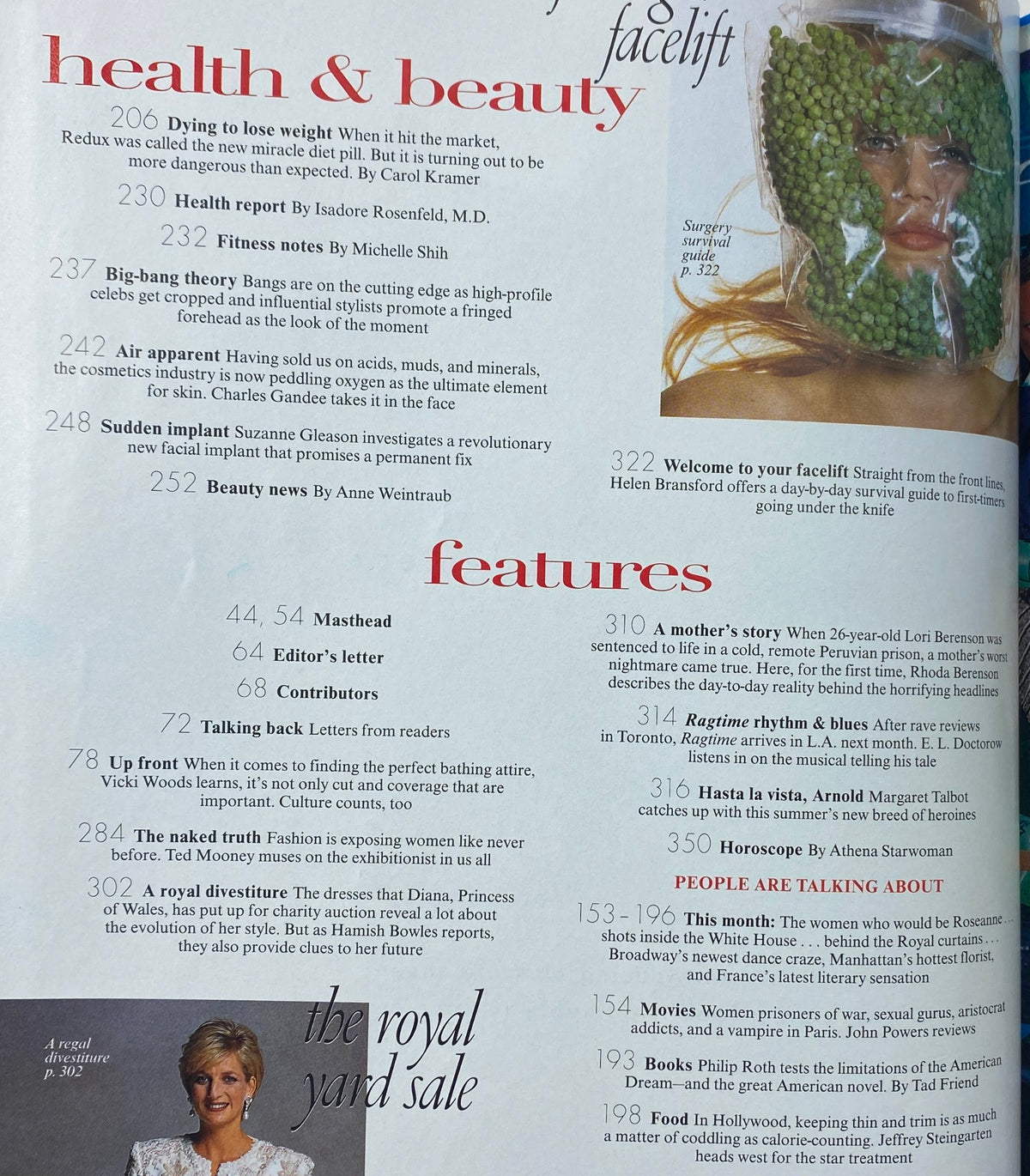
The feature content of this May 1997 issue is exceptionally rich and rewards serious research attention from multiple directions simultaneously. Hamish Bowles' feature on Princess Diana's charity auction of her dresses — "A Royal Divestiture" — is a primary document of one of the most significant fashion and cultural events of 1997, published just three months before Diana's August death would transform all coverage of her into retrospective eulogy. The specific dresses Diana chose to auction, and Bowles' reading of what those choices revealed about the evolution of her style and her future direction, constitutes primary source material of unusual value: it captures how Diana and her fashion legacy were being understood and discussed while she was still alive, before the mythology of her death had reshaped every retrospective account. The Redux diet pill investigation — "Dying to Lose Weight" — documents a specific and consequential early chapter in the modern diet drug story: Redux (dexfenfluramine) was withdrawn from the market in September 1997 due to heart valve damage concerns, and a May 1997 Vogue investigation into its dangers published four months before that withdrawal constitutes a primary document of the public health debate that preceded it. The broader late-nineties cultural context is documented across the 1997 magazine collection.
The additional features in this issue extend its research value further. E.L. Doctorow writing about the musical adaptation of his novel Ragtime provides a primary document of the author's engagement with the theatrical transformation of his most celebrated work. The Lori Berenson feature — about the American imprisoned in Peru — documents one of the most internationally discussed human rights cases of the mid-nineties. Philip Roth's work being reviewed for testing "the limitations of the American Dream and the great American novel" captures a specific moment in Roth's critical reception in 1997, the year of American Pastoral's publication and Pulitzer Prize. This combination of fashion editorial authority, investigative health journalism, royal fashion history, and serious literary and cultural commentary makes this issue one of the more substantively impressive entries in the magazine's late-nineties run.
About the Publication
American Vogue, founded in 1892 and acquired by Condé Nast in 1909, is the flagship publication of the global fashion media industry and the standard against which all other fashion magazines have historically measured themselves. Under the editorship of Anna Wintour, who took the helm in 1988, the magazine developed an editorial identity that combined fashion authority with genuine cultural and celebrity engagement — its covers became carefully negotiated statements of cultural currency, its fashion coverage engaged seriously with the economics and sociology of luxury consumption alongside the aesthetics of dress, and its feature content maintained a level of literary and journalistic seriousness that reinforced its claim to be something more than a fashion magazine. By May 1997, Wintour's tenure was in its ninth year and the magazine was operating with the full editorial confidence of a publication that understood exactly what its cover choices and feature selections communicated.
Key Highlights Inside
- Georgina Grenville May 1997 spring cover — a primary document of one of the nineties' most editorially valued models in a prestigious spring Vogue cover appearance, her angular, distinctive presence reflecting the magazine's specific aesthetic preferences at this point in its editorial identity.
- "A Royal Divestiture" (Hamish Bowles on Princess Diana's charity dress auction) — a primary document of Diana's fashion legacy published three months before her death, capturing how she and her style evolution were being understood while she was still alive, before retrospective mythology reshaped all subsequent accounts.
- "Dying to Lose Weight" (Carol Kramer on Redux diet pills) — investigative journalism published four months before Redux was withdrawn from the market due to heart valve damage, constituting a primary document of the public health debate that preceded and contributed to that withdrawal.
- E.L. Doctorow on Ragtime the musical — a primary document of the celebrated novelist's engagement with the theatrical adaptation of his most famous work, providing literary and cultural context for one of the decade's most discussed Broadway productions.
- Philip Roth literary review and Lori Berenson Peru imprisonment feature — together providing the serious literary and international human rights journalism dimensions that distinguished this issue's editorial range from purely fashion-focused content.
- Beauty features including the Redux investigation, the oxygen skincare industry analysis (Charles Gandee), and facial implant investigation (Suzanne Gleason) — together constituting a comprehensive document of mid-nineties cosmetic and wellness culture's most consequential and contested developments.
Condition & Rarity
Surviving copies of the May 1997 Vogue in very good condition represent a clean and display-quality example of one of the more substantively significant issues in the magazine's late-nineties run. Minor wear consistent with nearly three decades of age is the expected and honest condition profile of an original, unrestored periodical rather than a reproduction. The absence of a subscriber address label is a meaningful positive: the Georgina Grenville cover image survives fully intact as designed and printed, without the adhesive marks or obscured photography that subscription labels permanently leave behind. The protective plastic sleeve is the standard archival measure for a magazine of this paper stock and production quality, stabilizing further deterioration without requiring any alteration to the original item.
Looking for More Issues Like This?
A no-label very good condition copy of the May 1997 Vogue with Georgina Grenville on the cover — with the Princess Diana dress auction, Redux investigation, Doctorow, and Philip Roth content documented here — is one of the more historically layered entries in the magazine's late-nineties run, rewarding serious research attention from collectors working across fashion history, royal cultural history, public health journalism, and literary culture simultaneously. If this particular issue is no longer available, the full Vogue magazine collection at OriginalMagazines.com is the most comprehensive source for exploring other issues across the publication's long run. For collectors building a broader archive of the late-nineties cultural moment, the complete 1997 magazine collection brings together titles from one of the most consequential years in late-twentieth-century fashion and cultural history.