


Description
Collector's Note – Why This Issue Matters
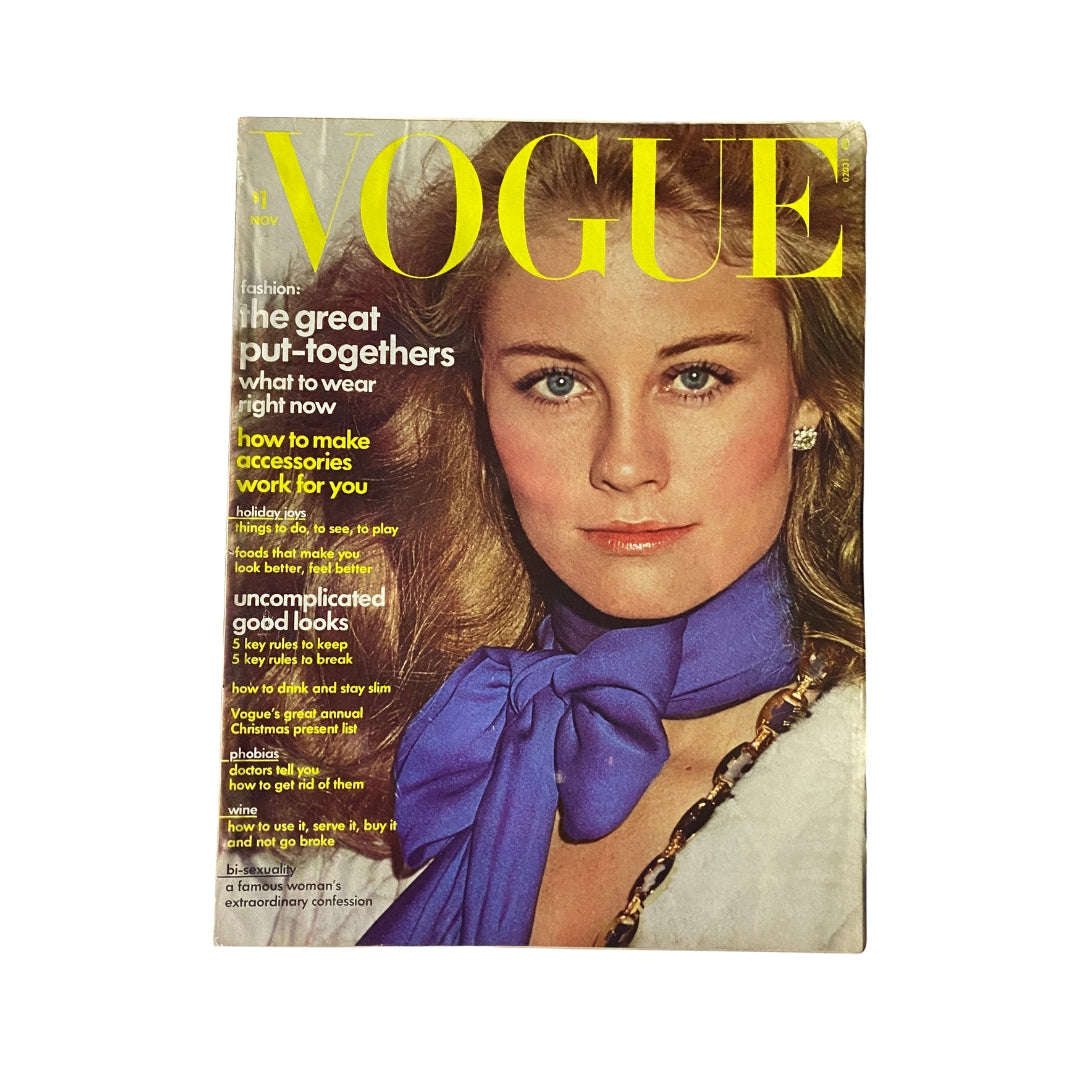
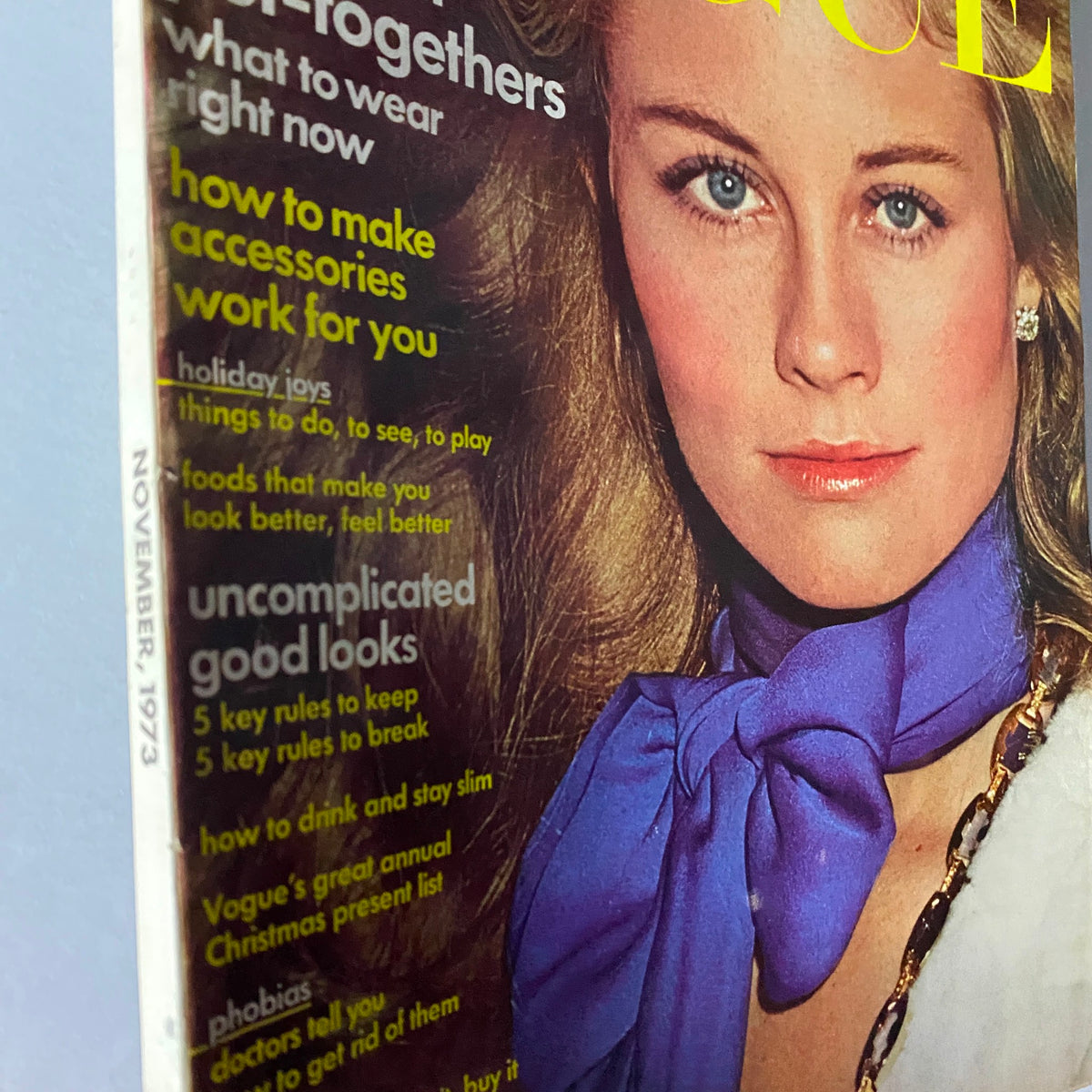
The November 1973 issue of Vogue featuring Cybill Shepherd on the cover documents the model-actress at one of the most precise and interesting moments of her cultural trajectory. Shepherd had been discovered as a model in 1968 and by the early 1970s had transitioned into film, most notably with her role in Peter Bogdanovich's The Last Picture Show in 1971 and her follow-up with Bogdanovich in Daisy Miller, which was in production around this period. Her appearance on the November 1973 Vogue cover — notably photographed in Rome in a furs editorial — places her at the intersection of the American model-turned-actress narrative and the European fashion and film world that Vogue consistently bridged. The Cybill Shepherd fur editorial in Rome was not incidental: it reflects the specific mid-1970s fashion aesthetic that was rehabilitating luxury after the austerity-inflected counterculture fashions of the late 1960s, and Rome as a setting connected the shoot to the European couture tradition that Vogue was actively re-centering in this period. Collectors who pursue vintage Vogue issues from the early 1970s will find that covers featuring American model-actresses who were simultaneously working in European film contexts are among the most culturally layered of the decade's run.
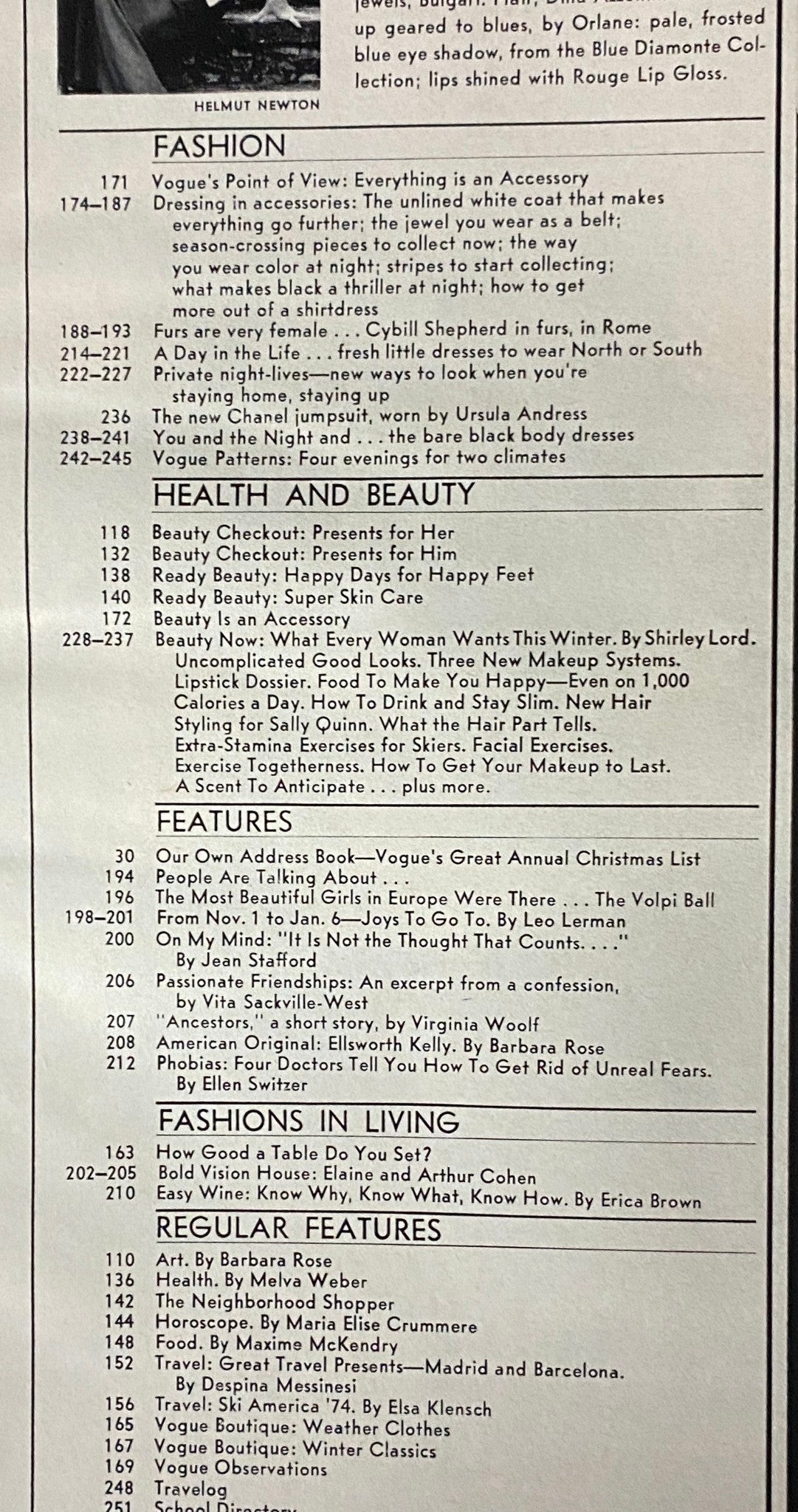
The table of contents for this issue reveals a publication operating at considerable editorial ambition. The literary content alone is remarkable: an excerpt from Vita Sackville-West described as "a confession" under the heading "Passionate Friendships," and a short story by Virginia Woolf titled "Ancestors." Including Woolf and Sackville-West — whose intimate friendship and correspondence were matters of literary record, though not widely publicly discussed in their full dimensions in 1973 — in the same issue, under the editorial framing of passionate female friendships, represents a degree of literary and cultural sophistication that defines early-1970s Vogue at its most serious. The feature by Jean Stafford — the Pulitzer Prize-winning novelist — on the philosophy of thoughtful giving, alongside a Barbara Rose essay on minimalist painter Ellsworth Kelly and coverage of the Volpi Ball in Venice, fills out a cultural range that makes this issue a genuinely dense primary document of upper-register American and European cultural life in the autumn of 1973. The full context of this pivotal year — the Watergate crisis reaching its decisive phase, the oil embargo beginning in October — is documented across the 1973 magazine archive, and this November issue sits within one of the most turbulent months of that extraordinary year.
The fashion content is equally historically specific. The new Chanel jumpsuit worn by Ursula Andress — the Swiss actress whose 1962 Dr. No appearance remained one of the defining images of 1960s cinema — documents the continued crossover between Hollywood stardom and haute couture that Vogue managed with consistent editorial authority. The accessories-centered fashion philosophy of the issue's lead fashion section, combined with the "private night-lives" and bare black body dress features, reflects the specific 1973 fashion moment: the move toward a more personal, eclectic approach to dressing that would define mid-1970s style, distinct from both the maximalist counterculture excess of the late 1960s and the power-dressing formalism of the 1980s. The Vogue Patterns section extending that editorial vision into the home-sewing market gives this issue reach beyond the luxury consumer audience into the broader American readership that engaged with high fashion through pattern-making.
About the Publication
Vogue, founded in 1892 and published by Condé Nast since 1909, was by November 1973 operating under the editorship of Grace Mirabella, who had succeeded Diana Vreeland in 1971. Mirabella's editorial vision represented a deliberate recalibration from Vreeland's theatrical maximalism toward a more wearable, accessible luxury — a fashion authority grounded in real women's lives rather than pure spectacle. The early Mirabella years are sometimes undervalued in retrospective assessments of the magazine, but they produced issues of considerable editorial depth, and the November 1973 issue's combination of serious literary contributions, fine art coverage, health and beauty journalism, and couture fashion documentation is characteristic of the Mirabella era at its most ambitious. The magazine's monthly format and national distribution made it the dominant authority on American fashion and cultural aspiration throughout this period.
Key Highlights Inside
- Cybill Shepherd cover and furs editorial in Rome — Shepherd documented at the intersection of American model-actress celebrity and European fashion photography, in a luxury furs feature that reflects the mid-1970s rehabilitation of couture after the late-1960s austerity aesthetic.
- Ursula Andress in the new Chanel jumpsuit — A fashion document pairing one of the decade's most recognizable film actresses with one of couture's most consequential design houses at a moment of significant aesthetic transition in Chanel's postwar evolution.
- Virginia Woolf short story "Ancestors" and Vita Sackville-West excerpt from "Passionate Friendships" — Literary contributions of considerable cultural weight, published together in a single issue with an editorial framing that reflects early-1970s Vogue's consistent ambition to be read as seriously as it was looked at.
- Jean Stafford essay on gift-giving philosophy — A contribution from the Pulitzer Prize-winning novelist, representative of the magazine's practice of commissioning serious American literary voices for its features sections throughout this period.
- Ellsworth Kelly profile by Barbara Rose — Coverage of one of the defining figures of American minimalism and hard-edge abstraction, written by one of the period's most respected art critics, situating fine art within the magazine's broader cultural frame.
- Health, beauty, wine, ski travel, and Christmas gift content — The November issue's full-service lifestyle coverage documents the specific consumer aspirations and leisure culture of the upper-middle-class American readership in the autumn of 1973, from Elsa Klensch on ski America to Erica Brown on wine literacy.
Condition & Rarity
Surviving copies of this issue graded excellent with light wear represent the upper range of the collector market for early-1970s Vogue issues. The magazine was printed on standard coated and newsprint stock combination typical of monthly fashion publications of the era, and copies in excellent condition after fifty-plus years will show only minimal surface aging — light toning at page edges, perhaps very minor spine stress — without the more significant wear that active readership or variable storage produces over this time span. The absence of a mailing label is a meaningful positive attribute, preserving the Cybill Shepherd cover image in its full presentation without adhesive marks or removal damage. The protective plastic sleeve is appropriate current storage for coated-stock periodicals of this age and paper weight. For any surviving copy of this issue, the condition of the cover image, the integrity of the literary content pages, and the completeness of the fashion editorial spreads are the primary collector evaluation variables.
Looking for More Issues Like This?
Early Mirabella-era Vogue issues with strong literary content, notable cover subjects, and intact no-label presentation are among the more substantive finds in the vintage fashion magazine collector market — the combination of Cybill Shepherd, Woolf, Sackville-West, and Chanel in a single November issue is not easily replicated across the decade's run. The full Vogue magazine archive at OriginalMagazines.com is the best place to browse what's currently available across the publication's history. For collectors building a broader picture of fashion, culture, and American life in this pivotal year, the 1973 magazine archive brings together issues from multiple titles that together document one of the most consequential years of the decade.