





Description
Collector's Note – Why This Issue Matters
The November 1996 issue of Vogue featuring Linda Evangelista photographed by Steven Meisel represents one of the most significant creative partnerships in the history of fashion photography at the absolute peak of its cultural influence. By November 1996, Evangelista and Meisel had already collaborated on some of the most celebrated fashion images of the decade, and their working relationship was widely understood in the fashion world as one of the most productive and creatively charged between a photographer and a model in the medium's history. Evangelista had spent the preceding decade establishing herself as the most technically versatile and creatively demanding supermodel of her generation — the one who famously declared she wouldn't get out of bed for less than $10,000 a day, and whose radical hair transformations for magazine editorials had made her as much of a visual artist as the photographers she worked with. Meisel, for his part, had become the dominant figure in American fashion photography by the mid-1990s, his covers and campaigns for Vogue setting the visual standard for an era when fashion photography was being taken more seriously as an art form than at any previous point in its history. For collectors who focus on vintage magazines featuring Linda Evangelista, a Meisel-shot Vogue cover from November 1996 represents a primary document of that creative partnership in its late-period expression — the last years of the supermodel era's unchallenged cultural dominance, before the heroin chic aesthetic and the rise of a younger generation of models began to shift the industry's visual priorities.
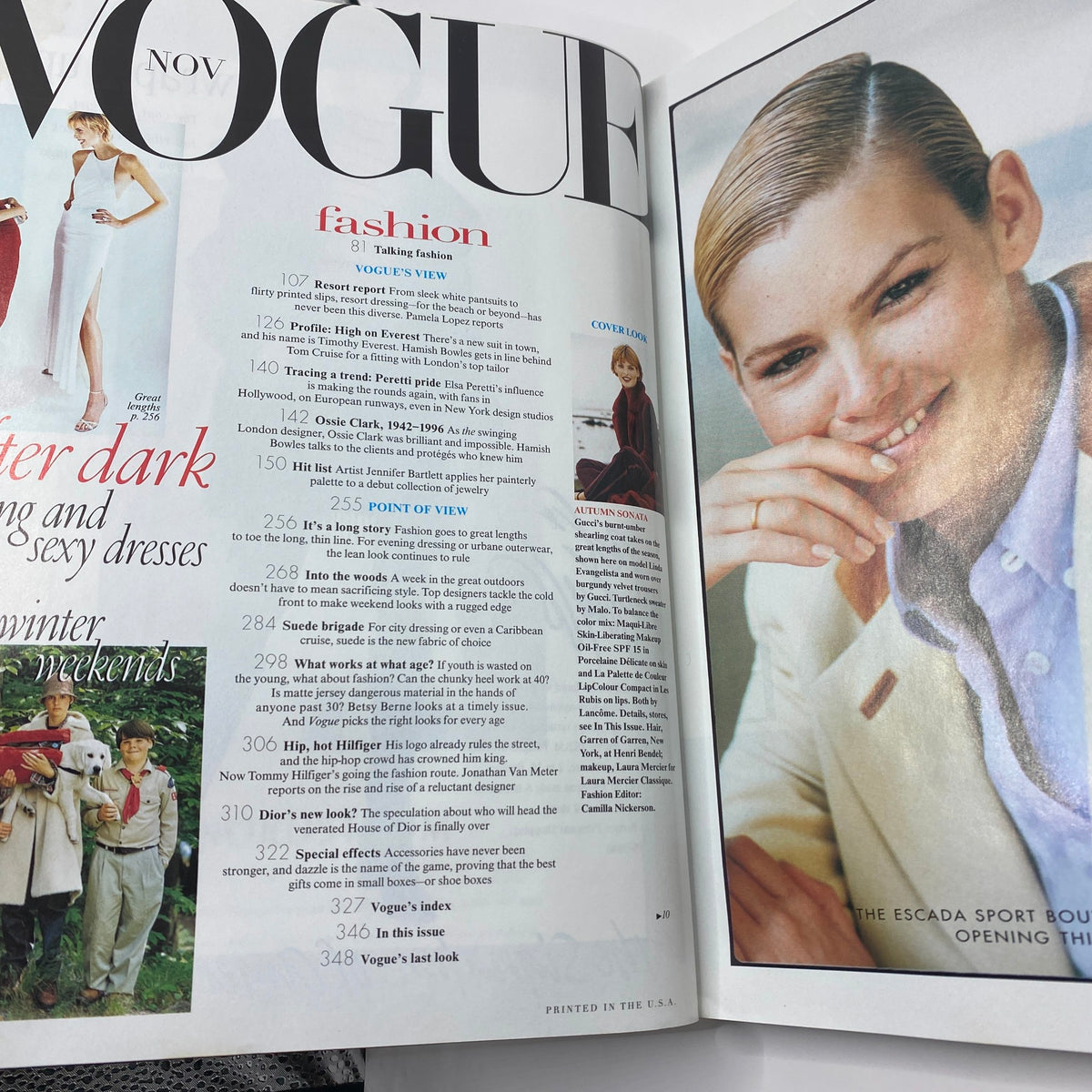
The table of contents of this issue is exceptionally well-documented and reveals an editorial package of unusual richness and historical specificity. The Jonathan Van Meter profile of Tommy Hilfiger — "Hip, hot Hilfiger" — documents one of the most consequential moments in American fashion's relationship with hip-hop culture: Hilfiger's logo had become ubiquitous in rap videos and on urban streets throughout 1994–96 in ways that the designer himself had not anticipated and that were reshaping his brand's identity and cultural meaning in real time. Van Meter's Vogue profile of this phenomenon, published in November 1996, is a primary journalistic document of that crossover at its peak moment. The Hamish Bowles tribute to Ossie Clark — who had been murdered in August 1996, just three months before this issue's publication — captures the fashion world's immediate response to the loss of one of the most significant British designers of the Swinging London era. The Timothy Everest profile, featuring Tom Cruise as a client, documents the early-1990s revival of Savile Row-influenced tailoring that would become increasingly significant through the decade. Collectors building archives around vintage Vogue issues from the mid-1990s will find this issue a document of unusual editorial depth and cultural specificity.
The broader fashion context of November 1996 adds further significance to this issue as a collecting target. The table of contents reveals a specific aesthetic moment — the "lean look," the suede brigade, the long hemlines, the resort dressing diversity, Elsa Peretti's revived influence — that is recognizably and precisely late-1996 in its preoccupations. The Dior succession story referenced ("Dior's new look? The speculation about who will head the venerated House of Dior is finally over") documents one of the most significant leadership moments in the history of the most storied house in French couture — the appointment of John Galliano to the position had been announced in October 1996, just weeks before this issue's publication. A Vogue issue that captures the Hilfiger-hip-hop crossover, the Ossie Clark tribute, and the Dior succession in the same editorial package — all framed by a Meisel-shot Evangelista cover — is a document of the fashion world at a specific and historically dense moment that rewards sustained attention from anyone building a serious archive of the mid-1990s fashion culture.
About the Publication
American Vogue, founded in 1892 and operating under editor-in-chief Anna Wintour since 1988, had by November 1996 established itself as the unchallenged authority of the American fashion press and the publication whose editorial decisions most directly shaped the industry's direction and public perception. Its collaboration with Steven Meisel — who shot more Vogue covers and editorial spreads than any other photographer of his generation — was central to the magazine's visual identity throughout the 1990s, and the Meisel-Evangelista partnership was among the most creatively significant and most frequently replicated in the publication's modern history. The magazine's audience encompassed both the fashion industry professionals and insiders who depended on it for industry intelligence and the broader educated general readership who looked to it as the authoritative guide to style and culture in the widest sense.
Key Highlights Inside
- A Linda Evangelista cover photographed by Steven Meisel — one of the most significant and most celebrated photographer-model partnerships in fashion photography history, documented in November 1996 at the late-peak of the supermodel era whose visual standards Meisel had done more than any other photographer to establish and sustain.
- "Hip, hot Hilfiger" by Jonathan Van Meter — a primary journalistic document of the Tommy Hilfiger brand's crossover into hip-hop culture, written at the precise moment when the designer's logo had achieved its maximum cultural saturation in rap videos and urban streetwear and was reshaping American fashion's understanding of the relationship between luxury branding and street culture.
- "Ossie Clark, 1942–1996" by Hamish Bowles — a tribute to the Swinging London designer who had been murdered in August 1996, published just three months after his death, capturing the fashion world's immediate response to the loss of one of the most influential and most troubled figures in British fashion history.
- "Profile: High on Everest" by Hamish Bowles — a feature on tailor Timothy Everest documenting the early-1990s revival of British bespoke tailoring and its intersection with celebrity culture, with Tom Cruise cited as a client at a moment when the tailoring revival was becoming one of the most significant stories in menswear.
- The Dior succession story — reporting on the announcement that ended months of industry speculation about who would lead the House of Dior, almost certainly referencing the October 1996 appointment of John Galliano, one of the most consequential leadership transitions in the history of French haute couture.
- "What works at what age?" by Betsy Berne — a feature engaging directly with the age politics of fashion that reflected one of the more substantive editorial concerns of mid-1990s women's magazines: the relationship between fashion, aging, and the industry's historically complicated relationship with women over forty.
Condition & Rarity
This copy is described as excellent condition, presented as a no-label newsstand edition with a plastic protective sleeve — the strongest combination of condition grade and preservation methodology available for a nearly thirty-year-old fashion magazine. The no-label status preserves the Meisel cover photograph of Evangelista as originally printed, without the subscription label adhesive damage that affects the cover presentation of mailed copies — a particularly meaningful distinction for a cover whose photographic quality is central to its artistic and collectible value. The excellent grade indicates a copy that has been stored with consistent care, with cover and interior page integrity well maintained and color fidelity preserved. The plastic sleeve provides ongoing protection against surface scratching, humidity exposure, and light damage. For a Vogue issue of this specific editorial richness — Meisel cover, Evangelista subject, Van Meter Hilfiger profile, Ossie Clark tribute, and Dior succession story all in the same edition — a no-label newsstand copy in excellent condition with a protective sleeve represents the ideal form in which a collector can acquire this historically significant document.
Looking for More Issues Like This?
A no-label Linda Evangelista cover Vogue photographed by Steven Meisel in excellent condition is a specific and highly sought find within the collector market for 1990s fashion magazine photography — this is one of the great creative partnerships of the era, and well-preserved no-label examples command consistent collector attention. If this November 1996 issue has already found a home, the dedicated Linda Evangelista magazine collection at OriginalMagazines.com is the natural first resource for collectors building a comprehensive archive of her extraordinary career. The broader vintage Vogue collection is worth exploring for other significant Meisel-era covers and editorially rich issues, and collectors focused on the cultural and aesthetic density of mid-1990s fashion will find the full 1996 magazine archive an exceptionally rewarding resource.