




Description
Collector's Note – Why This Issue Matters
November 1998 arrived at one of the most self-consciously transitional moments in modern fashion history. The industry was simultaneously processing the seismic shock of Gianni Versace's murder in July 1997, navigating the rapid commercial ascent of a new generation of superdesigners, and beginning to reckon with the internet as a force that would eventually reshape everything about how fashion was created, consumed, and communicated. Vogue's November issue — always one of the heaviest and most ambitious of the annual publishing calendar — was in 1998 a document of an industry at peak confidence and quiet anxiety in equal measure, pouring enormous creative energy into print at precisely the moment when print's cultural monopoly on fashion authority was beginning, almost imperceptibly, to loosen. The issue's internal feature "Windows '98," in which Kristina Zimbalist examines fashion's intersection with digital culture, suggests that Vogue's editors were alert to that tension even as the magazine itself represented its most lavish analogue form. Collectors researching magazines from 1998 will find this issue a remarkably self-aware document of a cultural industry standing at its own threshold.
Amber Valletta on the November 1998 cover is a precise and deliberate editorial statement. By the late 1990s, Valletta had established herself as one of the most consistently compelling and intellectually serious models of her generation — a figure whose presence on a cover signaled something more considered than pure commercial glamour. She had graced the covers of virtually every major fashion publication through the mid-to-late 1990s, worked with the most significant photographers and designers of the era, and was in the process of transitioning toward the acting career that would define her public profile in the following decade. Her association with the heroin chic aesthetic of the mid-1990s, and her subsequent very public advocacy around sobriety and mental health, gave her an authenticity that resonated beyond the fashion world. For collectors building a serious archive of Vogue magazine covers, a Valletta November issue represents one of the decade's most significant cover choices — a model whose cultural meaning extended well beyond the photograph itself.
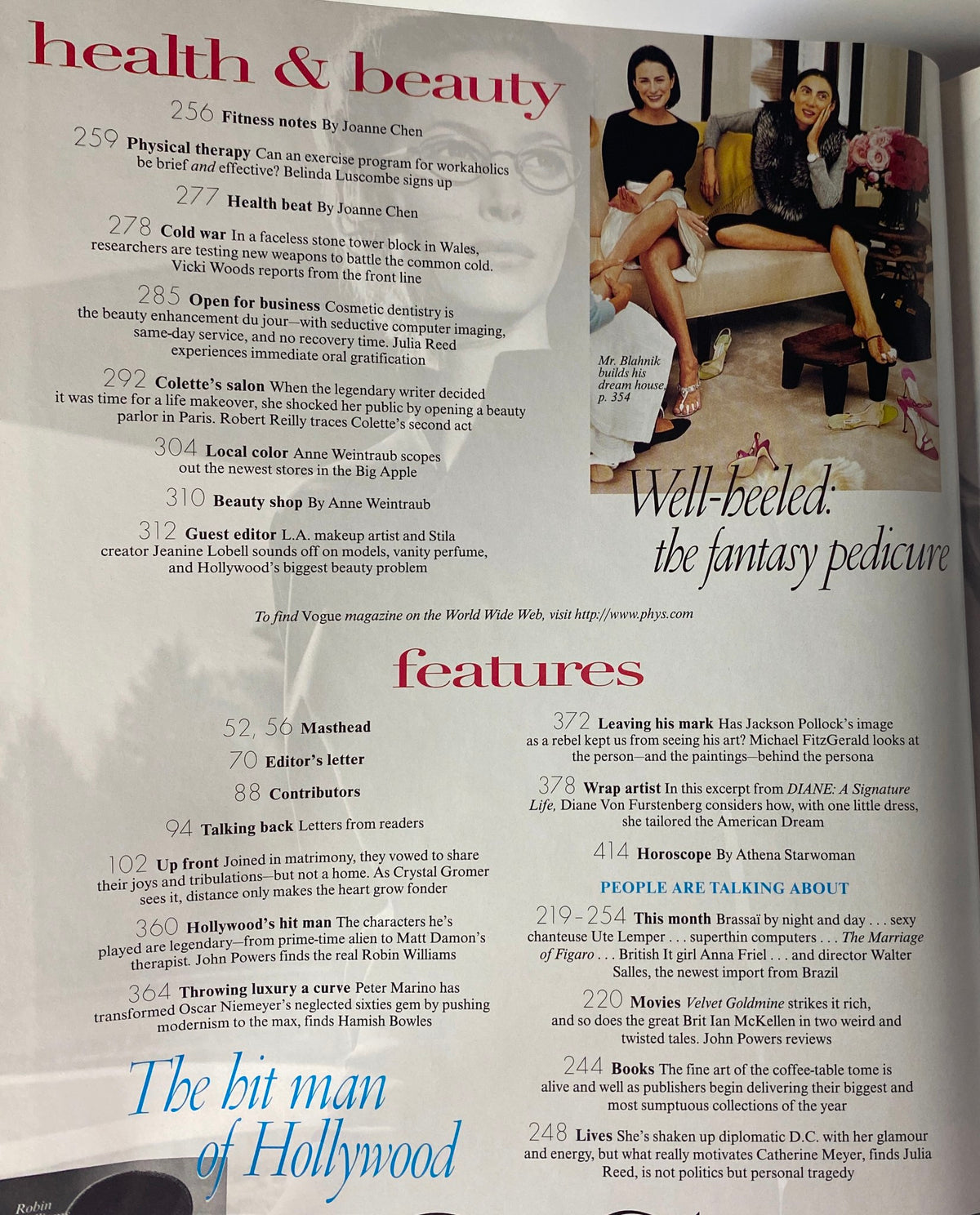
The editorial contents of this issue are unusually rich even by Vogue's standards, spanning fashion, architecture, fine art, celebrity culture, beauty innovation, and the mechanics of entrepreneurship with a coherence that reflects the magazine's ambition at the height of its pre-digital influence. The inclusion of a Diane von Furstenberg excerpt reflecting on the wrap dress alongside a Jackson Pollock reappraisal by Michael FitzGerald and Hamish Bowles on architect Peter Marino's vision of modern luxury suggests an issue that understood itself as cultural documentation as much as fashion journalism — a quality that makes it considerably more durable as a collector's object than issues built purely around trend coverage. The André Leon Talley contribution, the Plum Sykes fashion fiction, and the Jeanine Lobell guest editorship in the beauty section add further layers of named editorial voice that serious collectors and fashion historians find invaluable when reconstructing the intellectual texture of late-1990s Vogue.
About the Publication
Vogue, founded in 1892 and acquired by Condé Nast in 1909, had by the late twentieth century long transcended its origins as a society gazette to become the global standard-bearer of fashion journalism and one of the most culturally influential magazines in the world. Its American edition under Anna Wintour, who assumed the editorship in 1988, had by 1998 reached a level of cultural authority and commercial dominance that made it not merely a fashion magazine but a primary institution of the broader culture industry — a publication whose cover choices, editorial decisions, and advertising relationships shaped the fashion calendar in ways that extended far beyond its own pages. The magazine's format combined high-end fashion photography and editorial work with long-form cultural journalism, beauty coverage, and social commentary, targeting an affluent, educated, and culturally engaged female readership that expected the publication to be simultaneously aspirational and genuinely intelligent. A November issue of late-1990s American Vogue represents the publication operating at the full height of its pre-internet cultural monopoly, with resources, access, and editorial ambition that the fragmented media landscape of subsequent decades would make structurally impossible to replicate.
Key Highlights Inside
- Amber Valletta cover — one of the defining model presences of 1990s fashion photographed for Vogue's high-stakes November issue, representing both the aesthetic and cultural sensibility of the era's most significant modeling careers.
- "Style Fax: Escape Value" by André Leon Talley and "Talking Fashion" — Vogue's senior editorial voice applied to the season's defining style themes, offering the kind of authoritative trend framing that made the magazine's November issues essential reading for the industry.
- "Vogue's View" section encompassing "Big Deals" on female entrepreneurship, "Windows '98" on fashion and digital culture, and "Fashion Fiction" by Plum Sykes — a cluster of features that collectively document late-1990s Vogue's attempt to position fashion within the broader cultural and technological shifts of the closing decade.
- "Wrap Artist" — an excerpt from Diane von Furstenberg's memoir reflecting on the cultural impact of the iconic wrap dress, providing a primary-source account of one of American fashion's most enduring design innovations.
- "Leaving His Mark" by Michael FitzGerald, reexamining Jackson Pollock beyond his rebel mythology, and "Throwing Luxury a Curve" by Hamish Bowles on architect Peter Marino — two features that demonstrate the breadth of cultural ambition Vogue brought to its major issues in this period.
- Health and beauty section featuring guest editor Jeanine Lobell of Stila on beauty, vanity, and Hollywood, alongside contributions from Vicki Woods, Julia Reed, and Belinda Luscombe — a beauty section with named editorial voices whose work gives the issue lasting reference value beyond its fashion content.
Condition & Rarity
This issue is a no-label copy, meaning it was not delivered through postal subscription and carries none of the address labels or mailing markings that obscure cover art and reduce collector value in subscriber copies — a meaningful distinction for an issue whose cover image is central to its appeal. The condition is described as very good, with only minor edge wear noted, placing it toward the stronger end of the condition spectrum for a magazine now more than twenty-five years old and well above the acceptable threshold for display-grade collecting. Very good condition on a late-1990s Vogue of this size and page count — November issues were among the heaviest of the year, with advertising volumes that made them substantially thicker than monthly averages — indicates that the binding has held, the pages remain bright and uncreased, and the cover retains its visual integrity. A protective plastic sleeve has been applied, providing ongoing barriers against dust, handling wear, and environmental exposure. When evaluating any surviving copy of this issue, collectors should assess cover gloss retention, spine flatness, and interior page brightness as the primary condition criteria, understanding that minor edge wear is a standard and accepted characteristic of an unrestored newsstand copy of this age and format.
Looking for More Issues Like This?
Late-1990s Vogue issues in very good condition with clean covers and no label are consistently in demand among both fashion archive collectors and Amber Valletta enthusiasts, and November issues in particular — given their size, editorial ambition, and cultural weight — tend to be among the harder finds in any given year's run. If this particular issue is unavailable, the Vogue magazine collection at OriginalMagazines.com is the most comprehensive starting point for collectors tracing the publication's editorial history across multiple decades. The broader 1998 magazine archive is equally worth exploring for anyone building a multi-publication record of that pivotal closing year of the twentieth century.