




Description
Collector's Note – Why This Issue Matters
The November 2001 issue of Vogue places Britney Spears on its cover at one of the most precisely calibrated moments of her career — and of early 2000s pop culture broadly. She had arrived in 1998 as a teenager with a debut single that rewrote the commercial possibilities of the format, and by the fall of 2001 she was navigating the considerably more complicated territory of what comes next. A new album was imminent. An HBO special was in the works. Her first feature film was approaching release. Vogue's decision to profile her at this exact juncture, under the headline "The Heiress Apparent," was a serious editorial statement — not a celebrity puff piece, but a genuine interrogation of whether Spears had the cultural gravity to inherit Madonna's position as the defining female pop figure of her generation. Writer Jonathan Van Meter framed the question with real weight, and the issue captures a young artist at the threshold between phenomenon and institution.
The timing carries additional resonance because this is the November 2001 issue — published just weeks after September 11. American fashion media was in an unusual place that fall, reckoning with questions about glamour, relevance, and what it meant to continue covering clothes and celebrity in the aftermath of national trauma. Vogue's response, visible in the "Amazing Grace" feature on American designers showing strength through bold feminine power, was to lean into the resilience of the industry rather than retreat from it. Britney Spears on the cover of that particular issue is not incidental — she represented, for Vogue's editors, a strand of American pop confidence worth celebrating in that specific cultural moment. Collectors building a documentary record of Britney Spears's evolution from teen pop star to enduring icon will find the Britney Spears magazine archive an invaluable resource for tracking how her media portrayal shifted across the decade.
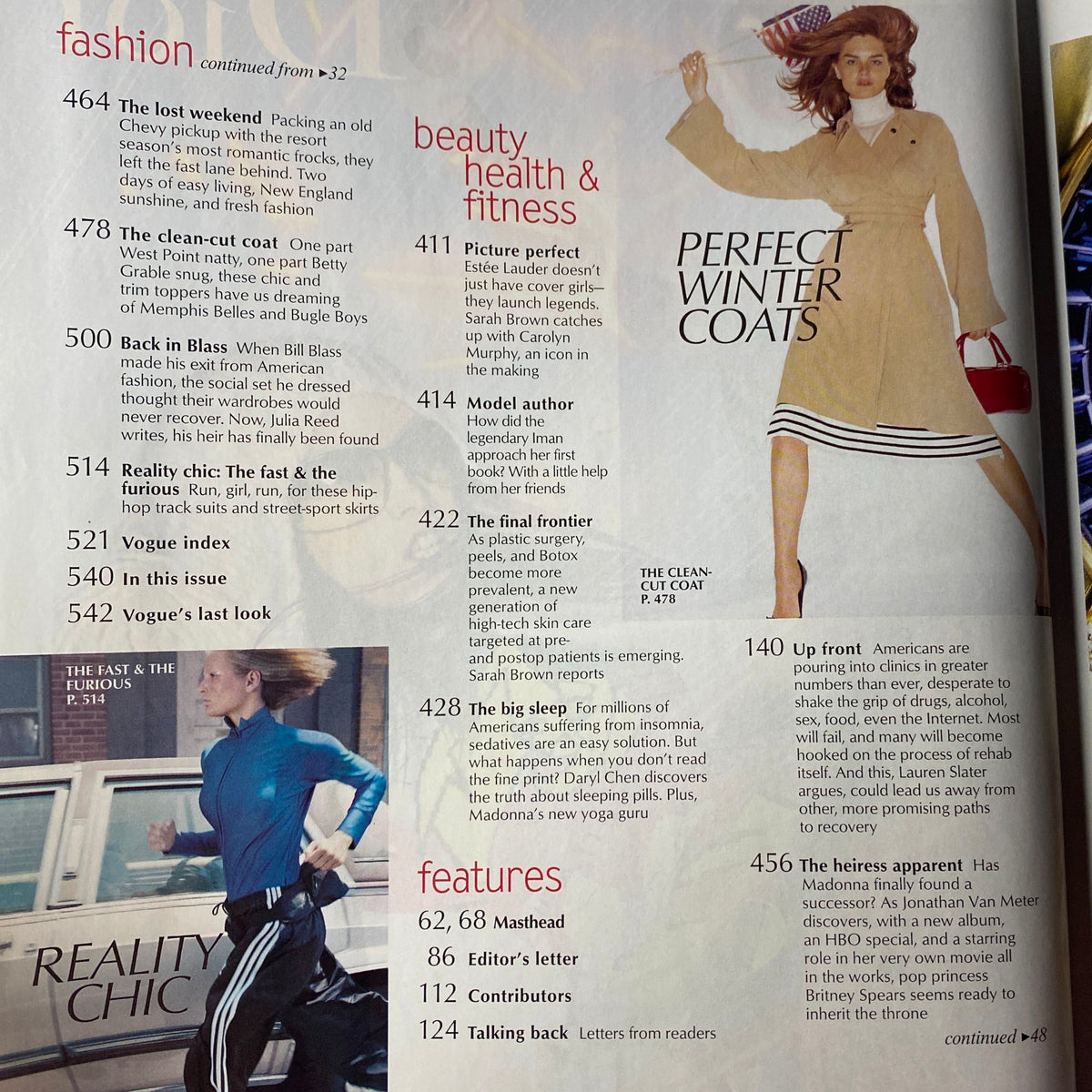
This issue also lands at an interesting intersection for fashion collectors independent of the Spears angle. The VH1/Vogue Fashion Awards coverage included here — with full results for Designer of the Year, Model of the Year, and Rock Style — makes it a useful primary source document for early 2000s fashion industry history. The broader editorial mix, touching on Jennifer Lopez and Alek Wek entering the design world, Victoria's Secret's marketing machinery, and the West Point–inspired coat trend, reads now as an exceptionally complete snapshot of where fashion's attention was focused in the months immediately following the millennium's first major rupture. Those assembling a comprehensive archive of the era should note that the full 2001 magazine collection at OriginalMagazines.com offers substantial context across multiple publications from this pivotal year.
About the Publication
Vogue, founded in 1892 and acquired by Condé Nast in 1909, had by the early 2000s been operating for decades as the uncontested authority publication of the American fashion industry. Under Editor-in-Chief Anna Wintour, who took the role in 1988, the magazine pursued a deliberate strategy of bridging high fashion and mainstream celebrity culture — placing pop stars, actresses, and cultural figures alongside traditional model covers in a way that dramatically expanded the publication's cultural footprint. Its November issues were traditionally among the most substantial of the year, heavy with advertising and editorial content reflecting the full scope of the autumn fashion season. By 2001, Vogue functioned simultaneously as trade publication, cultural arbiter, and mass-market celebrity magazine, a combination that made its cover one of the most coveted and analyzed placements in American media.
Key Highlights Inside
- "The Heiress Apparent" — Britney Spears profile by Jonathan Van Meter: The issue's central feature examines Spears at a career crossroads, framing her explicitly as a potential successor to Madonna's cultural throne at a moment when a new album, an HBO special, and her film debut were converging simultaneously.
- VH1/Vogue Fashion Awards coverage: Full results and coverage of the awards, including Designer of the Year, Model of the Year, and Rock Style — making this issue a primary source document for early 2000s fashion industry recognition.
- "Amazing Grace" — American designers respond: A feature examining how American fashion responded to the post-September 11 moment through bold, feminine design, providing rare editorial context for how the industry processed national trauma.
- Carolyn Murphy and Estée Lauder: A behind-the-scenes look at the making of one of the era's most recognizable beauty campaigns, with Murphy at the center of the Estée Lauder brand identity.
- Iman on her first book: A profile of the model and entrepreneur at the moment of her publishing debut — an early marker of the celebrity-author crossover that would accelerate throughout the decade.
- Style Fax by André Leon Talley, plus contributions from Sally Singer and Wendy Wasserstein: The issue's fashion and cultural commentary reflects Vogue's full editorial depth, with bylines from some of the most distinctive voices in the publication's stable at the time.
Condition & Rarity
Surviving copies of this issue are graded Very Good — a strong designation in the collector market for early 2000s glossy magazines, indicating a copy that presents well with only minor edge wear and no significant structural or cosmetic damage. The absence of a subscriber mailing label is a meaningful positive for this issue specifically: Vogue's covers from this era were visually ambitious, and a label-free copy preserves the Britney Spears cover photograph fully intact as originally designed. Very Good condition on a twenty-plus-year-old issue of this trim size and paper stock — Vogue's November issues were typically among the heaviest and most substantial of the year — suggests the copy has been stored carefully rather than circulated heavily. The plastic protective sleeve is consistent with intentional collector storage and typically correlates with better interior page condition, particularly for the high-gloss advertising and editorial pages that define Vogue's visual identity. For a post-2000 issue, Very Good with no label represents a genuinely clean example.
Looking for More Issues Like This?
Label-free, Very Good copies of this particular issue surface less frequently than the casual availability of early 2000s magazines might suggest — Vogue's November editions were read hard and rarely set aside with collectors in mind. If this issue is no longer available, the Britney Spears magazine collection at OriginalMagazines.com is the natural first stop for anyone tracking her presence across the full arc of print media coverage. The Vogue archive offers a much broader view of the publication's history across decades of landmark covers, and the 2001 magazine collection is worth exploring for anyone interested in the full range of what American print media looked like during one of the more consequential years of the modern era.