


Description
Collector's Note – Why This Issue Matters
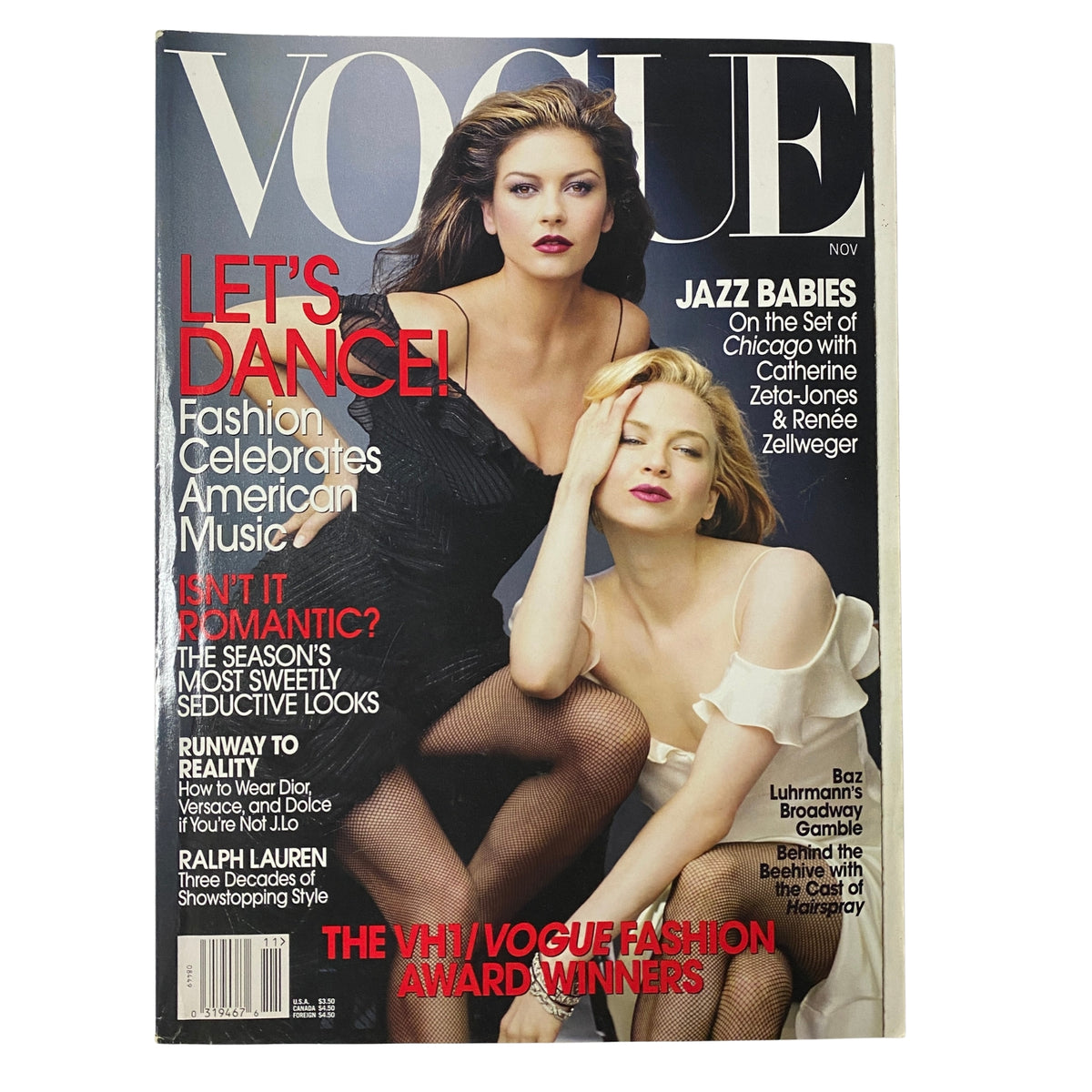
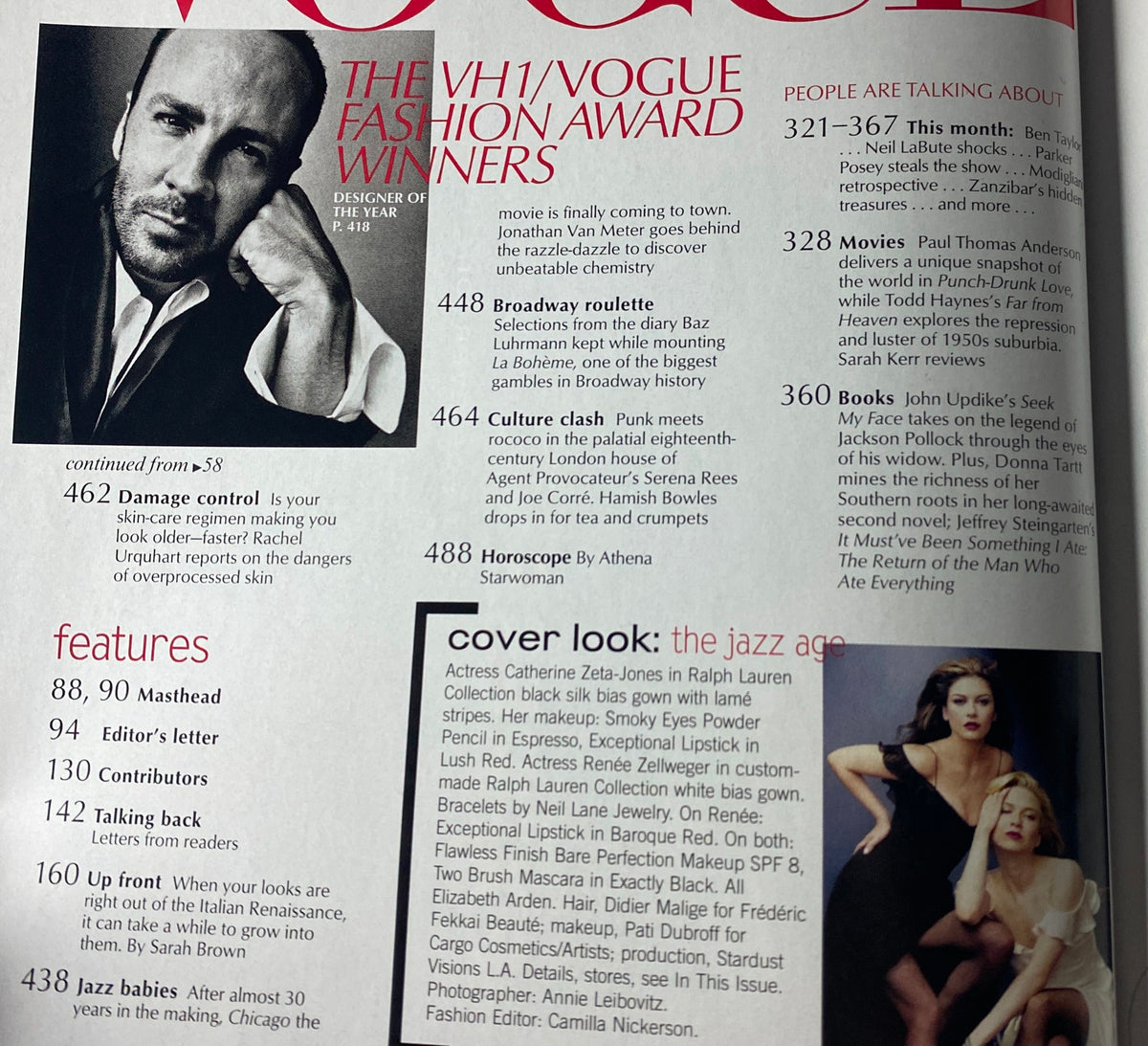
November 2002 is a historically specific and multiply significant publication date in Vogue's early-2000s archive, and this issue — with an Annie Leibovitz dual cover of Catherine Zeta-Jones and Renée Zellweger in Ralph Lauren Collection gowns, styled by Camilla Nickerson — is a primary document of one of the most significant Hollywood musical revivals in the history of American cinema. Chicago had been in development for nearly thirty years at the time of its release, and Rob Marshall's film version — arriving in December 2002, one month after this issue — would win six Academy Awards including Best Picture, becoming the first musical to win the top prize since Oliver! in 1968. The Vogue November 2002 cover positions Zeta-Jones and Zellweger in the specific 1920s Jazz Age aesthetic of the film before a single ticket had been sold, making this issue a primary document of Chicago's anticipatory cultural moment — the fashion press's authoritative endorsement of the film's aesthetic ambitions and its stars' capacity to embody them. Jonathan Van Meter's behind-the-scenes Chicago feature documents the chemistry between the stars and the enduring allure of the Jazz Age at the specific pre-release moment when the film's cultural impact was still unconfirmed. Annie Leibovitz's dual cover photography — staging Zeta-Jones and Zellweger in period-appropriate glamour — constitutes a primary visual document of both the film and the photographer's specific creative engagement with its aesthetic. For collectors building an archive of Vogue magazine issues from the early 2000s, this November 2002 edition is one of the most historically specific and most visually accomplished entries in the publication's early-decade catalog.
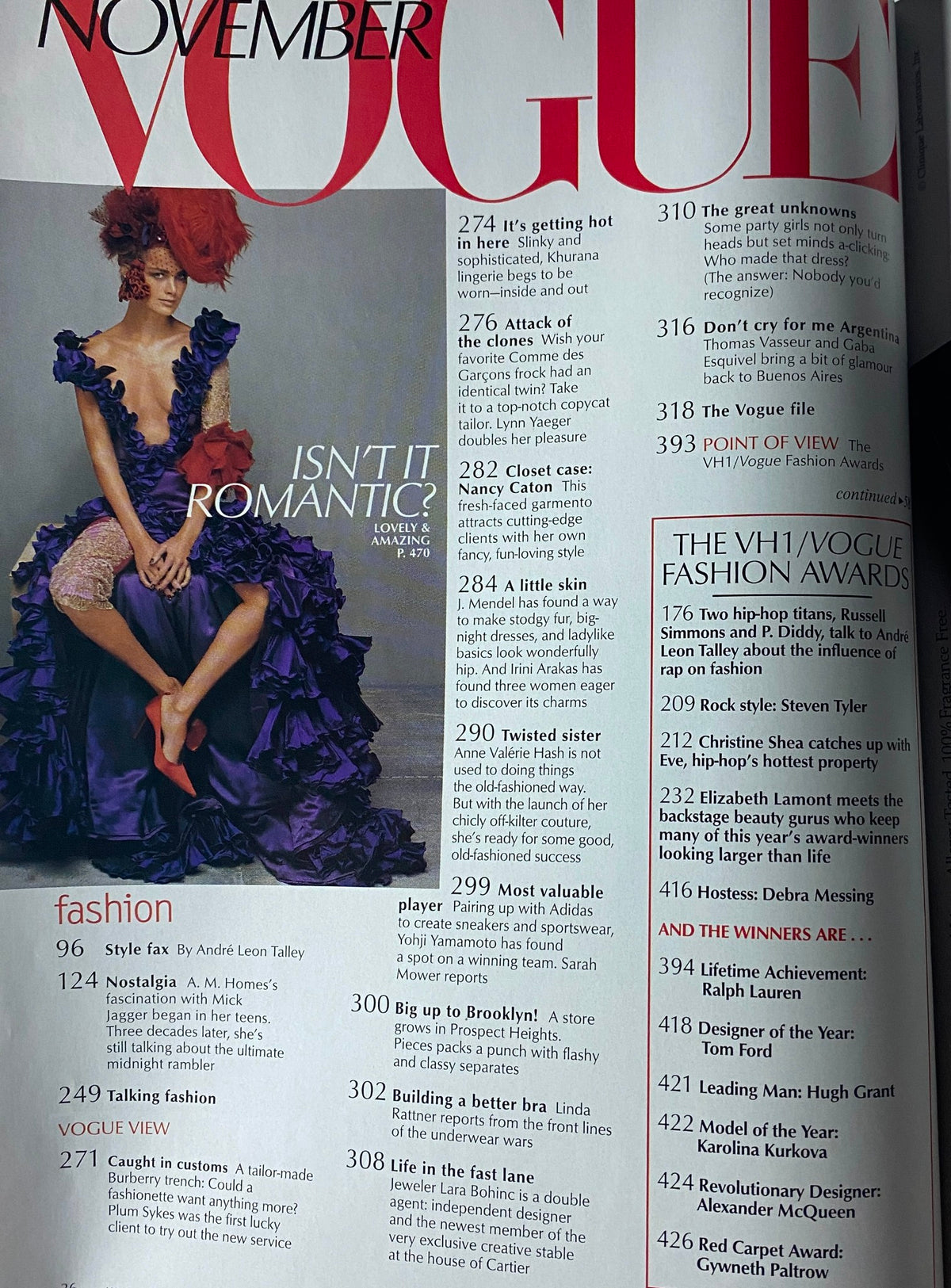
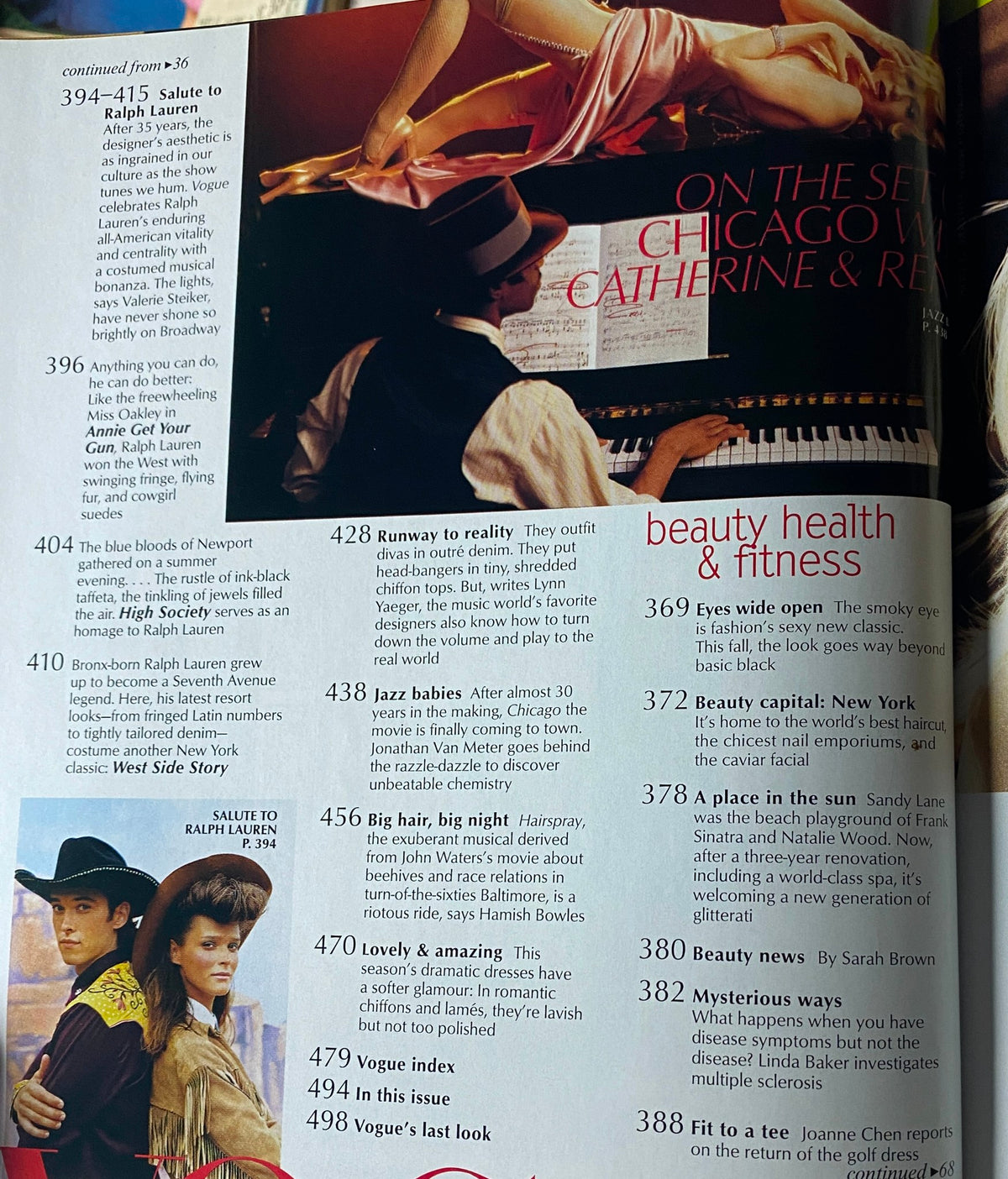
The VH1/Vogue Fashion Awards coverage gives this issue a second layer of primary source significance entirely independent of the Chicago film content. The documented honorees — Ralph Lauren (Lifetime Achievement), Tom Ford (Designer of Year), Karolina Kurkova (Model of the Year), Alexander McQueen (Revolutionary Designer), Gwyneth Paltrow (Red Carpet Award), and Hugh Grant (Leading Man) — constitute a primary record of the fashion industry's specific institutional self-recognition in November 2002, with the Tom Ford Designer of the Year designation arriving at the precise moment of his peak Gucci and YSL dominance and the Alexander McQueen Revolutionary Designer award constituting a primary bibliographic record of the fashion establishment's formal recognition of his specific genius. The Russell Simmons and P. Diddy conversation with André Leon Talley about rap's influence on fashion — alongside the Eve profile and Steven Tyler rock style feature — is a primary source document of the specific early-2000s fashion press engagement with hip-hop culture at the moment when its influence on mainstream luxury fashion was most actively being discussed and institutionalized. The Salute to Ralph Lauren — thirty-five years of his aesthetic celebrated through a theatrical Broadway framework — adds a fashion historical primary source dimension that the Valerie Steiker and Hamish Bowles contributions give genuine critical depth. Collectors researching fashion and cultural magazines from 2002 will find this Vogue issue a primary source document of the fashion industry's most significant institutional and commercial conversations at a specific and historically well-defined moment.
The literary and cultural journalism documented in the full table of contents adds further layers of primary source significance. The Books section's engagement with John Updike's Seek My Face — his novel about a figure modeled on Lee Krasner and Jackson Pollock — and Donna Tartt's long-awaited second novel constitute primary documents of the fall 2002 literary season's most discussed publications at the moment of their release. Paul Thomas Anderson's Punch-Drunk Love and Todd Haynes's Far from Heaven are reviewed by Sarah Kerr in the same issue that covers Chicago, making this November 2002 Vogue a primary document of one of the more remarkable single seasons in American cinema history. The A. M. Homes Mick Jagger nostalgia feature, the Baz Luhrmann La Bohème coverage, and the Agent Provocateur Serena Rees and Joe Corré punk-meets-rococo profile collectively document the full range of early-2000s cultural production across literature, film, theater, music, and fashion design that distinguished Wintour-era Vogue's editorial ambition from any competitor.
About the Publication
Vogue was founded in 1892 and has been published by Condé Nast since 1909, operating continuously as the most authoritative fashion magazine in the American market across more than a century of publication. Under Anna Wintour's editorial direction, which began in 1988 and extended through this November 2002 issue, the magazine combined its traditional fashion authority with expanded cultural journalism, celebrity profiles, and serious feature writing that gave individual issues a breadth and depth distinguishing them from competitors. The November 2002 issue's combination of Annie Leibovitz Chicago film photography, VH1/Vogue Fashion Awards primary source documentation, Ralph Lauren retrospective, and literary criticism across Updike, Tartt, Anderson, and Haynes reflects Wintour-era Vogue at its most culturally comprehensive.
Key Highlights Inside
- Annie Leibovitz dual cover of Catherine Zeta-Jones and Renée Zellweger in Ralph Lauren Collection gowns, styled by Camilla Nickerson — a primary visual document of one of the most accomplished fashion photographers in American history staging the stars of Chicago in period-appropriate 1920s glamour one month before the film's release, constituting a pre-release fashion press primary source of the film's aesthetic ambitions and its eventual Academy Award-winning success.
- "Jazz Babies: Chicago the Movie" by Jonathan Van Meter — a primary source document of the Chicago film's pre-release behind-the-scenes journalism, engaging the chemistry between Zeta-Jones and Zellweger and the nearly thirty-year development history of the musical adaptation, published at the specific anticipatory moment before the film became the first Best Picture-winning musical since 1968.
- VH1/Vogue Fashion Awards complete coverage — a primary record of the fashion industry's November 2002 institutional self-recognition, including Tom Ford's Designer of the Year award at his peak Gucci-YSL dominance, Alexander McQueen's Revolutionary Designer citation, Ralph Lauren's Lifetime Achievement, and the Russell Simmons-P. Diddy conversation with André Leon Talley on hip-hop's influence on luxury fashion.
- "Salute to Ralph Lauren" — a primary source document of the designer's thirty-five-year career retrospective framed through a Broadway theatrical tribute, with critical contributions by Valerie Steiker and Hamish Bowles constituting one of the more formally ambitious fashion historical essays in early-2000s Vogue.
- Books coverage — John Updike's Seek My Face, Donna Tartt's long-awaited second novel, and Jeffrey Steingarten's It Must've Been Something I Ate, alongside Sarah Kerr's reviews of Paul Thomas Anderson's Punch-Drunk Love and Todd Haynes's Far from Heaven — a primary source record of one of the more remarkable single seasons in American film and literary history, engaged in the same November 2002 issue as Chicago's pre-release fashion documentation.
- Yohji Yamamoto-Adidas collaboration feature by Sarah Mower, Anne Valérie Hash couture debut, J. Mendel modern reinvention by Irini Arakas, A. M. Homes Mick Jagger nostalgia by A. M. Homes, Hairspray Broadway coverage by Hamish Bowles, and Agent Provocateur punk-rococo style — the full fashion design, literary, theater, and cultural journalism range documented with the attribution specificity that makes this table of contents an unusually complete primary source of Wintour-era Vogue's November 2002 editorial identity.
Condition & Rarity
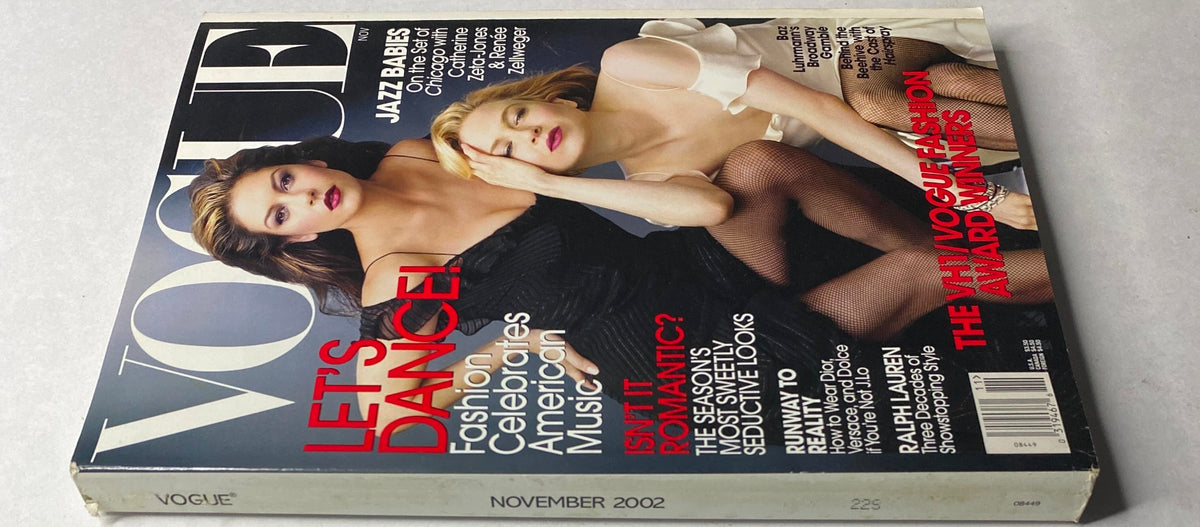
Vogue issues from November 2002 are approaching their twenty-fourth year of existence — recent enough that surviving copies remain relatively available, but old enough that condition variation is meaningful, particularly for a dual-celebrity cover of this specific cultural significance. Very Good condition with minor edge wear is an honest and strong grade for a twenty-three-year-old monthly fashion magazine, indicating a copy that retains full structural integrity, displays cleanly, and preserves the Annie Leibovitz cover photography without structural damage. The absence of a mailing label is a significant condition positive for Vogue specifically, where the magazine's enormous subscription base means that label-free copies represent a minority of surviving examples — the Leibovitz dual cover is preserved in its complete, unobstructed form. The plastic protective sleeve provides ongoing archival protection for a coated-stock publication whose cover surface benefits from protection against scuffing. Collectors evaluating surviving examples should prioritize the Leibovitz cover image integrity, the completeness of the Chicago film feature and VH1/Vogue Fashion Awards coverage, and overall structural integrity as primary condition criteria.
Looking for More Issues Like This?
A Very Good label-free newsstand copy of Vogue November 2002 with the Annie Leibovitz Chicago dual cover, the complete VH1/Vogue Fashion Awards primary source documentation, the Ralph Lauren retrospective, and the fully documented table of contents is a more historically layered find than its relatively recent vintage might suggest — the convergence of a landmark film's pre-release fashion documentation, a peak-era Tom Ford Designer of the Year award record, and one of the most significant literary seasons of the decade gives this issue a research profile extending across film history, fashion history, and American literary history simultaneously. If this issue is no longer available, the full Vogue collection at OriginalMagazines.com is the most comprehensive place to browse surviving issues from across the magazine's history and locate other Annie Leibovitz covers, VH1/Vogue Fashion Awards issues, or significant editions from Wintour-era Vogue's early-2000s run. The 2002 magazine collection brings together issues from across that year's major publications for collectors interested in the full range of American fashion and cultural print journalism during one of the most creatively active years of the early decade.