




Description
Collector's Note – Why This Issue Matters
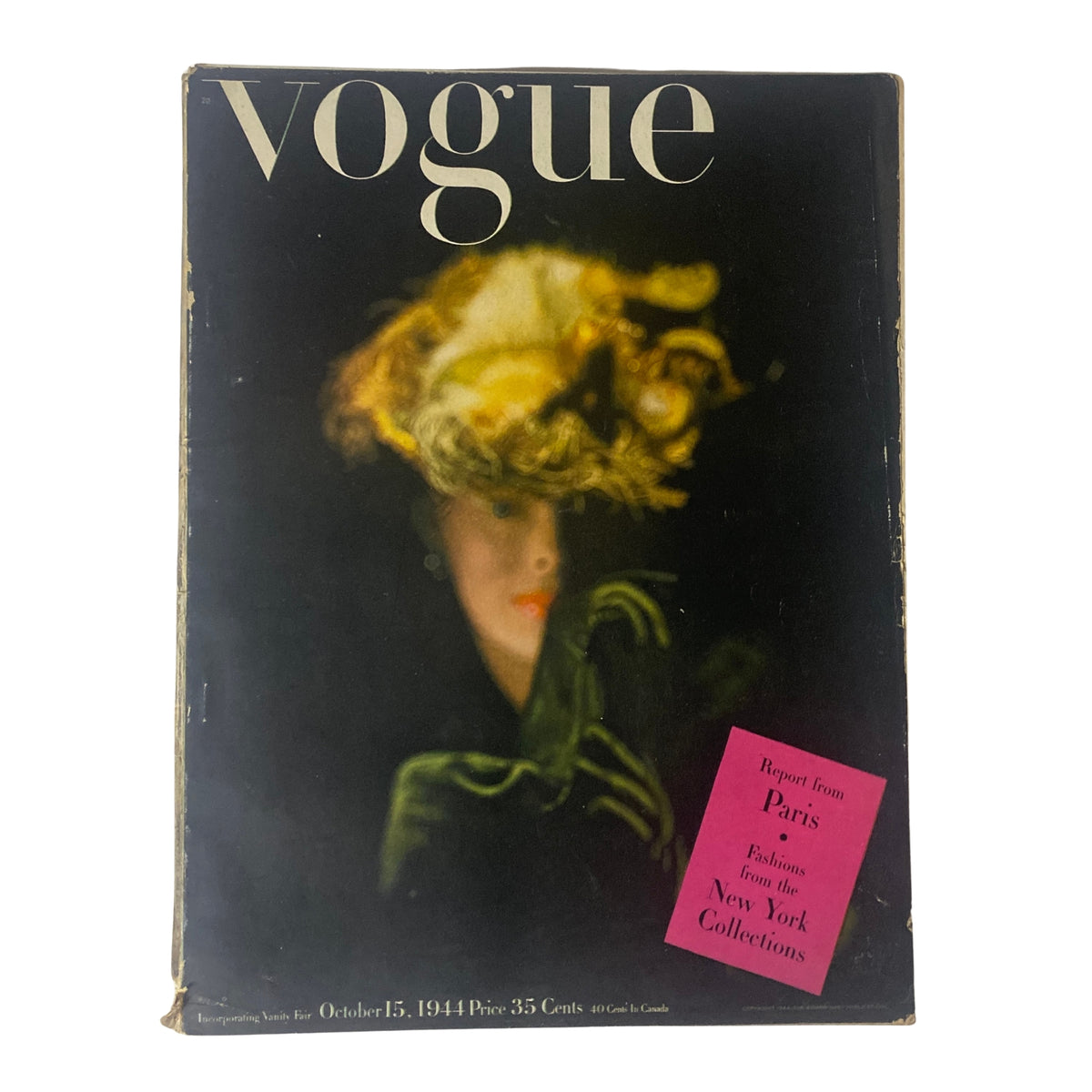
October 15, 1944 is one of the most extraordinary dates in the entire history of Vogue magazine. Paris had been liberated by Allied forces on August 25th — just seven weeks before this issue's cover date — ending four years of German occupation that had profoundly disrupted and transformed French fashion, culture, and daily life. The city's liberation was not merely a military event; it was a symbolic rupture of enormous cultural significance, and Vogue was positioned to document it in a way no other publication could. The magazine had maintained its London and New York editions throughout the war, and its correspondents were among the first journalists to enter liberated Paris. The result — visible in this issue's table of contents — is something genuinely without precedent in fashion publishing history: a single issue combining frontline war reportage, the reawakening of Paris couture, and the full machinery of American fashion coverage, all in October 1944.
The name that makes this issue irreplaceable for serious collectors is Lee Miller. Miller was one of the most remarkable figures of the twentieth century — a former Vogue model turned Surrealist muse turned combat photographer and war correspondent — and her dispatches from liberated France, published here across multiple pages, represent some of the most significant journalism the magazine ever ran. Her reports on the fall of St. Malo (pages 92–94) and the Liberation of Paris (pages 95–97), accompanied by her own photography, document events of historical magnitude in real time, written by a witness of extraordinary perception and courage. The additional pages covering Picasso, Éluard, and Bérard (98–99) and the first Paris fashions after the Occupation (100–103) complete a sequence of editorial content that fashion historians and World War II researchers have cited for decades. For collectors building a focused run of Vogue's wartime and postwar editions, this issue sits at the absolute apex of what the magazine produced during the conflict years.
The cover itself — photographed by John Rawlings and featuring model Meg Mundy — places this issue within another significant chapter of Vogue's history. John Rawlings was one of the most prolific and technically accomplished photographers in the magazine's mid-century roster, and his October 1944 cover represents the continuation of Vogue's commitment to visual excellence even under wartime conditions. Meg Mundy, who would go on to a long career as a Broadway and television actress, appears here at the beginning of her public life, and her cover appearance in this particular issue places her within one of the most historically loaded single editions of any fashion magazine ever published. Collectors assembling a record of American and European cultural life as documented in 1944 will find no single magazine issue from that year more densely layered with historical significance than this one.
About the Publication
Vogue, founded in 1892 and acquired by Condé Nast in 1909, maintained publication throughout the Second World War and emerged from the conflict with its editorial authority substantially enhanced by the quality and courage of its wartime coverage. Its October 1944 issue represents the magazine operating at the intersection of its two defining functions: as the preeminent document of fashion and luxury culture, and as a vehicle for serious cultural and journalistic engagement with the world its readers inhabited. Under editor-in-chief Edna Woolman Chase and with the photographic direction of figures like John Rawlings, the magazine's wartime editions combined the practical coverage of American fashion — necessary given the disruption of Paris couture — with the kind of direct reporting from the front that Lee Miller's dispatches exemplified. The result was a publication that expanded its own definition of what a fashion magazine could do, and this October 1944 issue is the clearest single demonstration of that expansion in the magazine's entire history.
Key Highlights Inside
- Lee Miller's "Fall of St. Malo" (pp. 92–94) and "The Liberation of Paris" (pp. 95–97) — frontline dispatches from one of the war's most significant combat photographers and journalists, published here in their original context as Vogue editorial content just weeks after the events they describe.
- Coverage of Picasso, Éluard, and Bérard (pp. 98–99) — documenting the immediate cultural reawakening of liberated Paris through its most prominent surviving artists and intellectuals.
- First Paris fashions after the German Occupation (pp. 100–103) — among the earliest documentation in any American publication of couture's resumption in a free Paris, representing the literal rebirth of the international fashion system.
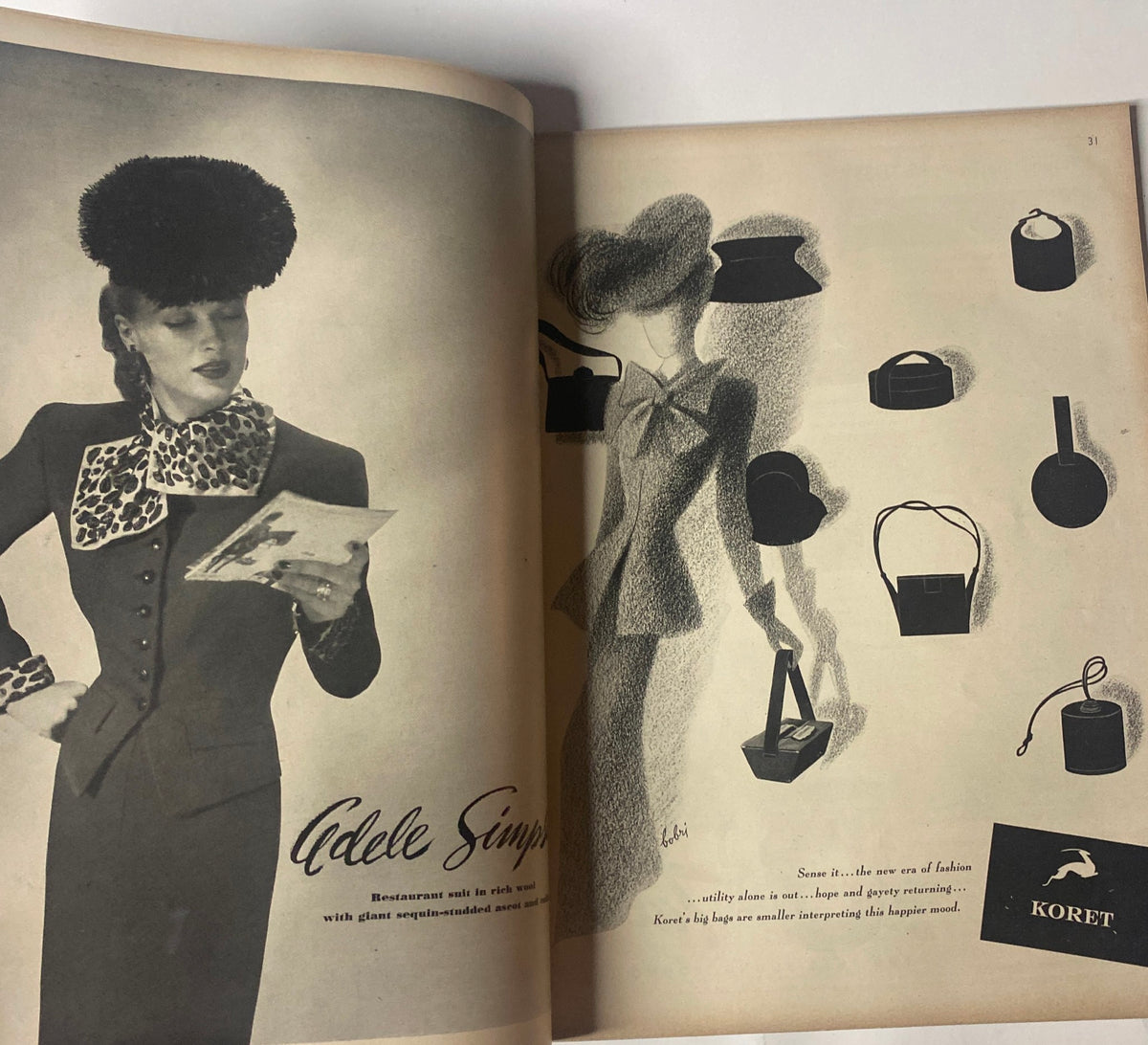
- Made-to-Order Collections and extensive New York fashion coverage (pp. 78–91, 104–124) — the full American fashion apparatus operating in parallel with the historic Paris content, documenting how wartime New York had developed its own sophisticated couture identity during the years of Parisian absence.
- Cover photograph by John Rawlings featuring Meg Mundy — one of the most accomplished Vogue photographers of the mid-century era, working here at the height of the magazine's wartime visual production.
- Profile of Mrs. Vincent Astor (p. 114) and the Townsend Martin house feature (pp. 118–119) — the magazine's signature engagement with American social and architectural culture, running alongside the historic war content as a document of the full range of Vogue's editorial identity in this period.
Condition & Rarity
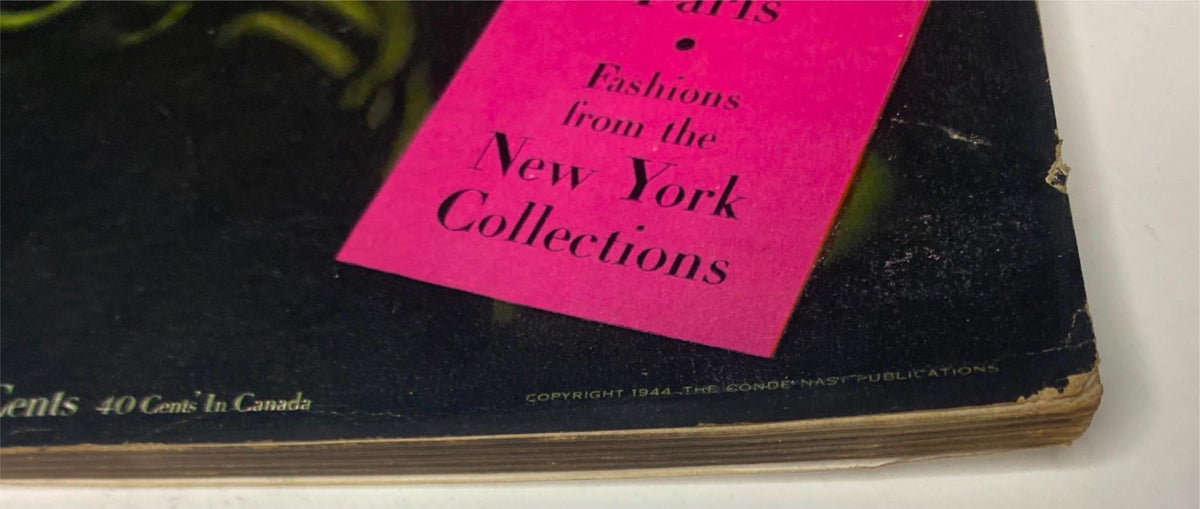
This issue originates from a privately held Vogue archive spanning the 1920s through 1970s, stored away for decades before being brought back into circulation with light dry surface cleaning — vacuum, brush, and smoke sponge only, no wet methods — and rehoused in archival sleeves. Collectors evaluating any surviving copy of this issue should expect honest vintage attributes consistent with long earlier storage: binding wear, possible small spine splits, staple-rust halos, edge toning, and period shelf dust that can present as dark residue along the spine. Interior pages are reported as dry and legible, and a light vintage paper aroma typical of mid-century magazines may be present. The overall grade is Good, which for a Vogue issue of this historical significance and age indicates structural integrity and full usability as both a collectible and a research document. For collector purposes, the critical condition factors in any surviving copy are the completeness and legibility of the Lee Miller dispatches and Paris fashion pages — which constitute the primary historical and research value of the issue — the integrity of the John Rawlings cover photograph, and the overall stability of the interior stock. The archival resleeveing and upright storage represent meaningful preservation interventions relative to the extended earlier storage conditions, and the complete table of contents provided with this listing is itself a significant research resource for anyone working with the Vogue archive from this period.
Looking for More Issues Like This?
The October 15, 1944 Vogue — with Lee Miller's liberation dispatches, the first postwar Paris fashion coverage, and a John Rawlings cover — is in a category of its own among wartime fashion magazine collectibles, and copies with complete, legible interiors are genuinely difficult to locate through any channel. The Vogue archive at OriginalMagazines.com draws from a deep privately held collection spanning five decades and is the most productive single resource for tracking down significant issues from the magazine's wartime and immediate postwar years. For collectors working across the full cultural and historical record of the period, the 1944 magazine collection brings together publications from across the American and international press in the decisive final year of the European war — an essential resource for anyone building seriously around this extraordinary moment in history.