




Description
Collector's Note – Why This Issue Matters
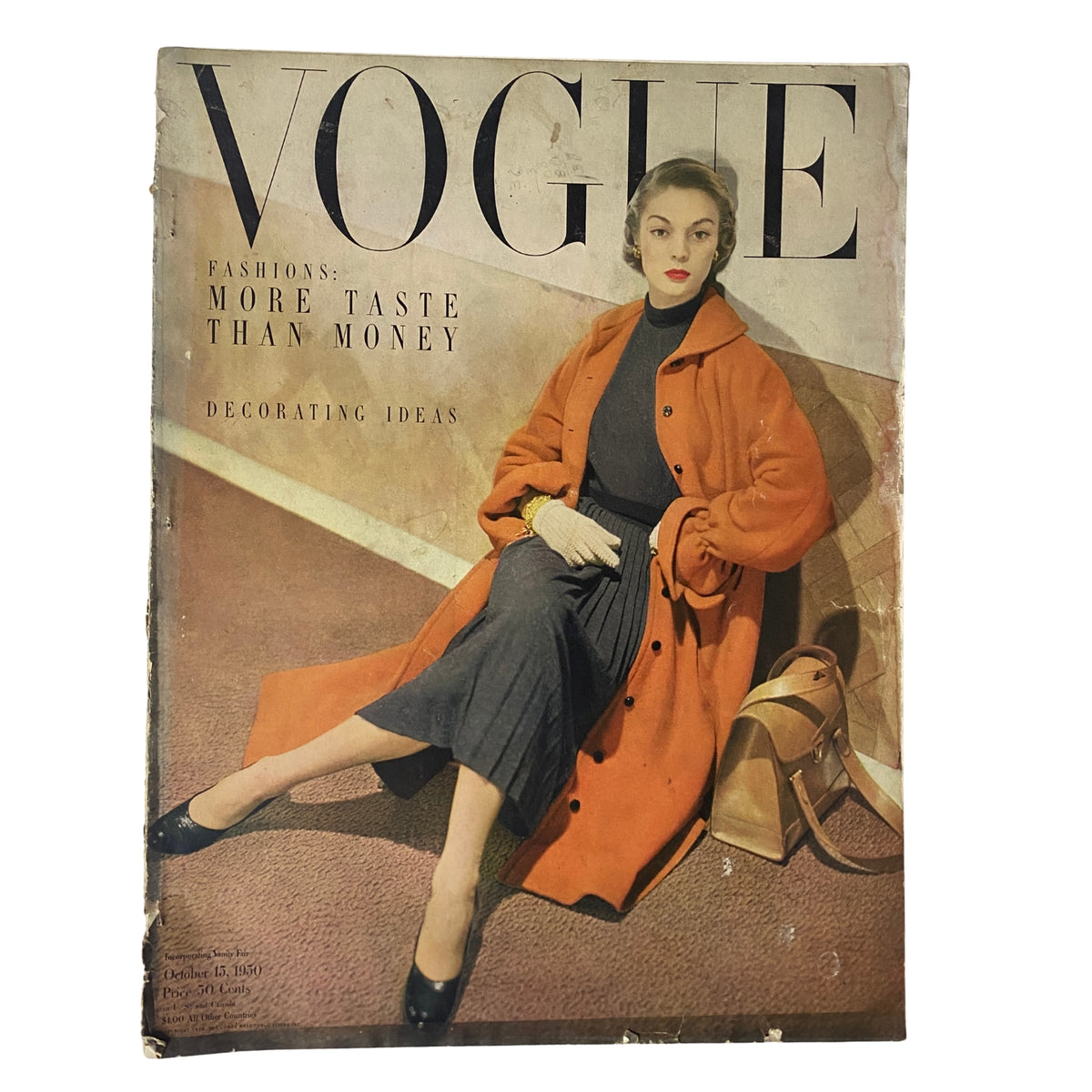
October 15, 1950 is a publication date of specific and layered significance in Vogue's postwar history, and this issue — photographed by Horst P. Horst, featuring Jean Patchett, organized around the "More Taste Than Money" editorial concept — is a primary document of the specific aesthetic and social moment of American fashion five years after the Second World War. Jean Patchett was one of the defining model faces of early-fifties Vogue, her specific combination of aristocratic bone structure and intelligent composure making her a favorite subject of the publication's most significant photographers. Horst P. Horst's cover photography places this issue within one of the most studied creative partnerships in the history of fashion photography — Horst had been shooting for Vogue since 1931, and his October 1950 work represents nearly two decades of collaboration that had produced some of the most significant fashion photographs of the twentieth century. A Horst-Patchett cover from October 1950 is therefore a primary document of both a significant model career and a significant photographer's late-career Vogue work, preserved in the original publication context that gives primary source photography its irreplaceable documentary value. For collectors building an archive of Vogue magazine issues from the postwar period, this October 15, 1950 edition is one of the most specifically documented and photographically significant entries in the early-fifties catalog.
The "More Taste Than Money" editorial concept that structures the issue's fashion content is itself a primary document of the specific social and economic moment of American life in October 1950. The Korean War had begun in June 1950, just four months before this issue's publication, and the specific combination of wartime production pressures, inflation concerns, and the memory of wartime rationing gave the "attainable luxury" editorial framing a particular resonance that peacetime prosperity alone could not have generated. The Paris couture content — Dior's "Amérique," Lanvin's "17 ans," and the "Paris ball gowns copied line for line" feature — reflects the specific postwar cultural relationship between American fashion consumers and Paris design, when the couture houses were actively marketing their American interpretations and American women were consuming Paris style through the copying and adaptation that Vogue's pattern and buying guide content facilitated. The Alexander Girard Detroit house architectural feature is a historically interesting secondary document: Girard was one of the most significant mid-century American designers, his subsequent work for Herman Miller and his textile and folk art collections making him a figure of lasting design historical importance, and a 1950 Vogue feature on his Detroit home is a primary document of his early-career design identity. Collectors researching Vogue and fashion magazines from 1950 will find this October 15 edition a primary source of unusual depth across photography, fashion history, and design history simultaneously.
The Pearl Primus "In Africa" essay is a historically significant secondary document that rewards specific collector attention. Pearl Primus was one of the most important African-American choreographers and anthropologists of the mid-twentieth century — her work connecting African dance traditions to African-American experience and her research in Africa had made her a significant figure in both the performing arts and the emerging academic study of African culture in the United States. A Vogue essay by Pearl Primus in October 1950 is a primary document of a major Black American intellectual and artist contributing to the most authoritative white fashion publication in America, at a specific moment in postwar American racial and cultural politics when such a contribution carried a significance that extends well beyond its immediate content. Sir Edmund Whittaker's "Energy and Eternity" essay and the "Deflating the Ego" piece by Agnes Whitney Cromwell complete an editorial package that reflects the specific intellectual ambitions of the early-fifties Vogue's essays section, addressing its readership as educated, culturally engaged women whose interests extended well beyond fashion into science, philosophy, and social commentary.
About the Publication
Vogue was founded in 1892 and has been published by Condé Nast since 1909, operating continuously as the most authoritative fashion magazine in the American market across more than a century of publication. The early-fifties Vogue was operating in the specific postwar moment when Paris couture was reasserting its dominance over international fashion after years of wartime disruption, when American fashion was simultaneously developing its own commercial and creative identity, and when the specific social concerns of postwar prosperity and Cold War anxiety were reshaping what American women expected from a fashion publication. This issue comes from a privately held Vogue archive spanning the 1920s through the 1970s, and has undergone light dry surface cleaning before archival sleeving.
Key Highlights Inside
- Jean Patchett cover photographed by Horst P. Horst — a primary visual document of one of the twentieth century's most significant fashion photographers working with one of the defining model faces of early-fifties Vogue, representing Horst's nearly two-decade collaboration with the publication at a specific late-career moment and preserved in the original October 1950 publication context that gives primary source fashion photography its irreplaceable documentary value.
- "More Taste Than Money" editorial concept spanning pages 70-81 — a primary source record of the specific postwar American fashion aesthetic of attainable luxury, with "Double-life coats lined with luxury," "Semi-precious furs in pale shades," and color-coordinated separates collectively documenting the specific fashion language of early-fifties Vogue at its most socially calibrated to its readership's economic realities.
- Dior's "Amérique" and Lanvin's "17 ans" Paris couture coverage on pages 118-119 and "Paris ball gowns copied line for line" on pages 120-121 — primary documents of the specific postwar relationship between American fashion consumers and Paris couture, engaging the transatlantic fashion dialogue at the specific 1950 moment when couture houses were most actively marketing their American interpretations.
- Alexander Girard Detroit house architectural feature on pages 94-95 — a primary document of one of the most significant mid-century American designers in his early career, before his Herman Miller textiles and Braniff Airways interiors established his lasting design historical significance, constituting a bibliographically specific early Girard documentation of considerable design history research value.
- Pearl Primus "In Africa" essay on pages 98-99 — a documented contribution by one of the most important African-American choreographers and anthropologists of the period, constituting a primary source record of a major Black American intellectual contributing to Vogue in October 1950 and representing the specific cultural politics of postwar American race and intellectual life in a fashion publication context.
- Sir Edmund Whittaker's "Energy and Eternity" essay and "Deflating the Ego" by Agnes Whitney Cromwell, Vogue Pattern exclusives from August Paris couture collections, and the Buying Guide and Shop Hound departments — the full intellectual and commercial editorial architecture of an October 15, 1950 Vogue documented with the page-level specificity that makes this table of contents an unusually complete primary source for fashion, design, and cultural historians.
Condition & Rarity
This issue comes from a privately held Vogue archive spanning the 1920s through the 1970s, stored away for decades before being brought back into circulation. The binding wear or small splits, staple-rust halos, edge toning, and period shelf dust noted in the collection description are honest and expected characteristics of a seventy-five-year-old bimonthly fashion magazine from archival long-term storage, reflecting storage conditions that preceded the current owner's careful conservation intervention. The light dry surface cleaning performed before archival sleeving — vacuum, brush, and smoke sponge only, no wet methods — represents the conservation standard for vintage paper materials. Good condition with interiors described as dry and legible is the most important positive attribute for a publication of this age and paper chemistry — it confirms that the Horst cover portrait and the full documented table of contents remain structurally intact and visually accessible despite the external evidence of seven and a half decades of existence. The plastic protective sleeve provides archival-standard protection going forward. Collectors evaluating surviving examples should prioritize the Horst-Patchett cover image integrity, the completeness of the Paris couture and Pearl Primus content, and the overall structural soundness of the staple binding as primary condition criteria for this historically significant mid-century issue.
Looking for More Issues Like This?
A documented archive copy of the October 15, 1950 Vogue with a Horst P. Horst cover, Jean Patchett as cover model, the Alexander Girard design feature, Pearl Primus's Africa essay, and the fully preserved table of contents is among the most specifically documented and multiply significant entries in the early-fifties Vogue archive — the convergence of photographic history, design history, African-American intellectual history, and Paris couture documentation in a single issue gives it a research profile extending across multiple scholarly disciplines simultaneously. If this issue is no longer available, the full Vogue collection at OriginalMagazines.com is the most comprehensive place to browse surviving issues from across the magazine's history and locate other Horst covers, Jean Patchett appearances, or significant issues from Vogue's postwar decade. The 1950 magazine collection brings together surviving issues from across that year's major publications for collectors working to document the full breadth of American print culture during the first year of the Korean War era and the height of the postwar fashion renaissance.