
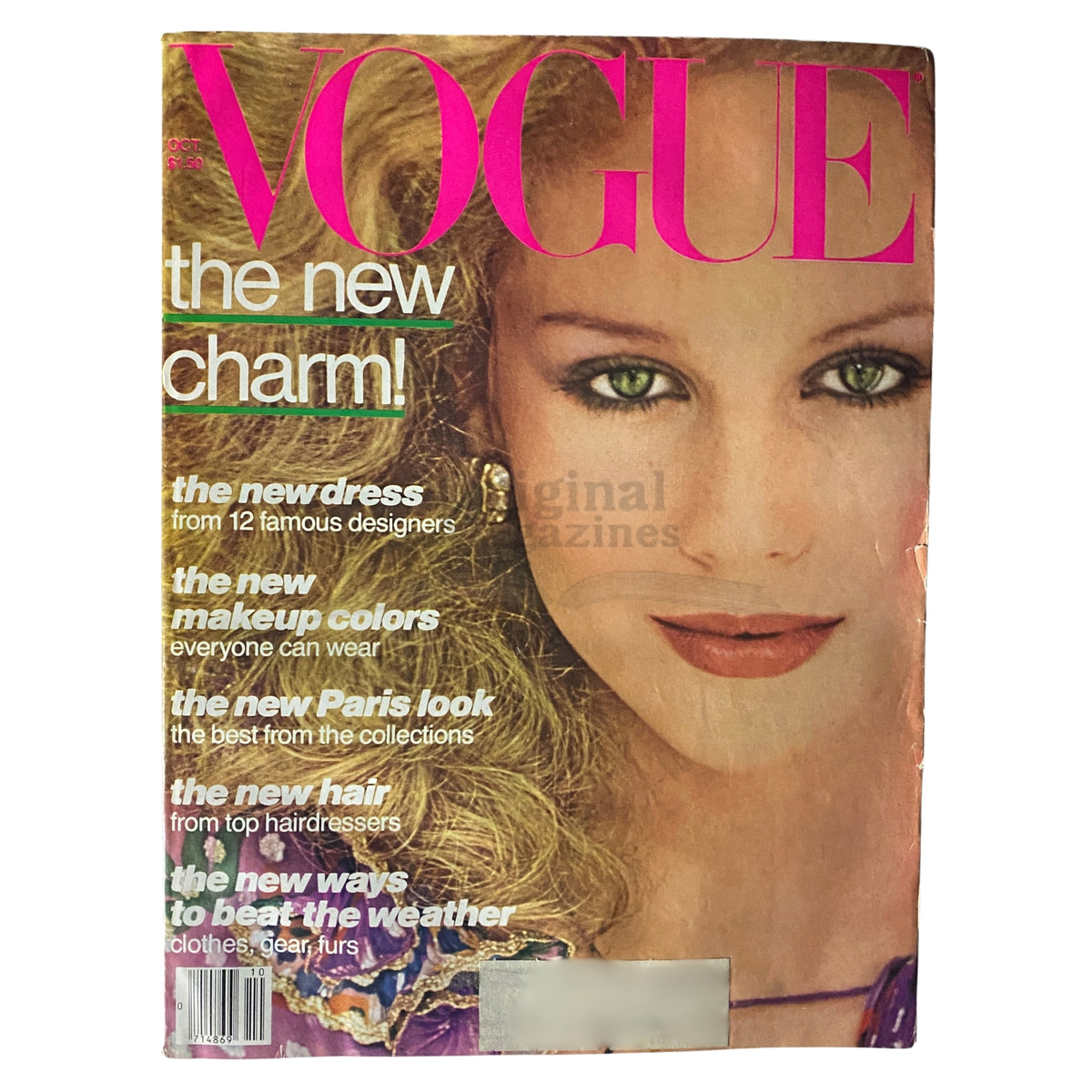


Description
Collector's Note – Why This Issue Matters
October 1977 arrived at a charged moment in American fashion — Paris couture was reasserting its authority after the disruptions of the early seventies, and the pages of Vogue were among the most important dispatches from that cultural front line. This issue documents the season with unusual richness: a full Paris couture report, a meditation on the "new dress," and editorial coverage spanning waist-focused silhouettes and fur — a picture of a fashion establishment both celebrating its heritage and feeling the pull of change. For collectors of vintage Vogue magazines, issues from the mid-to-late seventies occupy a particularly interesting niche: they sit at the hinge between the maximalism of early-decade fashion and the leaner, more architectural shapes that would define the decade's close.
The cover itself is the issue's primary distinction. Rosie Vela — a Texas-born model then at the beginning of a career that would make her one of the defining faces of late-seventies and early-eighties fashion — was photographed by Arthur Elgort, whose candid, movement-forward style was already reshaping how fashion photography felt. Elgort's approach stood apart from the formal studio formalism of earlier decades; his covers had energy, lightness, a sense of the subject caught mid-thought rather than posed for posterity. That quality makes this cover a strong example of the aesthetic direction Vogue was consciously pursuing under the editorship of Grace Mirabella, who had succeeded Diana Vreeland in 1971 and shifted the magazine toward a more practical, wearable conception of high fashion without sacrificing visual ambition. Issues from the remarkable publishing year of 1977 reflect that editorial balance with particular clarity — Mirabella's Vogue at something close to its most confident.
Beyond fashion, this issue is a genuine cultural document. The editorial roster is striking: Studs Terkel writes on the etiquette and politics of tipping; John Rockwell covers the American music scene; a profile of Pelé appears alongside a feature on Dolly Parton at a pivotal moment in her crossover into mainstream celebrity; and Gloria Emerson contributes a piece on fathers and daughters. Kate Millett — one of the defining voices of second-wave feminism — appears in a collaborative photo-essay with photographer Cynthia MacAdams. That a single October issue could contain this range of voices is part of what makes Vogue of this period something more than a fashion magazine.
About the Publication
Vogue was founded in 1892 as a weekly society publication and had evolved, by the mid-twentieth century, into the preeminent American authority on fashion, beauty, and culture. Under the successive editorships of Edna Woolman Chase, Jessica Daves, Diana Vreeland, and — from 1971 — Grace Mirabella, the magazine shaped not only what women wore but how fashion itself was discussed and valued. The October issue was traditionally one of the most significant of the publishing calendar, as it carried the fall fashion collections and set the editorial tone for the season. In the 1970s, Vogue addressed a readership that was increasingly career-oriented and culturally engaged, reflected in the magazine's expanding coverage of politics, finance, travel, and the arts alongside its core fashion and beauty content.
Key Highlights Inside
- Paris Couture Report: A substantial fashion feature titled "Paris Couture: Splendour, Seduction… the Pleasure Principle" covers the fall collections, accompanied by supporting editorial pieces on waist-focused silhouettes under the "Vogue's Eye View" banner — a direct record of what Paris was showing that season.
- Dolly Parton Profile: A feature on Parton — described in the contents as "Something Kind of Different" — ran at a significant moment: 1977 was the year her visibility in mainstream American culture was expanding rapidly beyond country music audiences.
- Marcello Mastroianni Interview: Writer Curtis Bill Pepper contributed a profile of the Italian screen icon discussing love and relationships, representative of Vogue's consistent interest in international cinema during this period.
- The Getty House: Photographer Horst — a Vogue legend whose career stretched back to the 1930s — contributed images of the San Francisco home of Ann and Gordon Getty, a document of California collecting and interior culture in the late seventies.
- Cultural Essays: Studs Terkel on tipping, Gloria Emerson on fathers and daughters, and a collaborative piece by Kate Millett and Cynthia MacAdams on women's identity represent the serious literary and social ambitions of Mirabella-era Vogue.
- Pelé Feature: Coverage of Pelé appeared as his final professional chapter — playing for the New York Cosmos — was drawing enormous public attention to American soccer and his broader cultural significance.
Condition & Rarity
This issue is described as excellent, with only light wear consistent with its age, and has been stored in a plastic protective covering. For collectors evaluating any surviving copy of this issue, those attributes translate into meaningful market value. Newsstand copies of 1970s Vogue that have avoided the label adhesion, spine roll, and humidity damage that compromise most surviving examples are genuinely uncommon at this age; the protective covering indicates a conscious preservation effort rather than casual storage. Covers featuring identifiable photographers and named models — as this one does, with the Elgort–Vela credit — tend to attract interest from both fashion photography collectors and general vintage magazine collectors, widening the potential audience. Interior page integrity is the primary concern in evaluating any copy of a nearly fifty-year-old glossy periodical: tanning, foxing, and loose signatures are the conditions most likely to affect value. A copy retaining its covers flat, its spine intact, and its pages free of significant tanning would be considered a strong survivor for this date.
Looking for More Issues Like This?
Copies of this particular issue — with the Elgort cover and its unusually strong editorial lineup — surface infrequently in collector-grade condition, and finding one with intact preservation history takes patience. If you're building a collection around this period or this title, the full Vogue archive at OriginalMagazines.com is worth browsing for other issues from the Mirabella years. For a broader sense of what the market holds from this moment in American publishing history, the 1977 magazine collection covers the full range of titles from that year — an interesting way to contextualize this issue within the wider cultural moment it documents.