


Description
Collector's Note – Why This Issue Matters
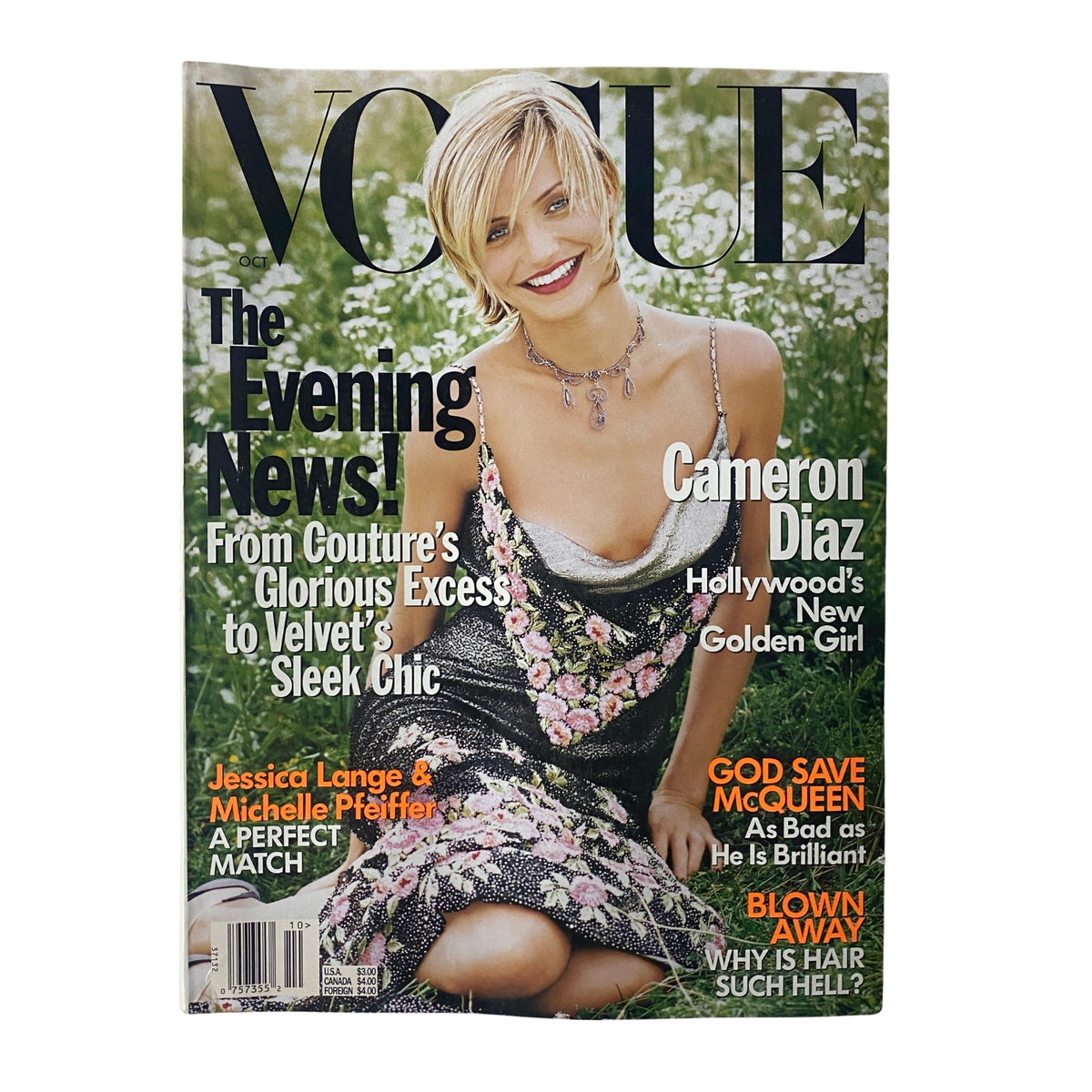
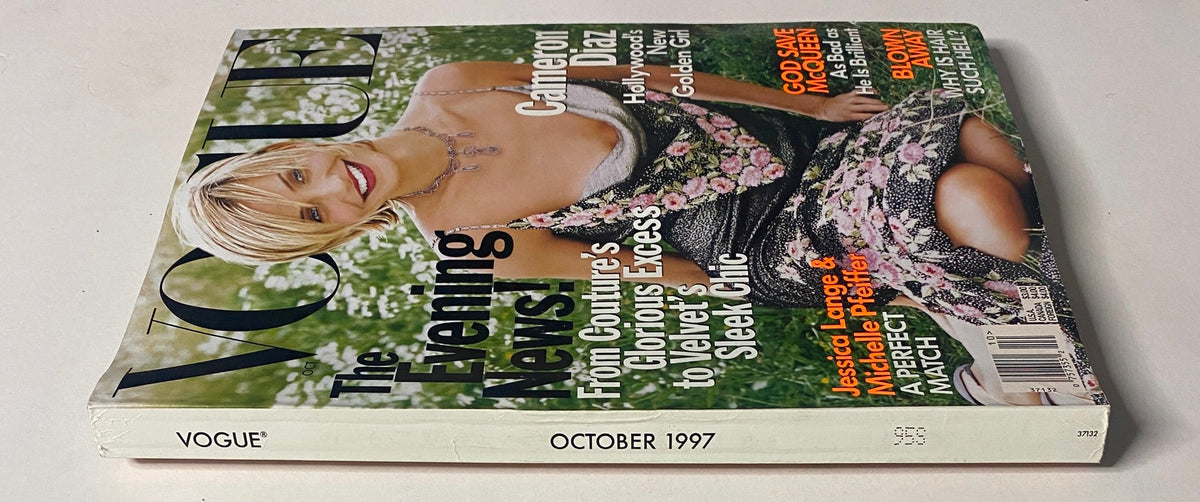
The October 1997 issue of American Vogue featuring Cameron Diaz on the cover documents the actress at one of the most significant transitional moments of her early career — and the timing is precise in ways that reward attention. Diaz had appeared in The Mask in 1994 and in several subsequent films, but it was her performance in My Best Friend's Wedding, released in June 1997, that established her as a genuinely bankable comedic actress capable of holding her own against Julia Roberts in a major studio romantic comedy. A Vogue October cover appearance — the magazine's most important issue of the year — in the months following that breakthrough reflects the editorial judgment that Diaz had crossed a threshold in her cultural significance. The Robert Sullivan profile inside, titled "Cameron-Ready" and described as examining her position as someone "poised to step into her own spotlight," engages with her career at this specific transitional moment before the full arc of her stardom was established, making it a primary document of how the mainstream fashion press was processing her emergence as a major actress. The full scope of Vogue's celebrity cover strategy and editorial evolution across this decade is traceable through the Vogue magazine collection.
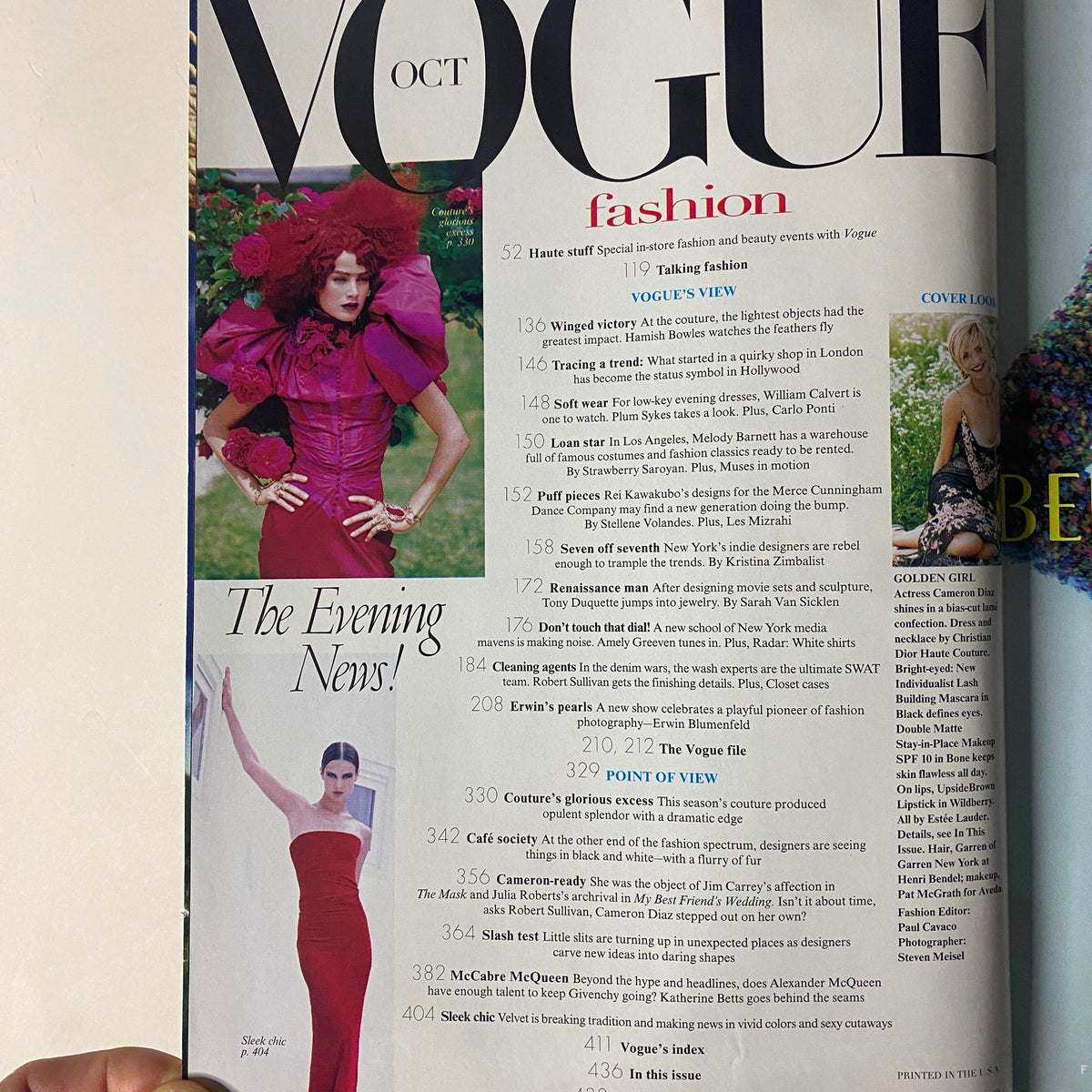
The editorial content of this issue is exceptionally rich in ways that extend well beyond the Cameron Diaz feature. Katherine Betts' "McCabre McQueen" — examining Alexander McQueen's work at Givenchy — is a primary document of one of the most consequential appointments in late-nineties fashion history. McQueen had taken over at Givenchy in October 1996, and by October 1997 his tenure was producing the exact collision of his raw, confrontational aesthetic with the house's legacy of Parisian refinement that made his Givenchy period one of the most discussed and debated in contemporary couture. A Vogue feature explicitly engaging with the "McCabre" dimension of McQueen's Givenchy output — naming it as such — documents the mainstream fashion establishment in the act of processing a genuinely disruptive creative force at close range. Hamish Bowles' feathers-in-couture feature, the Rei Kawakubo dance designs for Merce Cunningham, and the "Couture's Glorious Excess" runway survey together constitute a remarkably comprehensive document of where the couture world stood in October 1997. The broader publishing context is documented across the 1997 magazine collection, which brings together titles from a year that proved, in retrospect, one of the most consequential in late-twentieth-century fashion history.
The tribute to photographer Erwin Blumenfeld ("Erwin's Pearls," p.208) adds a significant historical dimension to the issue's content. Blumenfeld — whose mid-century Vogue covers are among the most celebrated in the magazine's history — had died in 1969, and a retrospective feature in October 1997 Vogue places his legacy within the context of the magazine that had been central to his career. For collectors interested in the history of fashion photography, the presence of a Blumenfeld tribute in the same issue as a McQueen profile and a Cameron Diaz feature captures three distinct layers of fashion history — foundational photography legacy, current couture disruption, and Hollywood's integration with fashion media — in a single October issue of unusual depth and range.
About the Publication
American Vogue, founded in 1892 and acquired by Condé Nast in 1909, is the flagship publication of the global fashion media industry and the standard against which all other fashion magazines have historically measured themselves. Under the editorship of Anna Wintour, who took the helm in 1988, the magazine developed an editorial identity that combined fashion authority with genuine cultural and celebrity engagement — its covers became carefully negotiated statements of cultural currency, and its October issues in particular carried the full weight of its editorial authority as the year's most heavily advertised and elaborately produced annual statement. By October 1997, Wintour's tenure was in its ninth year and the magazine's approach to celebrity-driven fashion coverage was fully developed and widely influential across the publishing industry.
Key Highlights Inside
- "Cameron-Ready" (Robert Sullivan) — a profile of Cameron Diaz published months after her breakthrough in My Best Friend's Wedding, documenting her at the specific transitional moment between emerging actress and established star that makes early career coverage particularly valuable as a primary source for researchers tracking her biography and media presence.
- "McCabre McQueen" (Katherine Betts) — an examination of Alexander McQueen's work at Givenchy, published during his first full year at the house, constituting a primary document of how the mainstream fashion press was processing one of the most consequential and disruptive creative appointments in late-nineties couture.
- "Winged Victory" (Hamish Bowles on feathers in couture) and "Couture's Glorious Excess" runway survey — together providing comprehensive documentation of the fall 1997 couture season's most characteristic aesthetic directions, from one of the magazine's most authoritative fashion writers.
- "Puff Pieces" (Rei Kawakubo's dance designs for Merce Cunningham) — a feature on the collaboration between one of fashion's most influential avant-garde designers and one of the twentieth century's most significant choreographers, documenting a specific intersection of fashion and contemporary dance at a moment when Kawakubo's influence on the broader culture was at its most widely discussed.
- "Erwin's Pearls" (tribute to Erwin Blumenfeld) — a retrospective feature on one of the most significant photographers in Vogue's history, connecting the magazine's mid-century photographic legacy to its late-nineties present in a single issue that also contained current McQueen coverage.
- "Seven Off Seventh" (Kristina Zimbalist on New York indie designers) — a document of the mid-nineties independent fashion designer ecosystem in New York, capturing the downtown design scene at a specific moment in its commercial and critical development.
Condition & Rarity
Surviving copies of the October 1997 Vogue in very good condition represent a clean and display-quality example of one of the more editorially significant issues in the magazine's late-nineties run. Minor edge wear on a copy of this vintage is the expected and honest condition profile of an original, unrestored periodical rather than a reproduction. The absence of a subscriber address label is a meaningful positive in collector evaluation: the Cameron Diaz cover image survives fully intact as designed and printed, without the adhesive marks or obscured photography that subscription labels permanently leave behind. The protective plastic sleeve on well-preserved copies is the standard archival measure for a magazine of this paper stock and production quality, stabilizing further deterioration from handling and environmental exposure without requiring any alteration to the original item.
Looking for More Issues Like This?
A no-label very good condition copy of the October 1997 Vogue — with Cameron Diaz on the cover and the McQueen, Blumenfeld, and Kawakubo editorial content documented here — is one of the more substantively rewarding finds in the magazine's late-nineties run, offering collector value across fashion photography history, couture criticism, and celebrity media simultaneously. If this particular issue is no longer available, the full Vogue magazine collection at OriginalMagazines.com is the most comprehensive single source for exploring other issues across the publication's long run, with strong representation in the nineties decades that fashion historians and cultural researchers are increasingly prioritizing. For collectors building a broader archive of 1997's extraordinary cultural and fashion moment, the complete 1997 magazine collection brings together titles from one of the most consequential years in late-twentieth-century fashion history.