





Description
Collector's Note – Why This Issue Matters
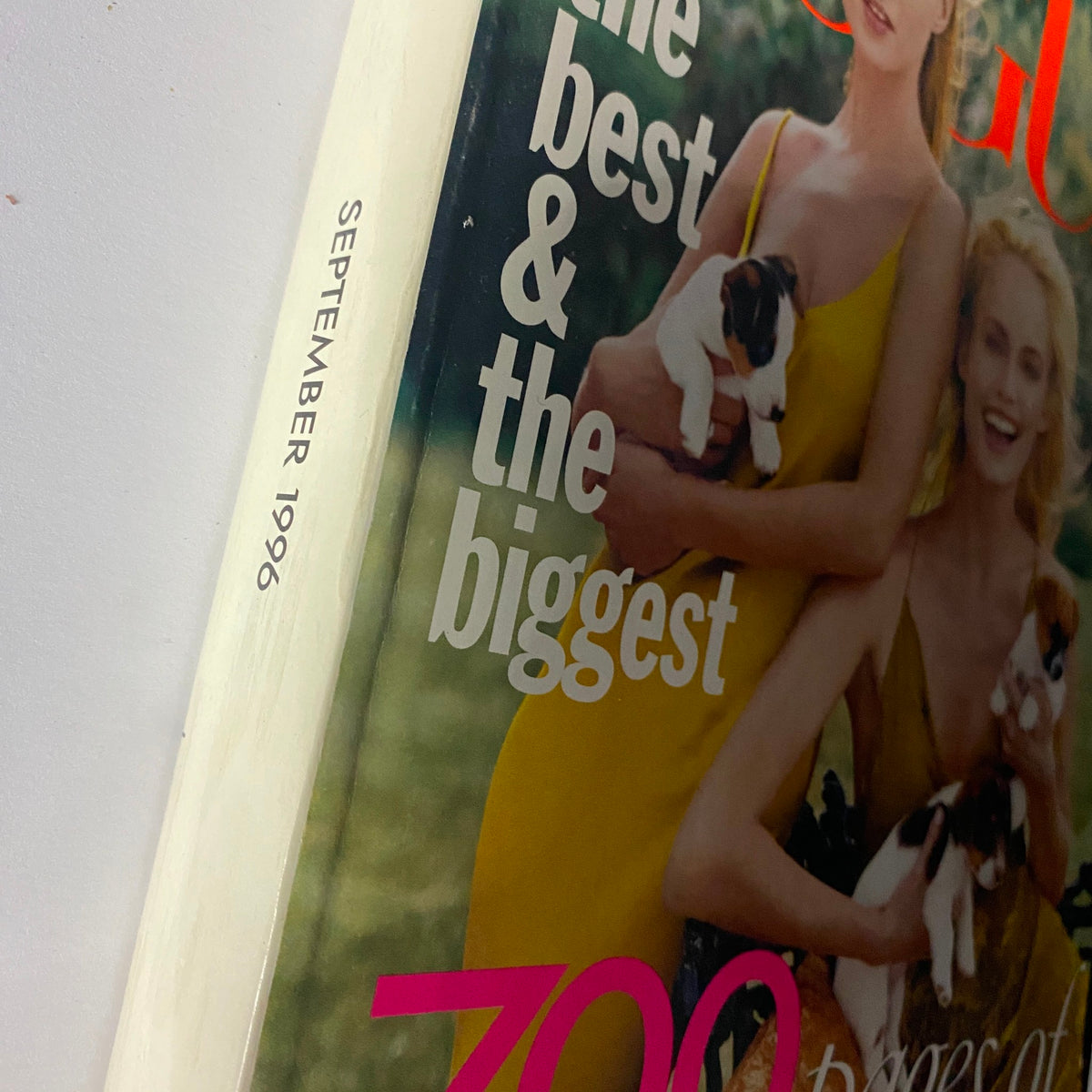
The September issue is the most important edition any fashion magazine publishes each year. It is the industry's annual statement — the definitive fall preview, the heaviest and most advertising-dense issue of the calendar, the one that editors, designers, and collectors treat as the benchmark for a publication's creative and commercial standing. Vogue's September 1996 issue arrives at a particularly charged moment in the magazine's history and in fashion more broadly. Kate Moss and Amber Valletta sharing the cover is a precise document of where the industry's center of gravity sat in the mid-1990s: two models who had, between them, defined the competing aesthetics of the decade. Moss had emerged as the face of a certain stripped-down, anti-glamour cool that had dominated the early 1990s; Valletta represented a return to a more classical, high-fashion elegance. Their pairing on a single September cover is an editorial statement about a moment of transition — the grunge-influenced minimalism of the early decade giving way to something richer, more overtly luxurious, more willing to announce itself. Collectors building a serious archive of Kate Moss magazine covers will find this among the more significant Vogue appearances of her mid-career period.
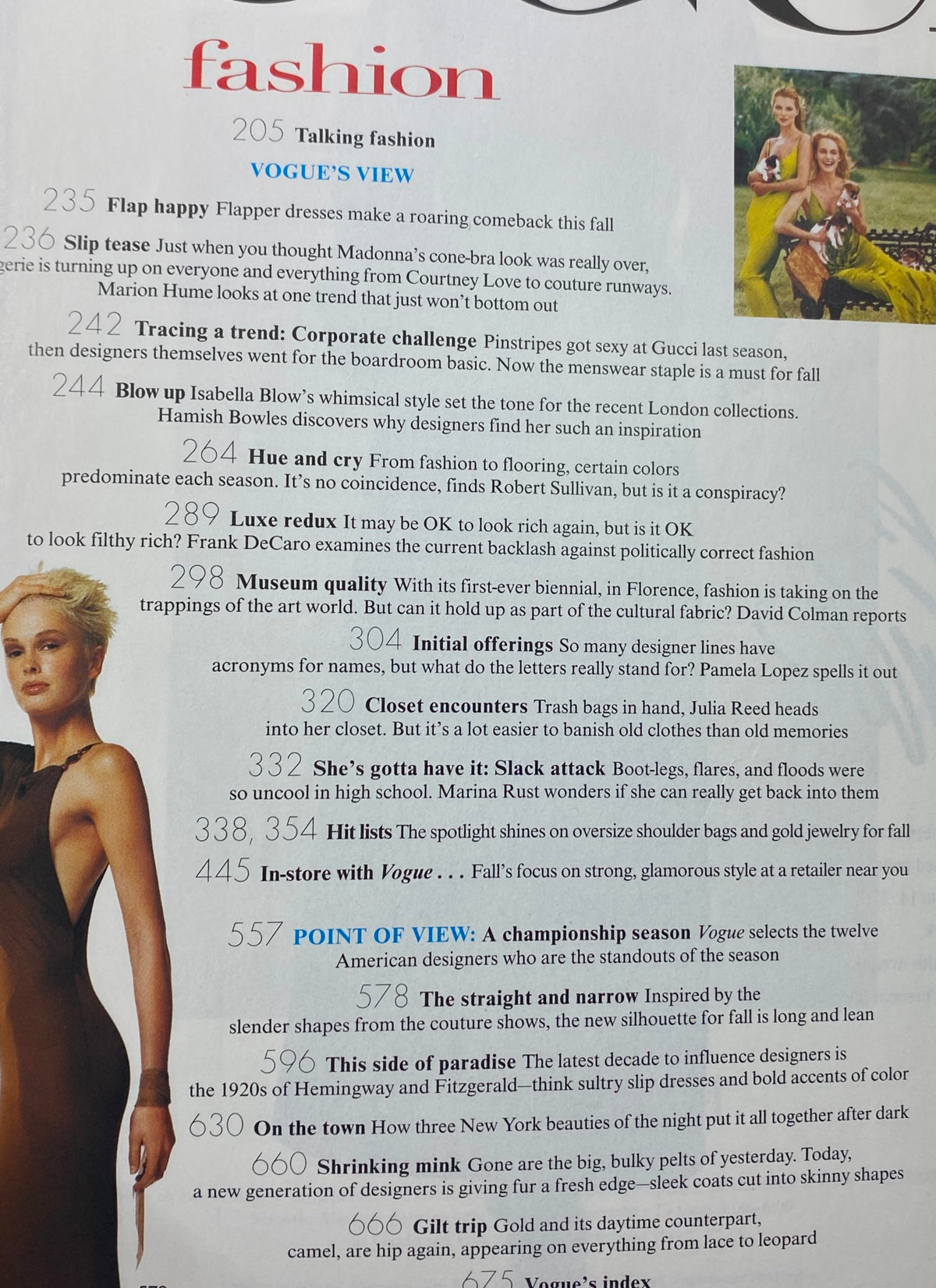
The interior confirms the transition. The issue's fashion content is preoccupied with exactly the tensions the cover image suggests: a "luxe redux" feature asks whether it has become acceptable to look "filthy rich" again after years of politically correct minimalism; a pinstripe feature traces how menswear suiting moved from Gucci's runways into the broader design conversation; a fur feature announces that "big, bulky pelts" belong to yesterday and a new generation is giving the material a sleeker shape. The 1920s surface repeatedly as a reference point — slip dresses, Hemingway and Fitzgerald invoked by name, the flapper silhouette making what the magazine calls "a roaring comeback." It is a fall season consciously reaching backward into glamour while insisting it is doing something new. The Isabella Blow profile by Hamish Bowles is particularly valuable as a primary document: Blow was among the most influential figures in British fashion at this moment, and her visibility in a major American Vogue issue marks her at the height of her international profile. For collectors of Vogue's most editorially rich issues, the density of significant names and ideas in this single edition is unusual even by September standards.
The mid-1990s occupy a specific and well-documented place in fashion history, and this issue captures the exact moment the decade's dominant aesthetic began to turn. The minimalism that had defined the early 1990s was visibly exhausted; the maximalism and logomania that would characterize the late 1990s and early 2000s were not yet fully formed. September 1996 sits in the hinge. The issue's "Point of View" feature, in which Vogue selects twelve American designers as standouts of the season, functions as a primary source for understanding which names the American fashion establishment was elevating at this precise inflection point. Anyone researching fashion magazines from 1996 as cultural documents will find this issue among the year's most substantive entries.
About the Publication
Vogue was founded in New York in 1892 and acquired by Condé Nast in 1909, under whose ownership it became the dominant American fashion authority of the twentieth century. By the 1990s, under editor-in-chief Anna Wintour, who had taken the helm in 1988, the magazine had reasserted itself as the preeminent voice in global fashion publishing — influential not only in documenting trends but in actively shaping them. Its September issue was recognized across the industry as the single most important edition of the American fashion calendar, with page counts and advertising revenue that dwarfed any other monthly magazine publication. Its audience encompassed fashion professionals, serious consumers, and cultural observers, and its covers and editorial features were treated as primary sources by historians of dress, photography, and popular culture.
Key Highlights Inside
- Kate Moss and Amber Valletta cover — The pairing of two of the decade's defining models on a single September cover is itself an editorial statement, documenting the coexistence of competing aesthetic sensibilities at a moment of stylistic transition in mid-1990s fashion.
- Isabella Blow profile by Hamish Bowles (p.244) — A feature on one of British fashion's most singular and influential figures, examining her role as a creative catalyst for the London collections and her relationships with the designers she championed.
- Luxe redux by Frank DeCaro (p.289) — An examination of the mid-1990s backlash against minimalism and politically correct fashion, asking whether conspicuous luxury had become culturally acceptable again — a question that proved prescient for the direction the industry took in the late 1990s.
- Museum quality by David Colman (p.298) — A report on fashion's first-ever biennial in Florence, documenting the industry's early efforts to position itself within the institutional art world.
- 1920s revival editorial (p.596) — A fashion feature drawing explicit connections between fall 1996's slip dresses and bold colors and the aesthetic world of Hemingway and Fitzgerald, with the decade serving as the season's dominant historical reference point.
- Point of View: Twelve American designers (p.557) — Vogue's seasonal selection of standout American designers, functioning as a primary document of the magazine's editorial hierarchy in fall 1996.
Condition & Rarity
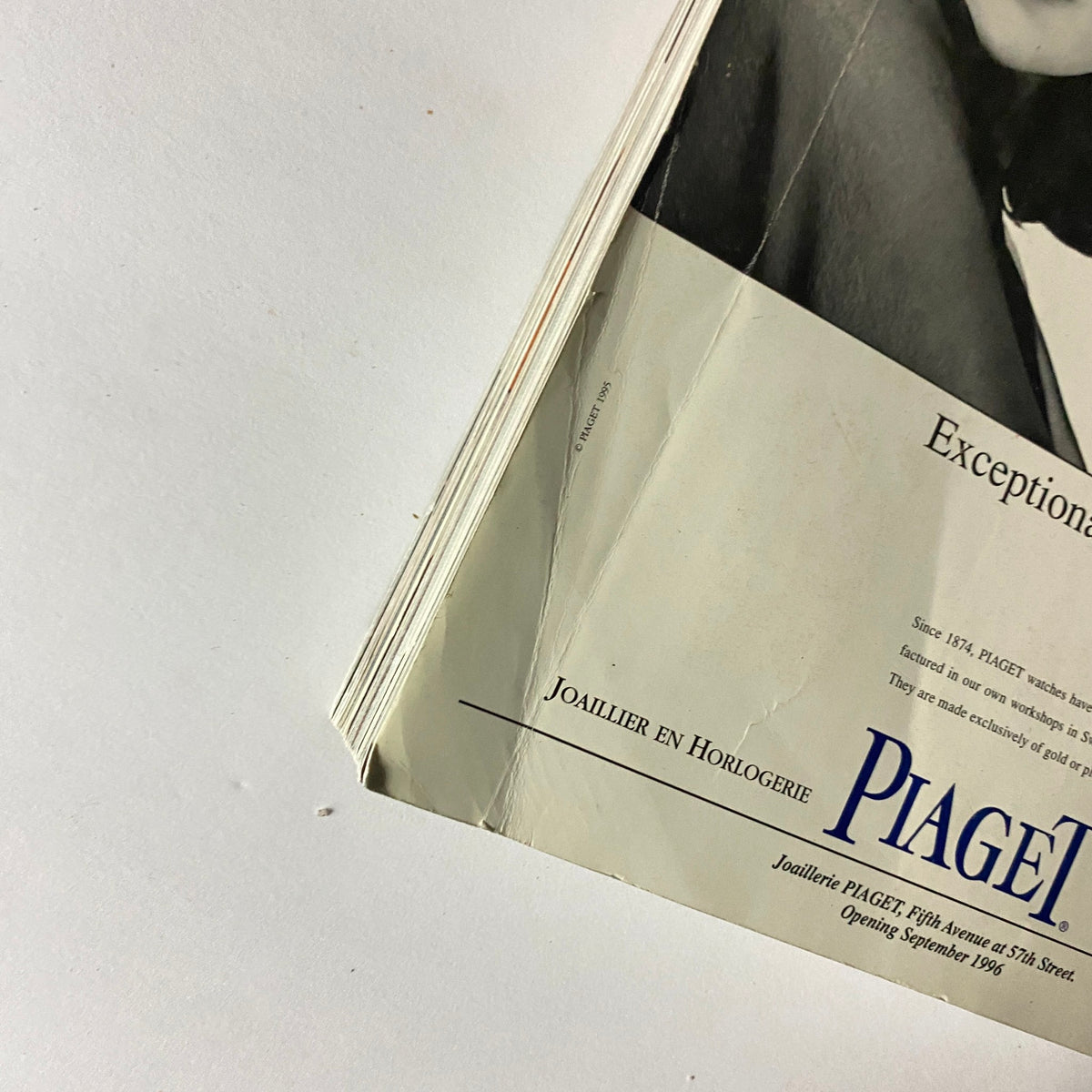
September issues of Vogue from the 1990s present a specific set of condition considerations driven by their exceptional size and weight. The sheer page count of a mid-1990s September Vogue — routinely exceeding 600 pages — places structural stress on the spine that smaller issues do not experience, and spine cracking or separation is among the most common condition issues in surviving copies. Minor edge wear, as noted, is entirely typical for an issue of this age and does not significantly affect display quality. The absence of a mailing label is a meaningful positive: Vogue subscription copies from this era carry address labels directly on the cover, and their presence or removal both compromise the cover image — a particularly significant issue for an edition whose cover photograph is a primary collector draw. A very good grade for an issue of this age and size indicates that the cover image, spine, and interior pages are all intact and display-quality, with only the minor wear consistent with careful storage over nearly three decades. Protective plastic covering suggests deliberate preservation, which in a magazine of this physical weight typically correlates with better spine integrity than unprotected storage would produce.
Looking for More Issues Like This?
September Vogue issues with significant cover subjects are among the most consistently pursued items in vintage fashion magazine collecting, and this particular pairing makes the 1996 edition a standout even within that competitive category. The Kate Moss magazine collection is the natural first stop for collectors following her editorial career across publications and years. The full Vogue archive at OriginalMagazines.com spans the magazine's most celebrated decades and includes many of the landmark September issues, and the 1996 magazine collection provides broader context for the cultural and fashion moment this issue so precisely captures.