





Description
Collector's Note – Why This Issue Matters
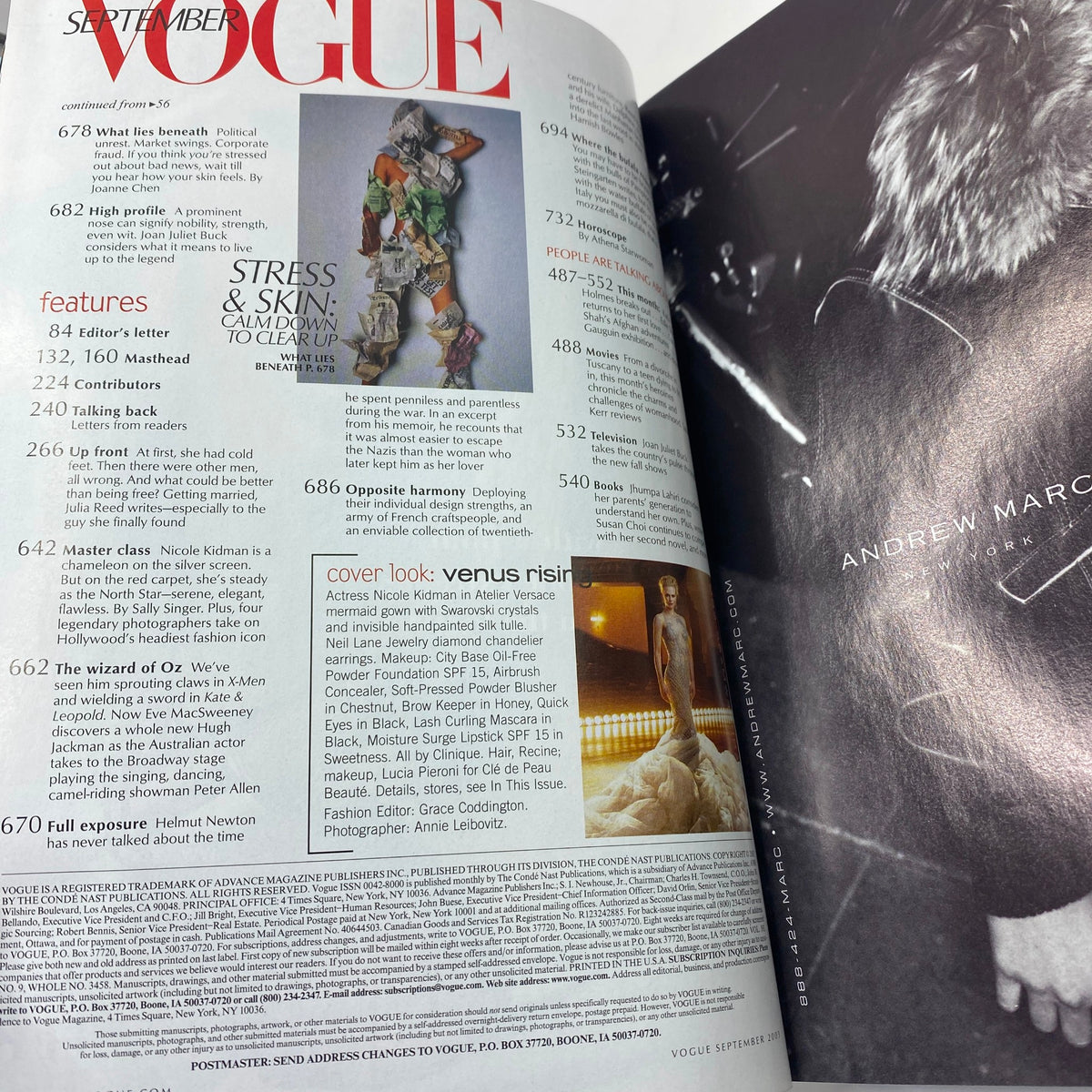
The September 2003 issue of Vogue featuring Nicole Kidman on the cover is one of the most artistically and culturally significant fashion magazine covers of the early 2000s, and the credentials behind it explain why. The cover was shot by Annie Leibovitz — one of the most celebrated portrait photographers in American history and the definitive voice of celebrity portraiture across the final decades of the twentieth century — with fashion direction by Grace Coddington, whose editorial vision had helped define Vogue's visual identity for decades. The cover image, described in the issue's own credits as "Venus Rising," shows Kidman in an Atelier Versace mermaid gown with Swarovski crystals and invisible hand-painted silk tulle, accompanied by Neil Lane diamond chandelier earrings — a combination of fashion, jewelry, and photographic craft that produced one of the most technically and aesthetically ambitious covers Vogue published during the Wintour era. The September issue is the most important single issue in Vogue's annual calendar, and the decision to place Kidman — photographed by Leibovitz, styled by Coddington, dressed by Versace — on its cover in 2003 represents the magazine operating at the absolute peak of its editorial and production ambitions. For collectors building a comprehensive archive of Nicole Kidman's appearances in major fashion and celebrity print media, this is the definitive cover of her career.
Kidman's cultural standing in September 2003 made her an exceptionally well-chosen September cover subject. She had won the Academy Award for Best Actress in March 2003 for her portrayal of Virginia Woolf in The Hours — a performance so technically demanding and so critically acclaimed that it had effectively settled, for most serious observers of film, any remaining questions about her place among the finest actresses of her generation. The Oscar win came after a run of films — Moulin Rouge! (2001), The Others (2001), The Hours (2002) — that had demonstrated a range and commitment rare among actors of comparable commercial profile, and it coincided with a period of intense personal public interest following her high-profile divorce from Tom Cruise in 2001. The Vogue September cover in this context was both a recognition of her artistic achievement and a document of her emergence as a fully autonomous public figure — an actress whose identity had been rebuilt and redefined entirely on her own terms in the two years since the end of her marriage. The interior feature, described in the table of contents as a profile of Kidman as "a chameleon on the silver screen" but "steady as the North Star" on the red carpet, and notably including photography by four legendary photographers, reinforces this issue's status as a sustained artistic and editorial tribute rather than a routine celebrity placement. The full Vogue archive across the Wintour years contains many distinguished September covers, but this one stands apart for the convergence of subject, photographer, fashion, and cultural moment that it documents.
The supporting editorial content in this issue further establishes its depth as a cultural artifact. A profile of Hugh Jackman, described as exploring a whole new dimension of the Australian actor as he takes to Broadway to play the singing, dancing showman Peter Allen, connects to a period when Jackman was expanding from the Wolverine role that had made him a global action star into a broader range of artistic work that would define his career for the following two decades. Helmut Newton's memoir excerpt — in which the legendary German-Australian fashion photographer recounts his wartime experiences — is a document of extraordinary historical and artistic significance in its own right, published just months before Newton's death in January 2004 and representing one of his final major public contributions to the record of his own life. The full magazine landscape of 2003 was a year of considerable cultural and geopolitical turbulence — the Iraq War had begun in March — and this September issue captures the fashion world's particular mode of engaging with and partially reflecting that turbulence through the subjects and stories it chose to foreground.
About the Publication
Vogue is the oldest and most internationally influential American fashion magazine, founded in 1892 and operating under Condé Nast ownership since 1909. The September 2003 issue falls within the long editorial tenure of Anna Wintour, who had taken over as editor-in-chief in 1988 and by 2003 had fully established Vogue as the unchallenged center of gravity in American fashion media — a publication whose cover selections were understood as meaningful cultural endorsements and whose September issue in particular was treated by the fashion industry as the most important single magazine event of the year. Wintour's editorial philosophy placed Hollywood celebrity at the intersection of fashion coverage in a way that distinguished her era sharply from her predecessor Grace Mirabella's more fashion-industry-focused approach, and the Nicole Kidman September 2003 cover is one of the clearest expressions of that philosophy — an Oscar-winning actress in couture, photographed by the greatest celebrity portrait photographer in the country, for the year's most significant fashion issue. The magazine's audience in 2003 was affluent, fashion-engaged, and broadly culturally literate, drawn to Vogue as much for the cultural authority of its cover selections and the quality of its editorial photography as for the seasonal fashion content that provided the magazine's commercial foundation.
Key Highlights Inside
- Cover photography by Annie Leibovitz featuring Nicole Kidman in an Atelier Versace mermaid gown with Swarovski crystals and hand-painted silk tulle, with fashion direction by Grace Coddington — a collaboration of three of the most influential figures in American fashion and celebrity culture producing one of the most technically ambitious and visually spectacular covers in Vogue's September issue history, titled "Venus Rising" in the issue's own credits.
- "Master Class: Nicole Kidman" — the cover profile by Sally Singer describing Kidman as "serene, elegant, flawless" on the red carpet, accompanied by photography from four legendary photographers, published in the months immediately following her Academy Award win for The Hours and documenting her at the absolute peak of her critical and public standing.
- "The Wizard of Oz" — a profile of Hugh Jackman by E. MacKensey covering the Australian actor's Broadway performance as showman Peter Allen in The Boy from Oz, documenting a significant expansion of Jackman's artistic range beyond the Wolverine role that had made him a global star and capturing a career moment of genuine interest to both theatre and film audiences.
- Helmut Newton memoir excerpt — a personal account from one of the most celebrated and controversial fashion photographers of the twentieth century, covering his wartime experiences, published just months before Newton's death in January 2004 and representing one of his final major public contributions to the historical record of his life and artistic formation.
- "Up Front" by Julia Reed — a personal essay on marriage, freedom, and the unexpected arrival of the right person, by one of American journalism's most distinctive voices, representing the kind of substantive literary contribution that distinguished the Wintour-era Vogue from more narrowly fashion-focused competitors.
- "What Lies Beneath" — a feature examining the relationship between political stress, market anxiety, and skin health by Joanne Chen, reflecting Vogue's consistent editorial practice of connecting its beauty content to the broader cultural and emotional landscape in which its readers were living in September 2003, just six months after the beginning of the Iraq War.
Condition & Rarity
This issue is presented without a mailing label on the cover — confirming newsstand origin and preserving the full visual presentation of Leibovitz's Kidman portrait without the adhesive damage or paper obstruction that subscriber labels frequently caused on Vogue covers of this era. For a title with Vogue's substantial subscriber base, clean label-free copies represent a proportionally smaller subset of the surviving pool, making newsstand editions in good condition consistently more desirable in the collector market. Specific condition details beyond the plastic protective covering are not provided in the listing, and collectors should refer to the available photographs for an accurate assessment of cover gloss retention, spine integrity, and interior page quality. The plastic protective covering present on surviving copies in this condition supports ongoing preservation of the cover stock — early 2000s Vogue was printed on high-quality coated paper that holds color and gloss well under careful storage — and for the interior photography spreads that represent the primary visual content of the issue. When evaluating any surviving copy of this September 2003 issue, collectors should pay particular attention to the Leibovitz cover portrait condition and color saturation, the spine integrity given the substantial pagination typical of September issues — the largest issues of the year by page count — the flatness and tanning of the interior page block, and the condition of the four-photographer Kidman feature spread inside, which alongside the cover represents the most artistically and historically significant visual content in the issue.
Looking for More Issues Like This?
The September 2003 Nicole Kidman Vogue cover — Leibovitz photography, Coddington fashion direction, Versace couture, and a freshly Oscar-crowned actress at the peak of her public life — represents one of the most fully realized single issues in the Wintour era's long and distinguished run, and label-free copies in good condition are among the more sought-after documents in the early 2000s fashion magazine collecting market. If this issue has already found a home, the full Nicole Kidman magazine archive at OriginalMagazines.com is the most focused place to explore her other significant cover and feature appearances across the decades of her career. The complete Vogue magazine collection spans the full range of the title's publishing history across multiple editorial eras and is essential browsing for anyone building a serious run of the magazine's Wintour-era September issues in particular. For collectors working through the broader American magazine landscape of this period, the complete 2003 magazine collection covers the full range of titles from a year defined by major geopolitical events and the cultural responses to them that are now visible as historical documents rather than current events.