

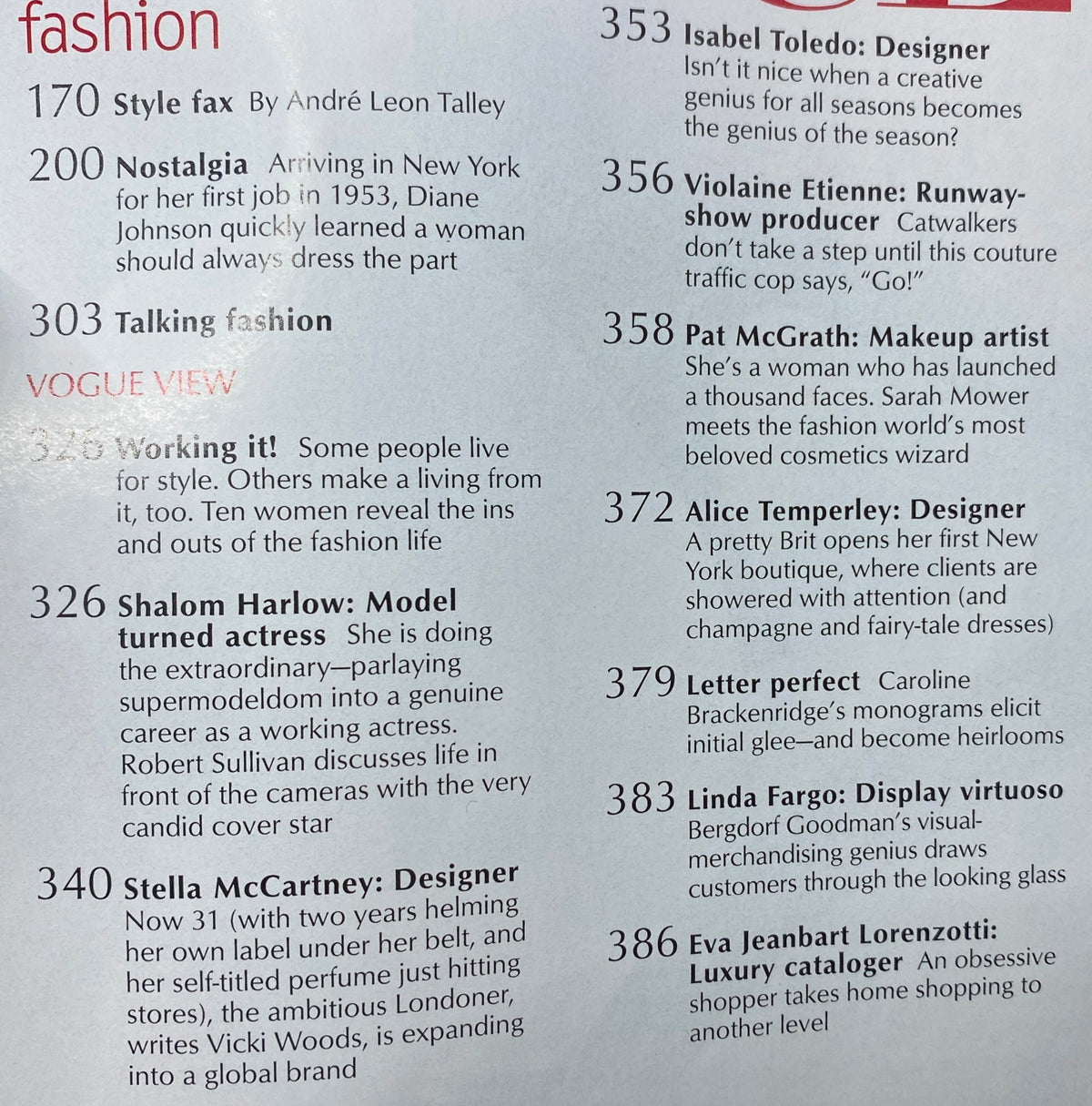


Description
Collector's Note – Why This Issue Matters
The September 2003 issue of Vogue, with Nicole Kidman on the cover, is one of the more editorially substantive configurations of the publication's early-2000s archive — and the confirmed "Working It!" feature at the heart of this issue's table of contents reveals exactly why. By September 2003, Kidman had won the Academy Award for Best Actress for The Hours in March of that year and was in the process of consolidating a post-divorce, post-Oscar public identity built on critical respect, fashion authority, and the specific kind of composed elegance that made her one of the era's most carefully watched celebrity presences. A September Vogue cover — the most significant editorial placement in the American fashion calendar — represents the fashion establishment's formal acknowledgment of that status. The "Working It!" section confirmed in this listing's table of contents is the issue's primary editorial achievement alongside the cover: ten profiles of women shaping the fashion industry, including Shalom Harlow, Stella McCartney, Isabel Toledo, Pat McGrath, and Alice Temperley, constituting a primary source document of fashion's power structure in September 2003. For collectors building an archive of Nicole Kidman magazine covers and fashion history, this September 2003 Vogue is the definitive document of her fashion establishment recognition in her post-Oscar year.
The ten-profile "Working It!" section is worth understanding as a historical document in its own right. The confirmed profiles capture their subjects at specific career moments: Stella McCartney two years into her own label with her self-titled perfume just launching, described as "expanding into a global brand"; Pat McGrath at the peak of her editorial dominance, identified as "the fashion world's most beloved cosmetics wizard" by Sarah Mower; Alice Temperley opening her first New York boutique; Isabel Toledo being named the season's creative genius; and Linda Fargo as Bergdorf Goodman's visual-merchandising authority. These are not retrospective assessments — they are real-time documentation of where these figures stood in September 2003, giving this issue the specific primary source value that only contemporary journalism can provide. André Leon Talley's "Style Fax" column and Diane Johnson's "Nostalgia" piece about dressing for a 1953 New York first job round out the confirmed editorial content with two contrasting perspectives on fashion's relationship with time and memory. Vogue magazine issues from the early 2000s capture the publication at a specific transitional moment, and this September 2003 edition is among the most editorially ambitious examples. Publications from 2003 document fashion and celebrity culture at a post-millennial moment of considerable creative energy.
About the Publication
American Vogue in September 2003 was operating under the editorship of Anna Wintour, who had led the magazine since 1988. The September collections issue was the most substantial and carefully produced edition of the annual publishing calendar, and its deployment of a ten-profile industry survey alongside a major celebrity cover reflects the full weight of Wintour-era Vogue's editorial investment in documenting fashion as a professional world populated by significant individuals rather than simply as a commercial product. The "Working It!" section's breadth — from runway show producers to luxury catalogers to makeup artists to designers — reflects Vogue's understanding that its authority came from documenting the full architecture of the fashion world, not just its most visible faces.
Key Highlights Inside
- Nicole Kidman cover — September 2003, her post-Academy Award year, representing Vogue's formal placement of her at the center of American fashion authority in the most significant editorial position in the annual publishing calendar.
- "Working It!" (pp.326–386) — ten profiles of women shaping the fashion industry in September 2003, including Stella McCartney (two years into her own label), Pat McGrath ("the fashion world's most beloved cosmetics wizard"), Isabel Toledo, Alice Temperley opening her first New York boutique, and Bergdorf Goodman's Linda Fargo, constituting a primary source document of fashion's professional power structure at this specific moment.
- Shalom Harlow profile by Robert Sullivan (p.326) — the model-turned-actress described as "parlaying supermodeldom into a genuine career as a working actress," capturing a specific career transition at its documented moment.
- Stella McCartney profile by Vicki Woods (p.340) — the designer at thirty-one, two years into her own label with her perfume just launching, documented at a specific stage of what would become a major global fashion brand.
- "Style Fax" by André Leon Talley (p.170) and "Nostalgia" by Diane Johnson (p.200) — confirming the issue's editorial range from Talley's authoritative fashion commentary to Johnson's reflective personal essay about dressing for a 1953 first job in New York.
Condition & Rarity
Very good condition with minor edge wear is a strong rating for a monthly fashion magazine now over twenty years old — particularly the September collections issue, which was typically the largest and most densely produced edition of the publishing year. The absence of a mailing label confirms newsstand origin, the preferred configuration for display collectors of early-2000s Vogue issues. The plastic protective covering indicates deliberate preservation storage. For a glossy-stock monthly publication of this vintage, the primary condition factors are cover surface brightness and color saturation — the Kidman cover photograph is the primary visual and collectible attribute — spine integrity given the September issue's substantial page count, and the completeness of the "Working It!" profile section pages that constitute the issue's most historically significant interior content.
Looking for More Issues Like This?
A label-free, very good condition September 2003 Vogue with Nicole Kidman on the cover and the confirmed "Working It!" ten-profile industry survey is a more historically layered find than a routine celebrity cover — the combination of Kidman's post-Oscar fashion authority and the detailed documentation of the fashion industry's power structure makes this issue worth seeking specifically. If it has already been claimed, the archive of Nicole Kidman magazine covers and fashion features is the natural first stop. The full Vogue magazine collection and the 2003 magazine archive offer additional context for this specific year in American fashion history.