




Description
Collector's Note – Why This Issue Matters
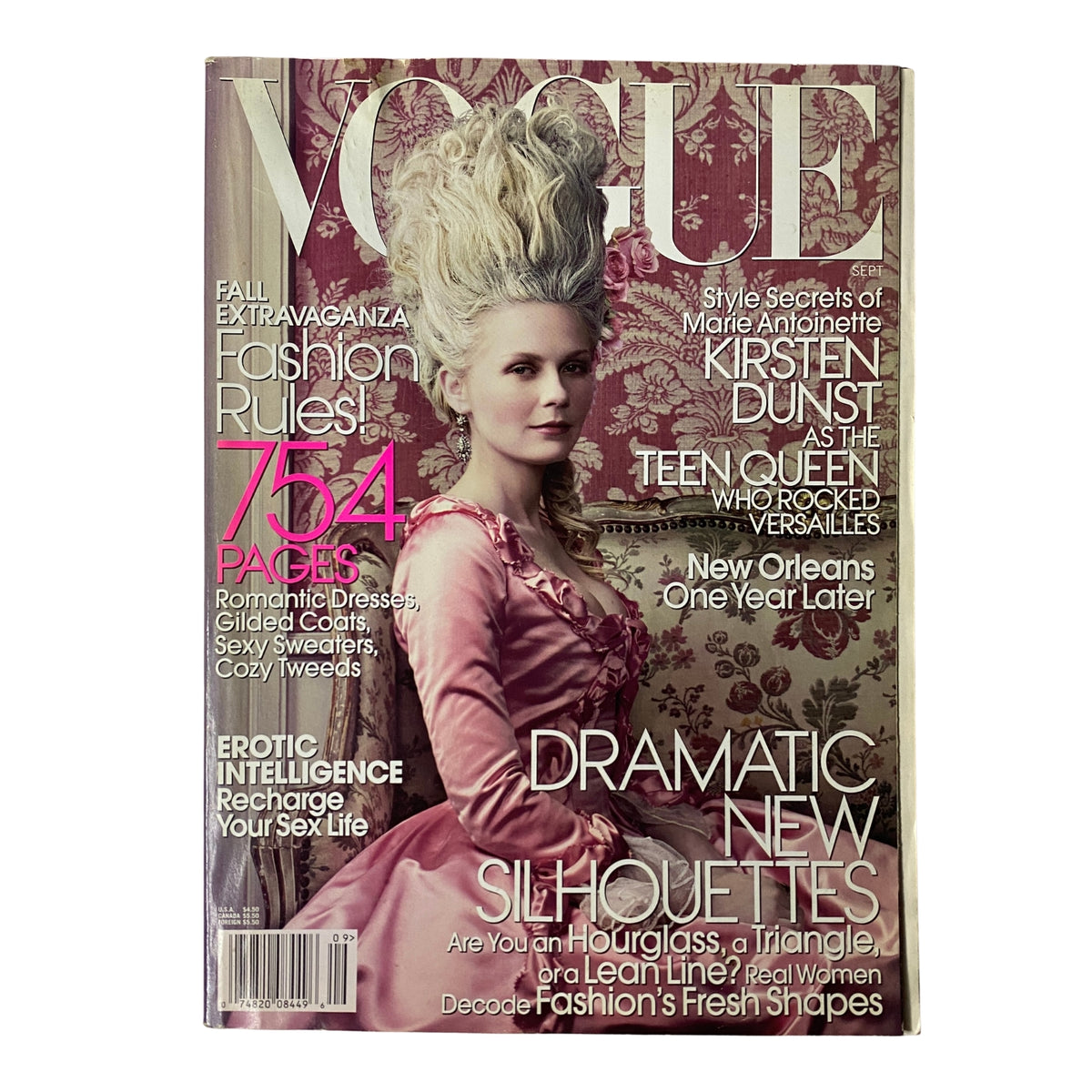
The September 2006 issue of Vogue arrives at a particular moment in both the magazine's history and in Kirsten Dunst's cultural trajectory. September is the most important publishing date in the fashion calendar — the largest, most advertising-dense, most editorially ambitious issue of any given year — and September 2006 was no exception. Kirsten Dunst was at this point one of the most recognizable actresses of her generation, having anchored the Spider-Man franchise through three films from 2002 to 2007, and her Vogue cover coincided with the buildup to Sofia Coppola's Marie Antoinette, which premiered at Cannes in May 2006 and was scheduled for wide release in October 2006. The timing of the cover — a September issue arriving the month before the film's wide release — places it squarely within the promotional arc of what was one of the most visually distinctive American films of the year, a movie whose entire aesthetic was built around an extravagant, anachronistic vision of eighteenth-century fashion that Vogue was uniquely positioned to document and celebrate. For collectors building an archive around vintage Vogue issues from the mid-2000s, this September issue documents both a significant cover subject and one of the more culturally specific editorial alignments between film and fashion publishing of the decade.
The table of contents reveals an issue with genuine editorial substance behind the fashion coverage. André Leon Talley — Vogue's larger-than-life contributing editor whose relationship with the magazine and its editor Anna Wintour was one of the defining creative partnerships in American fashion journalism — contributes a personal style reflection that would resonate differently in retrospect given his later public account of his complicated relationship with the publication. The skinny jean feature, "Mood Indigo," documents a specific and contested fashion moment: 2006 was precisely the year the skinny jean was transitioning from a polarizing runway trend to a mainstream wardrobe staple, and Vogue's engagement with that transition is a primary record of how the magazine negotiated between high fashion and consumer accessibility during this period. The Vienna cultural journey, the purple color story, and the style advice for mature women through the revived "Mrs. Exeter" column reflect the editorial breadth that made September Vogue issues function as annual documents of where fashion, culture, and American aspiration intersected in a given year. Anyone building a collection around magazines from 2006 will find this September issue one of the more content-rich single objects the year produced in fashion publishing.
About the Publication
Vogue, founded in 1892 and built by Condé Nast after his 1909 acquisition into the world's preeminent fashion authority, was in 2006 under the editorship of Anna Wintour — who had held the position since 1988 — producing its annual September issue as the most commercially significant and editorially ambitious publication in the American fashion magazine calendar. The September issue's size, advertising volume, and editorial ambition had grown dramatically through the 1990s and 2000s, and by 2006 it routinely exceeded 700 pages, functioning as an annual state-of-the-industry document as much as a monthly magazine. Its readership was affluent, fashion-literate, and culturally engaged, and its cover subjects were chosen with deliberate attention to the intersection of celebrity, fashion, and cultural moment.
Key Highlights Inside
- Cover featuring Kirsten Dunst — published one month before the wide release of Sofia Coppola's Marie Antoinette, placing the cover within the film's promotional arc and connecting the issue to one of 2006's most visually distinctive cinematic events.
- "Life with André" — André Leon Talley's personal style reflection (p. 224), a contribution from one of Vogue's most distinctive editorial voices during his long tenure as contributing editor at the magazine.
- "Mood Indigo" — coverage of the skinny jean trend (p. 490) documenting a specific and contested fashion moment, with "Going for Broke" (p. 494) offering accessible interpretations under $100, illustrating Vogue's editorial negotiation between high fashion and consumer reality.
- "What's Your Shape?" — real-world women in fall's new silhouettes (p. 405), and "Excessive Behavior" by Robert Sullivan on over-accessorization (p. 476), reflecting the issue's balance between aspirational fashion and cultural commentary.
- "The Last Waltz" — a cultural and style journey through Vienna (p. 608), and "Ask Mrs. Exeter" — style advice for the mature fashionista (p. 504), demonstrating the editorial range of a September issue operating at full scale across demographics and geographies.
- Nostalgia piece by Amy Wilentz on Warren Beatty (p. 242) — one of several non-fashion editorial contributions that positioned this September issue as a cultural document beyond its fashion coverage.
Condition & Rarity
Copies of this issue described as label-free represent the most desirable provenance for Vogue collecting, as subscriber copies typically arrived with address labels applied directly to the cover — particularly significant for a September issue whose cover image is a primary part of its collectible identity. Good condition with typical age-consistent wear is an honest and representative grade for a magazine now approaching twenty years old; September Vogue issues are structurally demanding objects given their substantial page count, and spine integrity across a 700-plus-page issue is an important condition criterion alongside cover presentation. The plastic protective covering indicates deliberate preservation storage. For mid-2000s Vogue issues, which lack the additional rarity premium of pre-digital-era copies but carry genuine documentary value as records of the magazine's editorial identity during a specific cultural period, label-free copies in good condition with intact spines and complete interiors represent the standard collector-grade baseline.
Looking for More Issues Like This?
September Vogue issues from the mid-2000s with significant cover subjects and documented editorial content of this depth are among the more complete single-object records of the decade's fashion culture, and label-free copies in good condition are a more selective subset of what the market typically produces for issues from this era. If this issue is no longer available, the broader vintage Vogue archive at OriginalMagazines.com spans the full Wintour era and is the most reliable place to continue searching across the magazine's modern run. The complete 2006 magazine collection is also worth exploring for collectors documenting the full cultural and fashion landscape of that year across multiple publications.