


Description
Collector's Note – Why This Issue Matters
The September issue of Vogue is not simply a monthly magazine — it is an annual event. Within the fashion publishing calendar, the September issue occupies a position with no real equivalent: it is the largest, most advertising-dense, and most editorially ambitious issue of the year, arriving at the moment when the fashion industry's fall collections are commanding maximum attention and the cultural conversation about style, identity, and aspiration resets itself for the coming season. A September Vogue is, by long institutional tradition, a statement of where fashion stands and where it intends to go — which is why collectors, fashion historians, and cultural researchers treat individual September issues as primary documents in a way that other monthly editions rarely achieve. The September 2009 issue carries additional historical weight as the first September issue following the global financial crisis of 2008, a moment when the fashion industry was actively negotiating its own identity in the face of dramatically changed economic conditions and a public conversation about luxury, excess, and relevance that fashion publishing could not ignore. For collectors building an archive of Vogue magazine issues across the publication's history, September 2009 represents a genuinely loaded cultural moment — the industry's attempt to reassert its confidence and authority after one of the most destabilizing years in recent memory.
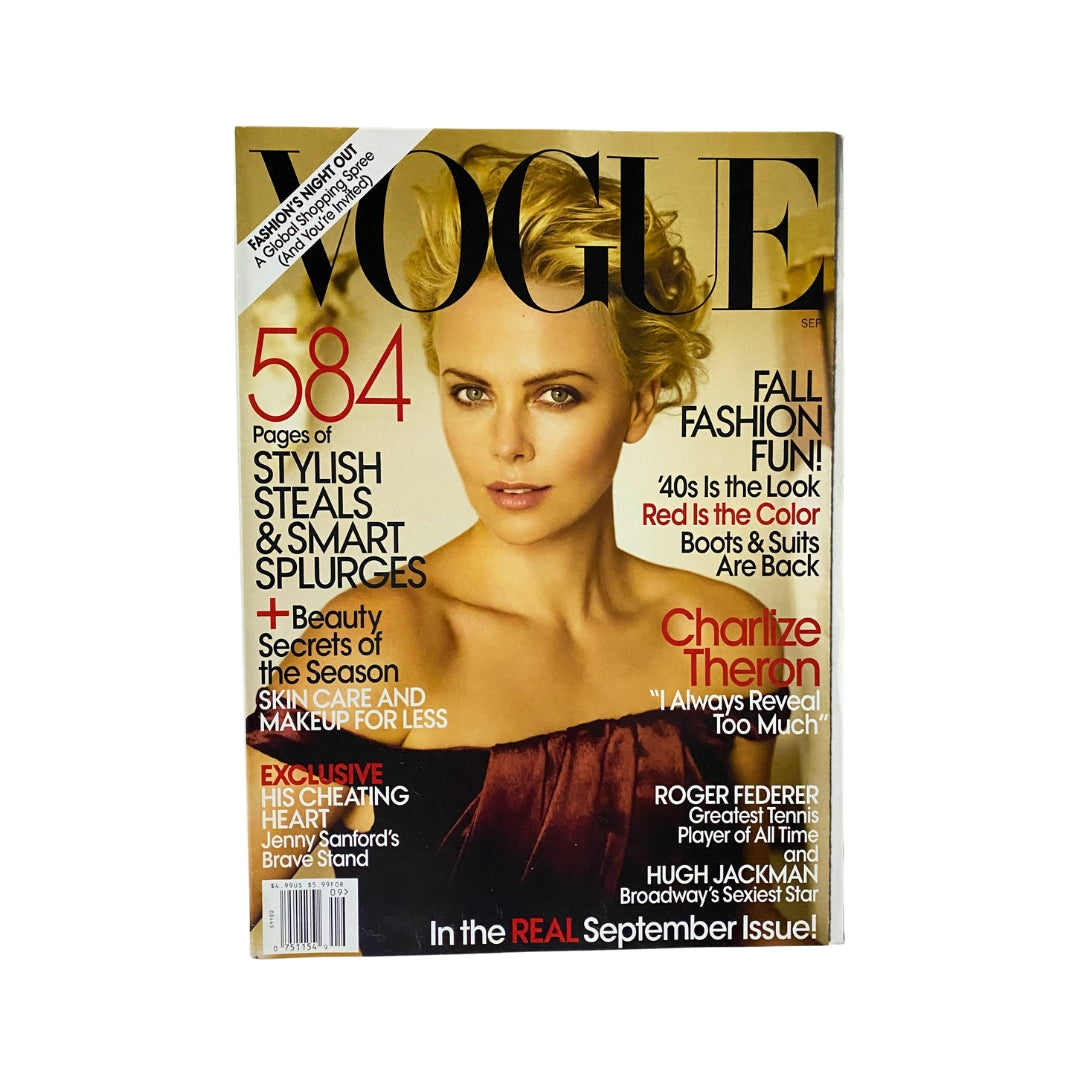
Charlize Theron on the cover of the September 2009 issue brought one of the most credible and internationally recognized faces in film to Vogue's most important annual edition. Theron had by this point long transcended the category of actress-as-cover-subject — her Academy Award for Monster in 2004 had established her as one of the most serious performers of her generation, and her consistent presence in major studio productions had made her a genuinely global celebrity in a way that translated effectively to fashion media across multiple markets. A September Vogue cover requires a subject who can carry the weight of the issue's cultural ambitions, and Theron's combination of physical presence, critical credibility, and mainstream commercial appeal made her a considered editorial choice rather than a reflexive one. The cover image itself would have been shot months in advance, representing the full resources of Vogue's photography and styling apparatus at their most ambitious — September cover shoots are among the most elaborately produced images in fashion magazine publishing, and surviving newsstand copies preserve that original visual document in its intended form. Collectors researching fashion and cultural magazines from 2009 will find this issue a particularly rich intersection of celebrity, fashion, and the specific cultural anxieties of a post-crisis industry trying to find its footing.
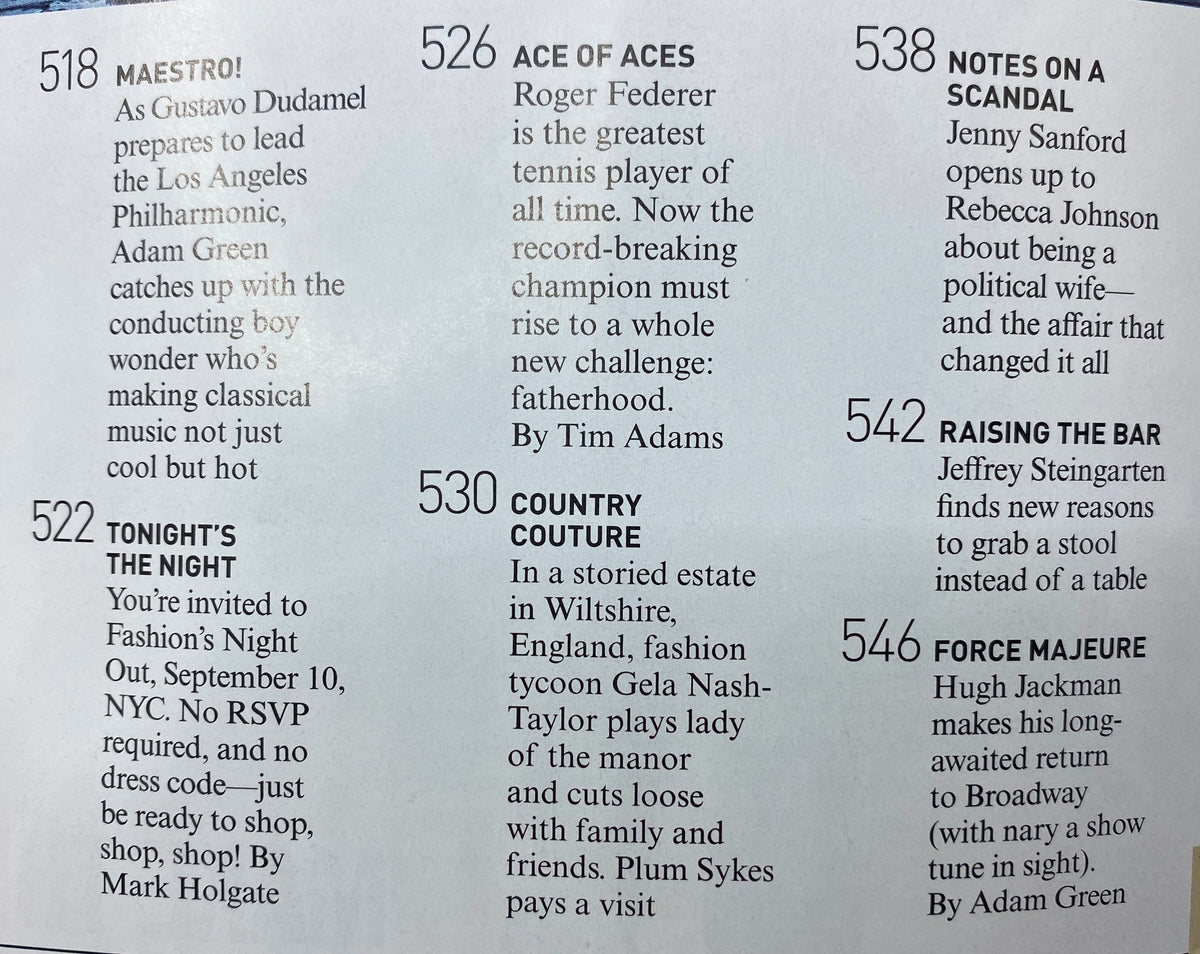
The editorial content documented in the listing extends well beyond fashion into the broader cultural journalism that has always distinguished Vogue's September issues from purely commercial fashion vehicles. The presence of features on Gustavo Dudamel — the Venezuelan conductor then preparing to lead the Los Angeles Philharmonic in what was one of the most discussed classical music appointments in years — alongside profiles of Roger Federer at his athletic peak, Hugh Jackman's Broadway return, and Jenny Sanford's account of her husband's infidelity scandal reflects the full-spectrum editorial ambition that Vogue brought to its most important issue of the year. Fashion's Night Out, launched in September 2009 as a direct response to the retail slowdown caused by the financial crisis, is documented here in its inaugural year — making this issue a primary source record of one of the fashion industry's most significant organizational responses to the economic crisis, captured in the month it launched.
About the Publication
Vogue is an American fashion and lifestyle magazine founded in 1892 and published by Condé Nast, widely regarded as the most influential fashion publication in the world across its more than thirteen decades of continuous operation. Under the editorial direction of Anna Wintour, who assumed the editor-in-chief position in 1988 and held it through and well beyond this 2009 issue, the magazine operated as the definitive arbiter of high fashion in the American market while simultaneously functioning as a broader cultural publication covering art, politics, celebrity, and ideas with the expectation that its readership — affluent, educated, style-conscious women — would engage seriously with all of it. The September issue in particular had become a cultural institution unto itself by the 2000s, its size and ambition regularly generating mainstream media coverage that extended far beyond the fashion press. By 2009 Vogue's September edition routinely exceeded eight hundred pages, making it among the largest regular magazine editions published anywhere in the world — a physical artifact whose scale alone communicates the commercial and cultural stakes the publication attached to its annual flagship edition.
Key Highlights Inside
- Charlize Theron cover image representing Vogue's most important annual edition — a September cover shoot produced at the full scale of the magazine's visual resources, and a primary document of how one of film's most credible performers was positioned within the fashion media landscape at the close of the decade.
- Feature on Gustavo Dudamel by Adam Green, timed to his assumption of the Los Angeles Philharmonic music directorship — one of the most significant appointments in American classical music in years, and an example of Vogue's September editorial ambition to place fashion alongside genuine cultural journalism of lasting relevance.
- Coverage of Fashion's Night Out by Mark Holgate, documenting the initiative's inaugural September 10, 2009 event in New York City — a direct industry response to post-financial-crisis retail conditions that makes this issue a primary source record of fashion's organized attempt to rebuild consumer confidence in the immediate aftermath of 2008.
- Profile of Roger Federer by Tim Adams, engaging the Swiss tennis champion at the height of his competitive dominance and the beginning of his transition into fatherhood — the kind of crossover celebrity journalism that distinguished Vogue's September issues from purely fashion-focused competition.
- Jenny Sanford interview with Rebecca Johnson, in which the political wife addressed the affair involving her then-husband, South Carolina Governor Mark Sanford — a piece of political and personal journalism that reflects Vogue's consistent editorial interest in the intersection of women's lives, public life, and private consequence.
- Additional features including a Wiltshire estate profile by Plum Sykes, a Hugh Jackman Broadway return piece by Adam Green, and Jeffrey Steingarten's food and drinks column — the full editorial architecture of a September Vogue operating at its characteristic range and ambition.
Condition & Rarity
September issues of Vogue present specific condition considerations that differ from standard monthly editions. Their exceptional size — routinely exceeding eight hundred pages in the 2000s — means that spines are under greater structural stress from the moment of binding, and copies that have been stored flat or upright without support frequently show spine curvature or stress cracking that smaller issues avoid. A copy graded Very Good with only minor edge wear is a strong survivor for an issue of this physical scale and age, indicating careful storage and handling that preserved both the cover integrity and the spine through fifteen-plus years of existence. The absence of a mailing label is a meaningful condition attribute for Vogue specifically, where subscriber copies were extraordinarily common relative to newsstand sales — the magazine's enormous subscription base means that label-free newsstand copies represent a minority of surviving examples, and the preservation of the full cover image without adhesive damage or label removal marks is both aesthetically and documentarily significant. The plastic protective sleeve indicates deliberate archival intent at some point in the copy's storage history, which for a publication of this size and paper stock quality correlates with better interior page condition and reduced likelihood of the binding stress and page tanning that claim unprotected September issues over time. Collectors evaluating surviving examples should prioritize spine integrity, cover completeness, and the preservation of the full interior page count as primary grading criteria.
Looking for More Issues Like This?
A clean newsstand copy of the September 2009 Vogue with a Charlize Theron cover and confirmed Very Good condition is a specific enough find that it surfaces infrequently — September issues in strong condition, particularly label-free newsstand copies, are among the more sought-after entries in any Vogue back-issue collection. If this issue is no longer available, the full Vogue collection at OriginalMagazines.com is the most comprehensive place to browse surviving issues across the magazine's history and locate other September editions, notable covers, or specific eras that fit your collection. The 2009 magazine collection brings together issues from across that year's major publications and offers broader context for collectors interested in the cultural and fashion landscape of this particular moment.