


Description
Collector's Note – Why This Issue Matters
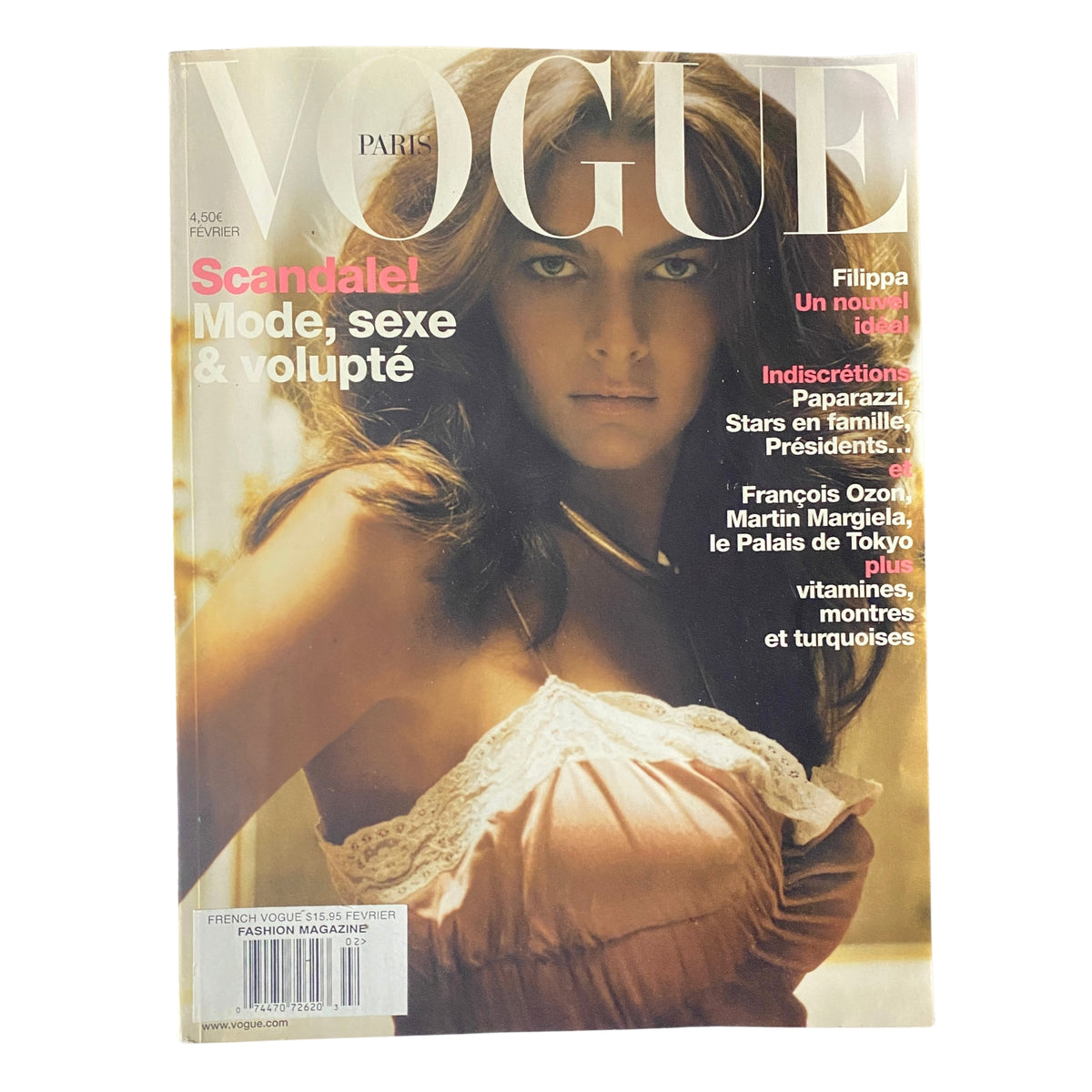
February 2002 is a historically and editorially specific moment in Vogue Paris's history, and this issue's documented table of contents reveals a publication engaging the specific cultural preoccupations of early-2000s French media culture with unusual depth and coherence. The cover, featuring Filippa Hamilton — the Swedish model who would later become most associated with Ralph Lauren and whose own career would intersect with significant public controversies in the following decade — represents the specific aesthetic of early-2000s French fashion photography at its most refined. But the editorial content documented inside places this issue in a much richer context than the cover model alone suggests. The Palais de Tokyo feature — a private visit with philosophical commentary by Régis Debray and photographs by William Klein — is a primary document of one of the most significant cultural infrastructure moments in early-2000s Paris. The Palais de Tokyo had just completed its renovation and was preparing to reopen as a contemporary art laboratory, and a February 2002 Vogue Paris feature on the not-yet-open museum, with Debray's characteristically theoretical engagement and William Klein's photography, constitutes a primary source document of that institution at its founding moment. For collectors building an archive of Vogue magazine issues from the early 2000s, this February 2002 Paris edition is a primary document of the French fashion and cultural press at one of its most intellectually ambitious moments — a Vogue issue that paired fashion with contemporary art theory, film criticism, and political photography history in a single coherent editorial package.
The paparazzi and celebrity media theme that runs through multiple features in this issue is a primary document of a specific cultural moment whose full significance is legible only in retrospect. The "Arrêt sur Image" feature by Brigitte Paulino-Neto — engaging the nostalgia of paparazzi culture through the memory of Tazio Secchiaroli, who is widely considered the original paparazzo and whose career began in Rome in the 1950s — appeared in February 2002, just four and a half years after the death of Princess Diana in a Paris tunnel while being pursued by photographers. The cultural conversation about paparazzi, celebrity privacy, and the ethics of celebrity journalism that Diana's death had intensified was still actively under way in early 2002, and a Vogue Paris feature engaging that conversation through the nostalgic lens of the original paparazzo is a primary source document of how the French fashion press was processing that ethical and cultural reckoning. The "Baisers volés" feature on celebrity press and paparazzi by Sophie Delavoie reinforces the theme, making this February 2002 issue one of the more sustained single-issue engagements with paparazzi culture in the Vogue Paris archive. The "Stéphanie de Monaco" flash-back photograph by Helmut Newton adds a Monaco royal family dimension that connects the paparazzi discussion to the specific royal celebrity culture that had been Secchiaroli's original subject. Collectors researching French fashion and cultural magazines from 2002 will find this issue a precisely dated primary source of the post-Diana celebrity journalism reckoning in the French press.
The François Ozon feature — an interview by Olivier Lalanne with a Nan Goldin photograph, timed to the release of 8 femmes — adds a significant French cinema dimension to an issue already remarkable for its cultural breadth. 8 femmes premiered at the Berlin International Film Festival in February 2002 and went on to become one of the most celebrated French films of the year, winning two Silver Bears at Berlin. A Vogue Paris interview with Ozon timed to the film's release in the same February issue is a primary source document of the film at the precise moment of its public debut, and the Nan Goldin photograph — commissioning one of the most significant photographers of her generation to document a director for a fashion magazine — reflects the specific editorial ambition of Vogue Paris at its early-2000s best. The Mario Testino exhibition at the National Portrait Gallery, engaged by Dahlia Cimain, adds a photography-world primary source that documents Testino's institutional recognition at a specific career moment. The "Hautement confidentiel" feature on five presidential photographs across four decades of political communication reflects the kind of political cultural journalism that distinguished Vogue Paris from its American counterpart throughout this period.
About the Publication
Vogue Paris — published as Vogue France since 2021 — was the French edition of Vogue, founded in 1920 and operating for more than a century as one of the most creatively ambitious and intellectually serious fashion publications in the world. By February 2002 it had established an editorial identity that was consistently more willing than its American counterpart to engage seriously with contemporary art, film theory, politics, and cultural criticism alongside fashion, and its contributor roster — which in this issue alone includes Régis Debray, William Klein, Helmut Newton, Nan Goldin, and Mario Testino — reflects the institutional authority it commanded across multiple creative disciplines simultaneously. Its readership was the French and international fashion and cultural elite, addressed as people whose interests spanned fashion, art, cinema, literature, and the full range of contemporary cultural life.
Key Highlights Inside
- Palais de Tokyo opening feature with text by Régis Debray and photographs by William Klein — a primary document of one of the most significant cultural infrastructure moments in early-2000s Paris, with Klein's photography and Debray's theoretical commentary constituting one of the more intellectually ambitious single features in early-2000s Vogue Paris, published as the institution was preparing to open as a contemporary art laboratory.
- François Ozon interview by Olivier Lalanne with Nan Goldin photograph, timed to the Berlin premiere of 8 femmes — a primary source document of one of the most celebrated French films of 2002 at the exact moment of its international debut, with Goldin's photography adding a significant visual art dimension to a film journalism feature whose cultural ambition reflects Vogue Paris at its editorial best.
- "Arrêt sur Image" by Brigitte Paulino-Neto on Tazio Secchiaroli and paparazzi nostalgia, alongside "Baisers volés" on celebrity press culture by Sophie Delavoie — a sustained two-feature engagement with paparazzi culture published in February 2002, in the specific post-Diana context that gave the French fashion press's treatment of celebrity journalism ethics an urgency and seriousness absent from equivalent coverage in other national editions.
- Mario Testino exhibition feature at the National Portrait Gallery by Dahlia Cimain — a primary document of Testino's institutional recognition at a specific career moment, published in the same period when his Vogue cover work was at its peak commercial and cultural visibility.
- Helmut Newton's "Stéphanie de Monaco" flash-back photograph and "Hautement confidentiel" feature on five presidential photographs across four decades of political communication — the documentary photography and political cultural journalism that gave Vogue Paris its consistently broader editorial range than its American counterpart, documented here with the attribution specificity that makes this table of contents an unusually complete primary source.
- Filippa Hamilton cover, Gilles Dufour restaurant guide, ski evasion feature, François Sanchez music column, and Shelley von Strunckel horoscope — the full editorial architecture of a February Vogue Paris issue operating at its most culturally comprehensive, documented here in French with the editorial specificity that makes this table of contents a primary source for researchers studying the publication's early-2000s editorial identity.
Condition & Rarity
Vogue Paris issues from February 2002 are approaching their twenty-fourth year of existence — recent enough that surviving copies remain relatively available, but old enough that condition variation is meaningful, particularly for a French edition whose distribution outside France was limited and whose back-catalog availability in the international collector market is considerably narrower than the American Vogue equivalent. Very Good condition with minimal edge wear is an honest and strong grade for a twenty-three-year-old monthly fashion magazine, indicating a copy that displays cleanly, reads completely, and retains the full visual integrity of the Filippa Hamilton cover without structural damage. The absence of a mailing label is a meaningful condition attribute for a publication whose subscription base meant that the majority of surviving copies carry label adhesion or removal marks on the cover — the label-free status preserves the cover image in its complete, unobstructed form. The plastic protective sleeve provides ongoing archival protection. Collectors evaluating surviving examples of this issue should prioritize cover surface quality, the Helmut Newton and William Klein photography page integrity, and the completeness of the Palais de Tokyo and Ozon features as the primary condition criteria most directly relevant to this issue's cultural and photographic documentary value.
Looking for More Issues Like This?
A Very Good, label-free copy of Vogue Paris from February 2002 with a Filippa Hamilton cover, the Palais de Tokyo opening feature with Régis Debray and William Klein, the François Ozon and Nan Goldin collaboration, and the sustained paparazzi culture journalism is a more historically layered and culturally ambitious find than its relatively recent vintage might suggest — early-2000s Vogue Paris issues with this density of documented cultural and photographic content surface considerably less frequently in the international collector market than their American Vogue counterparts. If this issue is no longer available, the full Vogue collection at OriginalMagazines.com is the most comprehensive place to browse surviving issues from across both the American and French editions of the magazine and locate other significant covers, notable photographer contributions, or editions from Vogue Paris's most culturally ambitious years. The 2002 magazine collection brings together issues from across that year's major publications for collectors interested in the full range of fashion and cultural print journalism from the early years of the decade.