


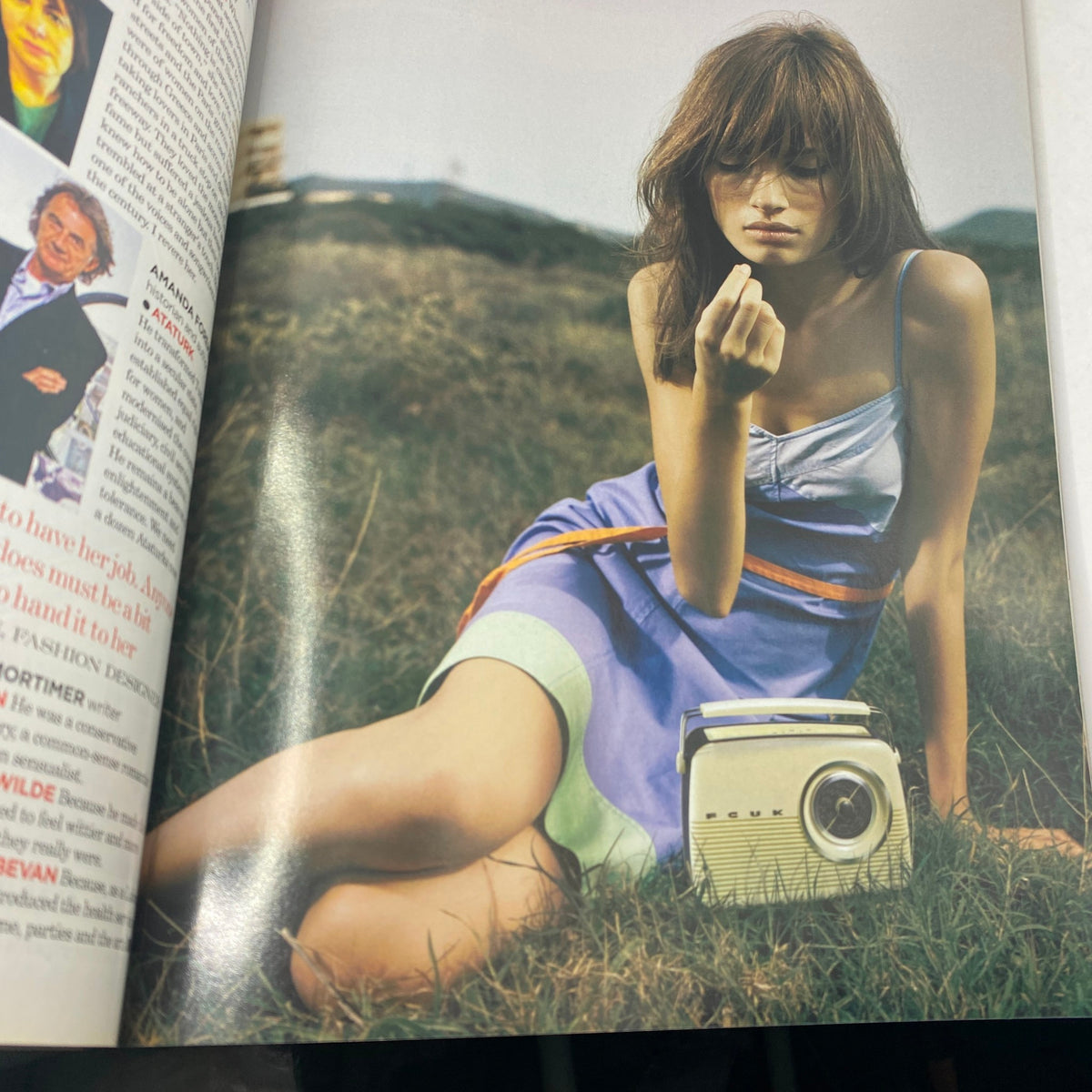


Description
Collector's Note – Why This Issue Matters
April 2004 is a historically specific and collector-significant moment in the history of British Vogue, and this issue — featuring Lily Cole and Gemma Ward together on the cover — is a primary document of one of the most consequential model discoveries in the history of the fashion industry at the precise moment of their simultaneous emergence. Both Cole and Ward were in the earliest phases of what would become two of the most distinctive and most discussed model careers of the decade. Lily Cole had been discovered in 2003 while still a London schoolgirl and was in the first months of a career that would take her to the cover of virtually every major fashion publication in the world while she simultaneously pursued a Cambridge University education — an unusual combination that made her one of the most intellectually distinctive celebrity figures to emerge from modeling in the 2000s. Gemma Ward had been discovered in Sydney in 2003 and had arrived in London and New York to almost immediate editorial demand, her specific facial architecture — wide-set eyes, small features, an otherworldly quality that photographers found endlessly interesting — generating a level of editorial attention that was genuinely unusual for a first-year model. A British Vogue cover pairing two models who would each go on to define the decade's aesthetic in distinct ways, captured in April 2004 when both were essentially at the very beginning of their professional trajectories, is a primary document of exceptional fashion historical significance — the fashion press's authoritative recognition of two careers at their literal point of origin. For collectors building an archive of Vogue magazine issues from the early-2000s era, this April 2004 British Vogue is among the most specifically historically significant model-cover entries in the publication's decade catalog.
The editorial features documented in the listing add a secondary layer of cultural and literary primary source significance. Alain de Botton's "Marriage Guidance" viewpoint on page 125 — "From literature to reality—how marriage changed Alain de Botton's view of love" — is a primary bibliographic record of de Botton's contribution to British Vogue at a specific career moment. De Botton had established himself through How Proust Can Change Your Life (1997) and The Consolations of Philosophy (2000) as one of the most commercially successful popular philosophers writing in English, and his Vogue viewpoint engagement with marriage and literature reflects the specific crossover between popular philosophy, literary culture, and the fashion press that British Vogue consistently cultivated in ways that distinguished it from its American counterpart. The Annabel Goldsmith profile by Christa D'Souza on page 103 — engaging her memoir and extraordinary life — documents one of the most significant figures in British social history at the moment of her memoir's publication, and the "Who do we admire now?" feature on page 135, with its selection of prominent people discussing admiration, reflects the specific early-2000s British Vogue tradition of cultural journalism that extended well beyond fashion. Plum Sykes's "My First Vogue Moment" on page 119 adds a behind-the-scenes primary source from one of the publication's most recognized contributing editors at a specific career moment following her 2003 novel Bergdorf Blondes. Collectors researching Vogue and fashion magazines from 2004 will find this British edition a primary source document of unusual literary and cultural depth alongside its landmark model cover significance.
The specific pairing of Cole and Ward as a dual cover rather than individual covers reflects an editorial judgment about their shared aesthetic sensibility — both had a quality of otherworldly, almost pre-Raphaelite beauty that distinguished them from the more conventional commercial model faces of the period, and British Vogue's decision to place them together was itself an editorial argument about a specific direction in fashion imagery that the publication was actively advocating. The no-label newsstand provenance preserves the full cover image — both Cole and Ward's faces, the specific styling, the April 2004 visual aesthetic — in its complete, unobstructed form, which for a cover of this specific fashion historical significance is the condition attribute most directly relevant to both display and documentary value. The plastic protective covering provides ongoing archival protection for a publication approaching its twenty-second year of existence in this specific example.
About the Publication
British Vogue — the UK edition of the Vogue brand — was founded in 1916 and by April 2004 had been publishing for eighty-eight years as the most authoritative British fashion publication, its editorial identity distinct from American Vogue in its consistently stronger engagement with British cultural life, literary journalism, and the specific social and artistic world of London. Under Alexandra Shulman's editorship, which had begun in 1992 and extended through this April 2004 issue, British Vogue had developed a specific editorial identity that combined fashion authority with literary and cultural journalism — the Alain de Botton viewpoint and the Annabel Goldsmith profile in this issue are characteristic of that identity — and its model discovery tradition was one of the most significant in British fashion publishing history.
Key Highlights Inside
- Lily Cole and Gemma Ward dual cover — a primary document of two of the most significant model discoveries of the decade photographed together on the cover of British Vogue at the literal beginning of both their careers, constituting one of the most historically specific fashion industry primary source records available from the early-2000s era and a primary visual document of the specific otherworldly aesthetic that both models embodied and that British Vogue was actively advocating through this editorial pairing.
- Alain de Botton "Marriage Guidance" viewpoint on page 125 — a primary bibliographic record of one of the most commercially successful popular philosophers writing in English contributing to British Vogue at a specific career moment, engaging marriage and literature in the specific crossover between popular philosophy and fashion press cultural journalism that distinguished British Vogue's editorial identity.
- Annabel Goldsmith profile by Christa D'Souza on page 103 — a primary document of one of the most significant figures in British social history at the moment of her memoir's publication, constituting a primary bibliographic record of D'Souza's profile journalism at a specific career moment and of Goldsmith's memoir at its moment of publication.
- Plum Sykes "My First Vogue Moment" on page 119 — a primary behind-the-scenes document from one of British Vogue's most recognized contributing editors following the 2003 publication of Bergdorf Blondes, reflecting the specific American-British fashion media crossover that Sykes embodied as a London-born New York-based contributing editor to both national editions.
- "Who do we admire now?" on page 135 and Chloe Fox's "In the Frame" film preview on page 140 — the cultural journalism and entertainment coverage range of an April 2004 British Vogue reflecting the publication's consistent engagement with the full breadth of British intellectual and cultural life alongside its fashion editorial content.
Condition & Rarity
British Vogue issues from April 2004 are approaching their twenty-second year of existence — recent enough that surviving copies remain relatively available, but old enough that condition variation is meaningful for collectors seeking the preferred label-free newsstand format of a cover of this specific fashion historical significance. Very Good condition with minor edge wear is an honest and strong grade for a twenty-one-year-old monthly fashion magazine, indicating a copy that retains full structural integrity, displays cleanly, and preserves the Cole-Ward dual cover without the structural damage that would compromise its display value. The absence of a mailing label is a significant condition positive for British Vogue specifically — the magazine's substantial subscription base means that label-free copies represent a minority of surviving examples — and the label-free status preserves the full cover image of both models in its complete, unobstructed form. The plastic protective sleeve provides ongoing archival protection for a coated-stock publication whose cover surface benefits from protection against scuffing. Collectors evaluating surviving examples should prioritize the Cole-Ward cover image integrity and the completeness of the de Botton and Goldsmith features as the primary condition criteria most directly relevant to this issue's documentary and display value.
Looking for More Issues Like This?
A Very Good label-free newsstand copy of British Vogue April 2004 with the Lily Cole and Gemma Ward dual cover — capturing both models at the literal beginning of two of the decade's most significant careers — alongside the Alain de Botton viewpoint and the Annabel Goldsmith memoir profile is a more historically layered find than its relatively recent vintage might suggest. If this issue is no longer available, the full Vogue collection at OriginalMagazines.com is the most comprehensive place to browse surviving issues from across both the British and American editions of the magazine and locate other early-career model cover discoveries, significant British cultural journalism issues, or notable editions from the Alexandra Shulman-era British Vogue. The 2004 magazine collection brings together issues from across that year's major publications for collectors interested in the full range of fashion and cultural print journalism during a year that marked significant transitions in the modeling industry and British popular literary culture simultaneously.