
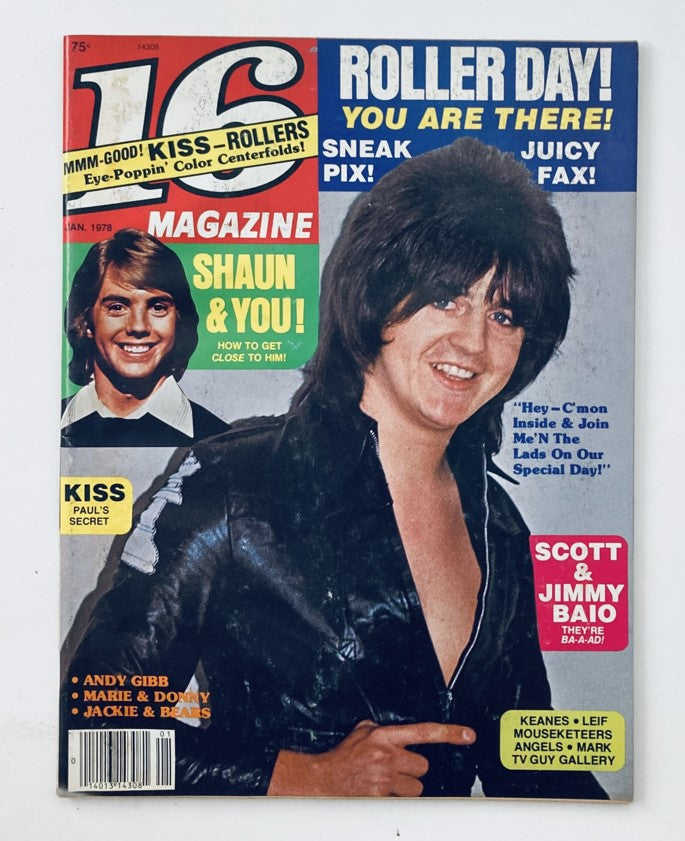


Description
Collector's Note – Why This Issue Matters
This January 1978 issue of 16 Magazine arrived at a curious crossroads for teen celebrity journalism. By the late 1970s, the magazine had moved well past its 1960s "Fave Rave" roots in clean-cut pop idols, and this cover captures that shift in miniature: KISS, the face-painted hard rock act that had become an unlikely sensation among younger fans, sharing space with Scott Baio, the teen actor then riding the popularity of the sitcom Happy Days, and his younger brother Andy Baio. The pairing of a theatrical rock band with a wholesome TV star was typical of the magazine's late-70s formula, which increasingly blended hard rock crossover appeal with the safer, more familiar territory of television heartthrobs.
KISS's presence in a magazine historically aimed at preteen and early-teen girls is itself notable, and by the time this issue hit newsstands the band had genuinely crossed that bridge. A 1977 Gallup poll had named KISS the most popular band in America, and as their record sales grew through albums like Destroyer, Rock and Roll Over, and Love Gun, their audience expanded beyond hard rock listeners to include the same younger "teenybopper" readership that magazines like 16 were built to serve. Merchandising played a major role in that crossover: Marvel Comics published a KISS comic book in mid-1977 that sold several hundred thousand copies, and the band's makeup, masks, and pinball machines turned them into a pop-culture phenomenon that fit naturally alongside the poster-and-pinup format 16 had perfected over two decades. Their elaborate face paint, pyrotechnics, and larger-than-life stage personas made them surprisingly compatible with teen-fan coverage, even though their music skewed harder than the magazine's traditional bubblegum fare.
Scott Baio, meanwhile, represented the more conventional teen-idol lineage the magazine had built its identity on since the Gloria Stavers era. Baio had been cast as Chachi Arcola, Fonzie's cousin, on Happy Days in 1977, and his popularity climbed quickly enough that he was soon receiving thousands of fan letters a week, a level of teen-press attention that made him a natural fit for 16's coverage by early 1978. Andy Baio's inclusion on this cover reflects the genre's habit of extending coverage to a star's family members to deepen the sense of intimacy readers felt with their favorite "faves," a technique 16 had used for decades to make distant celebrities feel personally accessible. Issues like this one sit at the tail end of 16 Magazine's classic era, just before the title would lean further into rock coverage with offshoots in the years that followed. For collectors tracing the magazine's evolution, a cover combining KISS and a sitcom star is a small but telling artifact of how teen publishing tried to hold together an increasingly fragmented youth audience as the decade wound down.
About the Publication
16 Magazine was an American teen fan publication founded in 1956, with its first issue reaching newsstands in May 1957 featuring Elvis Presley on the cover. Under longtime editor-in-chief Gloria Stavers, who led the magazine from 1958 to 1975, 16 became the defining voice of teen celebrity journalism, built around an intimate interview style she called "Forty Intimate Questions," candid photography she often shot herself, and the pull-out pinup posters that made the magazine a fixture of bedroom walls across the country. Stavers developed this formula after reading thousands of fan letters from girls aged nine through twelve, and at its mid-1960s peak the magazine reached a circulation exceeding one million copies and a readership estimated at over five million, almost entirely young girls drawn to coverage of acts like the Beatles, the Monkees, and Paul Revere and the Raiders. Notably, 16 ran no outside advertising for most of its history, a policy that let its editorial stay focused entirely on reader-driven fan content rather than sponsor interests. Through the 1960s the magazine introduced its young readers to rock and pop acts referred to in-house as "Faves," and by the 1970s its focus had shifted toward bubblegum and television idols such as Donny Osmond, David Cassidy, and the Bay City Rollers, alongside an increasing willingness to feature harder-edged rock acts like KISS and Alice Cooper as their crossover appeal grew. Stavers left the magazine in 1975 amid a publishing dispute, and by the time this January 1978 issue was published, 16 was operating in the years after her departure, still following the visual and editorial format she had established a decade earlier. The magazine continued publishing in some form for several more years before its influence waned, but the core formula she created, intimate-feeling interviews, glossy pinup posters, and a relentless focus on what young fans wanted from their favorite stars, remained intact throughout this period. For collectors, that continuity makes late-1970s issues like this one valuable touchpoints for studying how a magazine built for one generation of idols adapted to a new and more musically diverse one.
Key Highlights Inside
- Cover and interior feature coverage of KISS, the face-painted rock band whose 1977 Gallup poll win as America's most popular band coincided with a deliberate crossover into younger fan-magazine territory. Their growing catalog of merchandise, including Marvel comic book tie-ins and elaborate stage makeup, made them a natural subject for teen publications by this period. This issue captures that moment when a hard rock act's audience had expanded well beyond traditional rock listeners.
- Coverage of Happy Days actor Scott Baio, who had been cast as Chachi Arcola in 1977 and quickly become a significant draw for teen fan magazines. His rising profile on one of the most-watched shows on American television made him a recurring subject in publications like 16 throughout this period. By early 1978 his fan mail had reportedly reached the thousands per week, reflecting the kind of teen-idol momentum that fan magazines were built to cover.
- Feature material on Andy Baio, Scott Baio's brother, reflecting the genre's long-standing practice of extending coverage to family members of featured idols. This approach, used throughout 16's history, was designed to make distant stars feel more personally accessible to young readers. It added a layer of behind-the-scenes intimacy that distinguished fan magazines from conventional entertainment press.
- Includes the issue's pull-out poster, a signature format element of 16 Magazine since the Gloria Stavers era of the 1960s. These full-color posters were designed for removal and display, and were a major part of what made the magazine a fixture of teenage bedrooms nationwide. Surviving examples with the poster intact are an important factor in how collectors evaluate an issue today.
- Specific article titles, photo captions, and interview contents for this issue are unconfirmed beyond what is reflected on the cover. As with many surviving issues from this era, detailed inside contents are not always documented or catalogued publicly. Collectors should treat the cover subjects as the verified scope of this issue's known content.
Condition & Rarity
This issue is described as a newsstand copy without a subscriber mailing label, a distinction collectors take seriously when grading periodicals of this kind. Subscriber copies were mailed directly to readers and frequently carry an address label or mailing imprint on the cover, sometimes along with postal markings or fold lines from transit, while unlabeled newsstand copies were sold directly off the rack and typically present a cleaner, unmarked cover surface. For a magazine whose visual appeal is central to its collectibility, that distinction matters considerably to buyers assessing display quality. Plastic protective covering is a standard preservation measure used by sellers and collectors alike to slow the natural yellowing, oxidation, and brittleness that newsprint-based magazines like 16 are especially prone to over time, given the inexpensive paper stock common to teen fan magazines of this era. Because these issues were manufactured as inexpensive, disposable entertainment rather than archival print products, surviving examples in stable condition are inherently less common the further removed they are from their original publication date. As with any periodical now approaching fifty years old, page integrity, spine and staple condition, color retention on the cover, and the presence or absence of the original pull-out poster are the primary factors collectors weigh when assessing a surviving copy's overall grade. A complete issue with its poster intact and minimal handling wear is generally considered more desirable than one missing those elements, since the poster was often removed and displayed by original owners, making fully intact copies harder to find decades later.
Looking for More Issues Like This?
Issues pairing a hard rock act like KISS with a television idol such as Scott Baio don't surface often, and this particular 1978 cover is a tough one to track down given how specific that combination of subjects is. Collectors drawn to this era of teen publishing may want to browse the broader 16 Magazine collection for other issues from the same period, since many of the cultural threads touched on here, the rise of Happy Days idols, the KISS crossover into teen media, and the magazine's post-Stavers editorial direction, run through other issues from the late 1970s as well. For those more interested in browsing chronologically, the 1968 magazines collection offers a window into an earlier and quite different period of the title's history, useful for collectors who want to compare how the magazine's tone and subject matter evolved across the decade.