




Description
Collector's Note – Why This Issue Matters
The October 1953 issue of Better Homes & Gardens sits squarely within one of the most important shifts in American domestic life: the postwar reimagining of the home as a place of comfort, efficiency, family identity, and upward mobility. By the early 1950s, home ownership had become a central ideal of middle-class life, and magazines like Better Homes & Gardens helped shape how that ideal looked in practice. An issue centered on building and remodeling is especially revealing because it captures not just decoration trends, but the larger mindset of improvement that defined the era. It reflects a moment when Americans were being encouraged to update, expand, and modernize their homes in ways that aligned with new technologies, new materials, and new expectations about everyday living.
The October 1953 date also matters because it places this issue in the middle of the Eisenhower years, when consumer confidence, suburban expansion, and the culture of home planning were all gaining momentum. In collector terms, that gives the issue significance beyond its immediate editorial content. It becomes a document of how mainstream American households were being taught to think about renovation, practicality, and style at a specific historical moment. A surviving copy from 1953 offers a useful snapshot of what counted as desirable, modern, and livable in the early postwar period.
For serious collectors, this kind of issue is valuable not because of celebrity association or sensational content, but because it preserves the visual and editorial language of ordinary aspiration. Shelter magazines often tell historians and collectors things that broader news or entertainment titles do not: how rooms were staged, how family life was marketed, and how editors translated social change into practical advice. That is where an issue like this earns its long-term interest. It belongs not only in a run of Better Homes & Gardens, but also in the wider history of mid-century American domestic culture.
About the Publication
Better Homes & Gardens was one of the defining American shelter and service magazines of the twentieth century, created for readers interested in home design, gardening, cooking, decorating, and practical household management. Its audience was broad but clearly centered on homeowners and families who wanted advice that felt both aspirational and usable. In the early 1950s, the magazine’s editorial identity rested on that balance: polished presentation, attractive layouts, and visually persuasive ideas paired with instructions and articles that readers could actually apply in their own homes. It was not simply a style magazine, nor purely a how-to manual. It occupied the middle ground that made it influential, helping shape everyday standards of taste while also functioning as a guide to maintenance, improvement, and domestic planning. An issue devoted to building and remodeling fits squarely within that editorial mission and reflects the publication at one of its most culturally representative moments.
Key Highlights Inside
- The listing identifies building and remodeling as the central theme of the issue, making it particularly relevant to collectors interested in mid-century home-improvement publishing.
- Its October 1953 publication date places it within the postwar housing and renovation boom, when American families were investing heavily in making existing homes feel more modern, efficient, and attractive.
- As an issue of Better Homes & Gardens, it would have been aimed at readers looking for a blend of visual inspiration and practical household guidance rather than purely architectural theory or trade-level construction material.
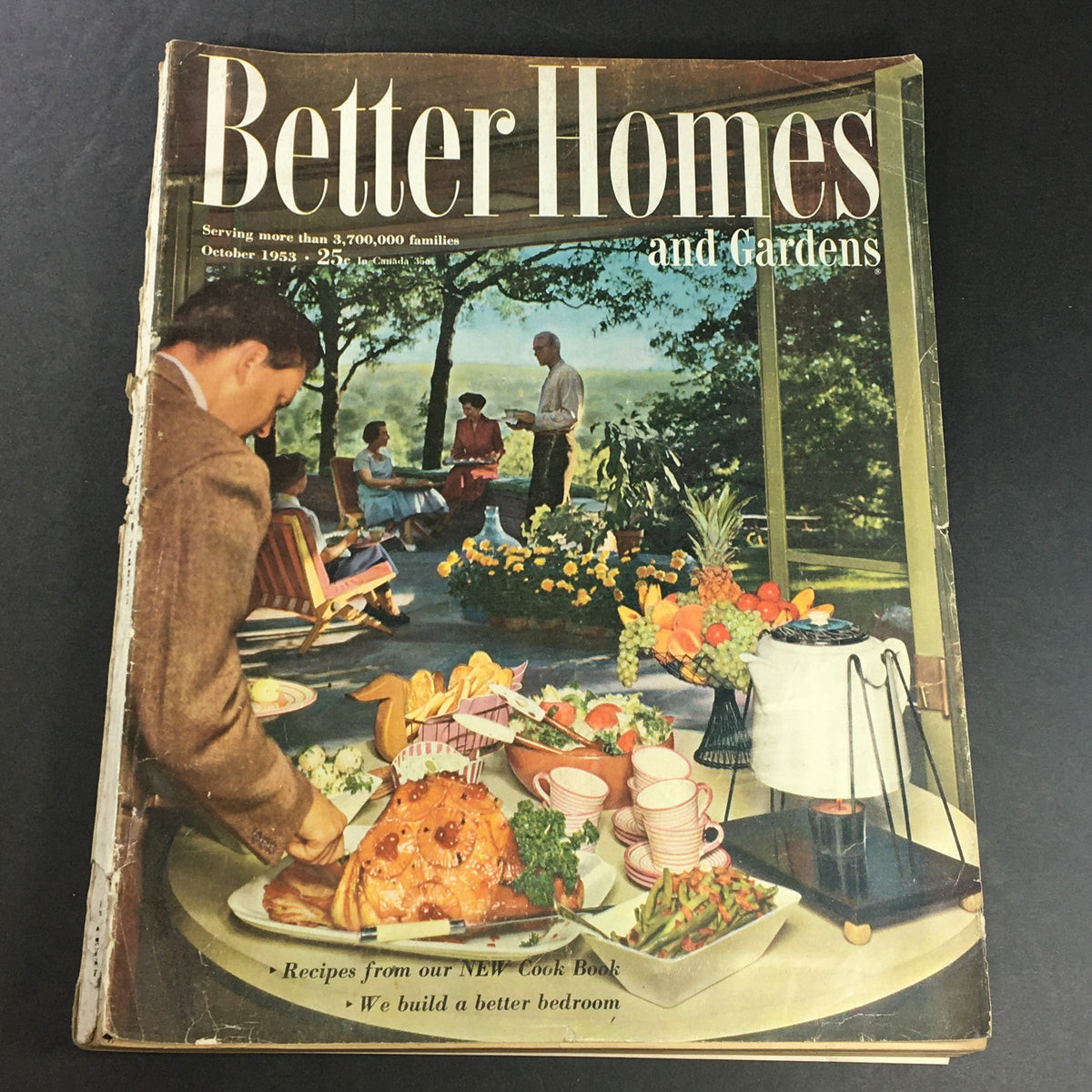
- The cover presentation and period headlines are part of its appeal, especially for collectors who value mid-century magazine design, editorial packaging, and the visual culture of American domestic life.
- The issue also has research value for those studying how magazines translated broad social trends—such as suburban growth and postwar consumer optimism—into everyday advice about the home.
- Detailed interior contents are not fully confirmed from the source listing, so article-level highlights should be verified against a table of contents or interior photographs rather than assumed.
Condition & Rarity
From a collector’s standpoint, the most notable condition detail is the newsstand status with no mailing label, which often carries special appeal for mid-century magazine buyers because the cover presents more cleanly and more closely resembles its original point-of-sale appearance. For a 1953 issue of a household monthly, that matters. Label-free examples are often preferred when the cover design itself contributes to display value, and shelter magazines frequently have strong graphic appeal even when they are collected primarily for content. The noted minor wear, edge marks, and slight rips are consistent with ordinary age-related handling for a general-interest periodical of this vintage, especially one produced for active use rather than preservation. Collectors typically look closely at completeness, staple attachment, cover integrity, and the absence of clipped pages, detached wraps, or missing inserts when evaluating surviving examples. The mention of a plastic protective covering indicates later preservation rather than original issue state, but it is still relevant because proper storage can help limit additional edge wear and surface handling over time. In market terms, magazines of this kind are usually valued less for pristine perfection than for strong survival, clean presentation, and intact historical character.
Looking for More Issues Like This?
Issues like October 1953 tend to appeal to more than one kind of collector. They matter to readers building a run of Better Homes & Gardens, but they also attract people interested in mid-century interiors, postwar family culture, and the printed history of American home improvement. That makes the broader Better Homes & Gardens collection a useful place to continue, especially for comparing how the magazine’s editorial priorities and design language changed from issue to issue.
It is also worth viewing this issue in the wider context of 1953 magazines, since that year captures a distinctive moment in American print culture. Looking across titles from the same year can reveal how ideas about style, domesticity, and modern living were being presented across the magazine landscape. For collectors and researchers alike, that broader context often makes a single surviving issue much more meaningful.